The Question You're Not Asking: Should You Go To College?
If you have (or are currently attending college in pursuit of) an engineering, law, computer science, medical or any other kind of degree that qualifies you to do something with a tangible effect on the world, this is not the column for you. You're not going to get anything out of it. Well, maybe some well-earned Schadenfreude at the expense of all the little grasshoppers who didn't till for winter, but aren't you above all that? Why don't you go somewhere and understand some math, asshole.
For the rest of you, I need to tell you something, and it's probably going to hurt: All that talk about how a higher education improves you as a human being, instantly launches a stellar career and hurls you screaming into the transcendental nirvana of financial stability -- yeah, that was all bullshit. Unless you're going for a professional degree, you really should not go to college.
You know what to do here.
Not for credit, and not at a four-year school, anyway. I know, I know: "But what about all those posters in the guidance counselor's office, stating in plain, hard numbers how much more a degree-earner makes over their lifetime?" Even a Bachelor's degree, they say, nets you over a million dollars more than a high school graduate.
Isn't that number strange? A million.
Even $900k sounds substantially less impressive, doesn't it? But no, it's that fabled "more than a million." Shit, that's no longer money, it's a lifestyle: Going to college makes you one whole millionaire better than those savage high school plebeians. And though the findings change a little with every new census bureau report, it's always been right around that magic number. The latest version tells us this: High school graduates average 1.2 million over their lifetimes, while a Bachelor's degree nets you 2.1 million, and it scales upward from there. But here's the actual language:
"Adults ages 25 to 64 who worked at any time during the study period earned an average of $34,700 per year. Average earnings ranged from $18,900 for high school dropouts to $25,900 for high school graduates, $45,400 for college graduates"
I've bolded the relevant text. Everybody in that survey has a job, which, incidentally, is a thing that your college degree absolutely does not guarantee you. All the unemployed people, their college degrees doing nothing for them? They don't factor in. But hey, maybe the situation will be better when you're out of college. Things might pick up. You just need to get more loans for now, to get you through, is all. And that's exactly what's happening, according to Robert Shireman, deputy undersecretary of the Education Department: "We're also in an economic situation that nobody predicted. The eye-opening increase in borrowing is largely due to the dire economic environment, which is causing more people to seek federal loans."
So, the reason you're collecting federal debt like soul-sucking Pokemon is because the working world is rough right now. Your parents, like most people, are in a tough financial spot, and they can't afford to send you to school. Since you can't find a job to support yourself either, you just need to borrow more, assuming you're going to make it back in the future, when you get out of college and into that thriving working worl- aw, shit.
Soon the old brag "first in the family to go to college" will be "first in the family to be debt free after high school."
But, hey, you're young and full of foolish hope: Let's assume the optimistic scenario -- that you get out of college without owing an unreasonable amount, after which you're immediately and miraculously employed, and you make that nice, round, one million dollars more per lifetime. Awesome, right?
But what if it wasn't a million dollars? What if that amount starts dropping? How low does that number have to go until it's no longer worth it? 750K? Half a million? The real figure, when all is said and done, is closer to 300,000. Over a lifetime. An economist tasked with studying the long-term value of a college degree found the following:
"College graduates earn, on average, about $20,000 a year more than those who finished their educations at high school. Add that up over a 40-year working life and the total differential is about $800,000 ... But since much of that bonus is earned many years from now, subtracting out the impact of inflation means that $800,000 in future dollars is worth only about $450,000 in today's dollars. Then, if you subtract out the cost of a college degree -- about $30,000 in tuition and books for students who get no aid and attend public in-state universities -- and the money a student could have earned at a job instead of attending school, the real net value in today's dollars is somewhere in the $300,000 range a number confirmed by other studies."
OK, but $300,000 is not to be dismissed outright. That buys you a decent house in Oregon, a sweet parking spot in New York or an extravagant meal in Tokyo. But still, 300k has a lot less kick than "more than a million dollars more!" For some reason, "exchange four years of your life and a decade of debt for a house ... 40 years later!" just doesn't have the same ring to it. And that's IF you get a job, and THAT depends on whether or not your degree is even remotely useful.
And we sent all those useful people away at the start, so that's probably not you.
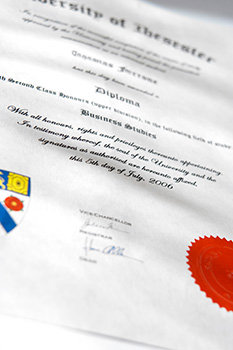
Pictured: You. Not being useful.
If you start looking into the benefits of a college degree, you'll see this phrase a lot in the articles extolling their virtues: "... people with professional degrees earn more/have more rewarding employment/satisfy more sexual partners on top of a Ferrari." What does that mean, exactly? Can you even get an amateur degree? You can get a professional degree in the Liberal Arts, right? Like ... like a professional Theoretical Sociologist? Nope! They mean the hard sciences again, or law, or medicine.
So very, very not you.
But I think we need to pause and clarify now: If those are the fields you want to go into, you absolutely should go to college and study incredibly hard. If an architect skips the wrong day - to play an ARG, listen to retro-grunge-pop, start a Libyan revolution, or whatever it is kids these days do for fun - and he makes a mistake in his job, my apartment building collapses. If, say, a philosophy major skips the wrong day, he might not know what kind of idealism Kant supports, and that freshman with the pink MacBook won't give him a handjob in the back of her Jetta later.
The stakes are different.
So I'm not saying college does not have a use, I'm just saying that if you're the type of kid who, at 18, hasn't quite formed a complete and detailed plan for the next sixty years of your life, then you're probably not majoring in Esoteric Quantum Engineering. You're taking a survey on Quentin Tarantino films and you won't even show up for that half the time.
Right around the time you catch yourself pirating cliff's notes for Pulp Fiction, you start to redefine the term "higher education."
But then, I never quite understood the professional degree kids who knew exactly what they wanted to do with their lives before they were even legally allowed to smoke. At 18, all I actually "knew" that I wanted to do was girls, bong rips, and handstands - and I never did get that handstand down. We live in a coddling society, and our culture is extending mental adolescence further and further into the late teens and even 20s. I, for example, didn't really feel like a grown, responsible adult male until any day now, hopefully. The kids that have a life-map at 18 were always somewhat rare to start with, and now they're a dying breed. But even the lost teenagers still have that drive. It kicks in the second they get out of high school, and it's propagated by one of the most pervasive PR campaigns ever: "Go to college. You're nothing without a college education. It doesn't matter what you want to do, or even if you know what that is at all. Go to college. College fixes everything."
And why would the government be so gung ho about it -- willing to offer you all that free money (hey, you don't have to pay it back until college is over, and that's a lifetime from now! That's basically not even you anymore! Ha ha, fuck that guy!) - if it just ultimately screws you? Because of something called SLABS. If you haven't clicked on that link, that's okay: You're probably high right now and muddling through the second half of Jackie Brown. You're in no shape for the finer points of finance, but the gist is this: Remember what collapsed the housing market? The repackaged loans being traded with no capital behind them? This is the exact same deal.
Well, that's not fair. It's better. For the loaners, anyway, but much worse for the loanees (that's you).
The average debt load of a college student is $23,186 by graduation. And after the Bankruptcy Reform Bill passed back in 2005, student loans were no longer wiped clean during bankruptcy. That means there is literally no scenario, short of death, where you don't have to pay back that student loan - pay it back to the government, or private lending institutions backed by the government. You know, those people who funded all the programs telling you that you have to go to college or you're worthless and will die in a gutter while baccalaureate holders cavort about your stinking corpse on their golden unicorns? Yep, same guys.
They know they've got you, too: College tuition has been steadily rising, at three to four times the rate of inflation (and that's not even counting the textbooks, which clock out at an average of $7200 now). But, hey, that's no problem, because everybody qualifies for those loans, and you can basically take as much as you need! It's a vicious circle: They jack up the rates because they know the money's there, and then they have to make more money available because those rates are so jacked up. It's a debt circle-jerk and you're the one in the middle that everybody's aiming at.
Wait, it's not all loans though, right? Hey, yeah, you can get free money, too! Yep, the Pell Grant (the only free money everybody guaranteed qualifies for, if they present sufficient financial need). In 1990, those covered 60 percent of a student's costs. In 2006, they covered 30 percent.
If you go to college, you're all but guaranteed some significant debt, and don't think it won't affect you: In a 2006 survey, 39 percent of college graduates needed more than the default 10 years to pay back their loans. Most couldn't buy a house because of the payments, and 28 percent even delayed having children. Jesus, we're not just putting off idle hopes and dreams because of student debt; we're putting off propagating the fucking species. College graduates have yet another reason not to have kids, while dropouts, with their raging, debt-free boners, are out there whoring it up with impunity. Two seconds ago, somebody stopped reading that last sentence to page down to the comments section and write "IDIOCRACY WAS RIGHT!"
Yes. I know it was. It was a satire about current trends, not prophecy. If you believe otherwise, you're the kind of idiot the movie was referring to.
So the financial gains aren't so great, so what? College isn't about money: You learn things, you gain wisdom and you improve as a human being. Maybe the benefit isn't in net worth, but in collective knowledge ...
Maybe not: Sociologists at New York University found that about 45 percent of students showed no intellectual progress by sophomore year.
"To gauge their progress, at the start of college and also at the end of each student's sophomore year, we did surveys, collected transcripts and administered something called the Collegiate Learning Assessment, which measures higher education's impact on student learning. We tested them in areas like critical thinking, complex reasoning and written communication. These are the general skills that most people believe should be at the core of undergraduate learning...as many as 45 percent of students by sophomore year show little to no progress."
And again, that 45 percent probably wasn't taking Super Hard Math 701 as a prerequisite for their For Realsies Adult Degree. They were probably majoring in English with a minor in Oh God, What Am I Going to Do When They Make Me Leave Here. And just to hammer in that financial distress angle one more time, those researchers followed the same students beyond college, and it didn't get any better:
"Since graduating, 60 percent have full-time jobs, nearly 36 percent have moved back home to live with either their parents or relatives and nearly one-tenth are carrying more than $60,000 worth of debt. Of those who have jobs, more than two-thirds were making less than $35,000 a year and 45 percent were earning $15,000 or less."
Where I live, you make more than that working full time at a gas station.
"I really find that course in West African Feminist Fiction has helped me distinguish between the regular and the plus pumps."
I'm not saying you won't get anything out of college: While I was there, I certainly felt like I learned and grew as a person...for about the first year and a half. I think everybody should go to a community college for a bit. Everybody needs some of those early mandatory classes and social experiences, assuming they didn't already get them in high school. You need to take at least up to Calculus in math, so you can immediately forget it, but insist to the IT guys that you totally understood it at one point in your life. You need the introductory writing classes, at least up until argumentative essays, so you can win fights on the internet. And you need all of the general survey history courses, with a few psychology and philosophy courses thrown in on the side, so you can see how fucked up our species is, and come up with some pretentious bullshit reasons as to why that might be. And by all means, if you have the money, audit any class that sounds interesting, but keep in mind that this is the information age: You can get an Ivy League education for nothing. All that knowledge is free now. If you're paying, you're paying for paper.
Listen: Learning is awesome, and you should always be doing it, but unless your life goals line up with one of those handy Professional Degrees, you probably shouldn't sell fifteen years of your life for a certificate that says you got to the finish line once.
"He wasn't the absolute worst in school!"
But in the end, we can only really speak to personal experience: I'm a writer/editor, and I have an English degree. Yet I was so turned around and brainwashed by college-lust that I actually postponed accepting my dream job, writing dick jokes on the internet, because I wanted finish my degree...so that I could get a job writing someday. This is the only career that I know, and all I can tell you is that college didn't do much for me, personally, past sophomore year. If I've learned anything in my field, I've done it by practicing writing. A lot. If you want to go into the same profession, then I highly advocate joining writer's workshops. You can learn a lot there. But if you find yourself paying twelve hundred dollars for one -- like they charge in most colleges - you should look down and see at least four strong but supple hands on your junk at all times.
Now, in the interest of public service, I'll see if I can't save you a bit of time and a lot of money. The single most important lesson I learned in college -- and it was a good one, so I hope you're paying attention -- is this:
Never, ever, ever give Hamed, the Sudanese crackhead who lives above you, $50. He's like a bear: If you feed him once, he will only see you as a source of food. And he will come back to your apartment in the night, jimmy the lock on your sliding glass door, creep in silently past your helpless slumbering form on the couch that doubles as your bed and he will steal your toaster.
You can buy Robert's book, Everything is Going to Kill Everybody: The Terrifyingly Real Ways the World Wants You Dead, or follow him on Twitter and Facebook. Oh, but for the record, it's not this bad everywhere: Here's a list of reasonably priced schools that are as full of exotic potential sexual partners as they are of knowledge.
Want to reduce your college debt? Find out how in 7 College Scholarships That Require Absolutely No Talent. And get you some more Brockway in 5 Movie Martial Artists That Lost a Deathmatch to Dignity.


What's sad is that I have a lot of respect for the Humanities. We need philosophers. We need writers. We need artists.
ReplyWe don't need philosophy majors.
Right now, everyone goes to college. Those that can't do technical work study the Humanities. It devalues what should be an exclusive area of study.
My father received only an associate’s degree, my mother never went to college and doesn't work, and they had ten children together. I must say, disregarding my happiness in having a large family, the biggest benefit from all of these kids is financial aid. I receive I think 8k a year in scholarships from my college and the rest is covered by financial aid (I shell out a few hundred for tuition and text books every now and then). I'm working on getting a Mathematics/Computer Science degree and a Psychology degree currently. Honestly, this school is not worth all of the money that the others have to pay who weren't poor enough or don't have rabbits for parents.
ReplyI already cringe as I type these words, as they make me sound very arrogant, but I believe I am one of those people who are cut out for college. In fact, if I could take more credits without being charged, I would triple major instead of double major--why the hell not? I have no doubts in my ability to learn any material so long as I put forth the effort, and so far effort has not been lacking in my department.
However, there are PLENTY of students here who either (1) should not be in college or (2) if they want to go to college, they need to go back to high school first. There is little motivation amongst these kids, and many of them still try to get away with childish excuses like "I didn't know it was due today!" or "my printer wasn't working!" It's pathetic.
A prime example would be my older brother. He and I attend the same school (he's a junior, I'm a freshman, almost sophomore) and he's got to be the laziest student I've seen. He lost in scholarship twice for failing too many classes, and he still takes the bare minimum per semester--I doubt he's graduating on time, and sometimes I wonder if he will at all. He has no idea what he wants to do and has no interest in any subject. He should not be in college, especially not a private school with an 18k per year tuition.
Also, though Brockway feels everyone should take those mandatory college courses, I disagree--they piss me off. I'm trying to complete two degrees and it'll be hell trying to graduate on time with such credit consuming core requirements. The core is fine if you don't know what you want to major in, but not for those of us who do know our major and need to squeeze as many credits in per semester as possible because of our obligations. The only mandatory classes should be English/writing ones, because holy crap is this school full of morons.
I do feel that I am learning still in college, and still beyond what the classes themselves teach. But I have plans for graduate school and the like, so I’m someone who was meant for college. When I asked my brother what he wants to do with his life, he said “Be a bum.” There’s quite a dichotomy in terms of the types of students (and people, for that matter) there are.
Tl;dr: I agree.
I was looking through the comments and it seems that no one has heard of scholarships. Ya know, free money that isn't paid back? They are harder to get, since so many people apply for them, but you can apply for as many as you possible can.
ReplyLove, love, love this article. I just finished law school(Thursday) and realized that if I hadn't planned on seeking this degree, then college would have been a complete waste of my time and money. Hell, if I could have gone to law school without a bachelor's, I would have. I really can't see any justification for a college degree unless it's going to be a stepping stone to advanced education. In our parent's day, going to college to spend 4 years partying and discovering yourself was a pretty good deal. Now, the costs are just prohibitively high-- you'd be better off(financially, at least) just blowing the same amount of money outright to "find yourself" , because at least then, you wouldn't have to pay interest on it. Not to mention the opportunity cost of the time you could have spent working, gaining experience, and possibly moving up the ladder at a company.
ReplyI'm a UK student doing my first BA now (yes, first, I'm doing BA Criminal Justice, then my Law degree, then training to be a solicitor - I will wind up with 2 degrees and take 10 years to qualify) As things stand now I can't get so much as a minimum wage cleaning job without a degree - I'm never going to earn big money and probably will die with student loans still hanging over me. But what else can you do really?
ReplyGee, what an article. If you waste your time in college, it's a waste of time.
ReplyI'm really glad that you reduced success and happiness into the nice simple equation of "amount of money earned"/"amount of money spent".
Excellent points raised, but for all of those high school and college students freaking out right now, pay close attention. This article is not titled "make more money and have a happier life with only a high school diploma." Our economy has shifted dramatically, and as many comments have said already, many hiring managers require a college degree for even low-skill jobs. Even in jobs that don't explicitly require a college degree, good luck being chosen for a secretarial/barista/gas pumpologist position when you're competing against all of the above-mentioned college grads looking for work. I'm not even saying that, after a long look at your detailed work experience, you will come in second or third for those positions. There is a good chance that your resume will end up in the garbage immediately upon receipt. I'm not saying that your 12 years of experience working as a lumberjack isn't valuable (it is, no sarcasm), but our system is fucked. There are just too many resumes for the HR hiring team to look through, and they are always looking for ways to narrow down the pool of candidates without actually having to read them.
ReplyIf anything, just ask yourself why exactly you're going to college, and try and keep that in mind as you choose classes and look for internship and volunteer opportunities. If that question is difficult to answer (because you're probably 19 and have no idea), don't freak out. Explore other options (2 years of community college finishing your degree at a 4 year school can save major money) and try to do something interesting with your life. That way, when you finally decide if and how college can help you reach your goals, you're not doing it "just because someone told you to." Still, don't be surprised if you end up needing a college degree as the bare minimum requirement to get your foot in the door.
And for the "well I got a job straight out of high school and now I have a job I love and own my own island" argument, don't listen to it. Good for them and every other person who has won the lottery, but a few anecdotal experiences tell you absolutely nothing without data to back them up. Just because I wrestle grizzly bears and win every time doesn't mean it's a good idea for you to do the same (it totally is, though).
Its sad,..its more about who you know then how much schooling you get to land a top job,..
ReplyWhat really bothers me are the recent news reports about people in massive student loans debt. Of all the ones I've seen (on nbc, abc, etc.), they all seem to want the government to just the government to come in and wipe out their debt. Did they not realize that taking out loans generally puts one into debt?
ReplyMost of the comments in this article I wholeheartedly agree with, but I'd like to add on this rebuttal: it still feels like you can't even get a job as a school janitor unless you have a bachelor's degree in janitorial sciences. Because of how much pressure to get a college education has pervaded this generation, everyone seems to expect that much of young, new employees.
ReplyYou're right.........and the fact that everyone now a days has a bachelor's degree, most higher-level employers are looking for graduate degrees...yeah right like im going to spend another $100,000 and waste another four years of my life, so that when I grduate they can once again tell me its not good enough!
How much of this is applicable to students outside the U.S.?
Reply*double fists in the air* Gonna get me a Biology degree, become a geneticist and make mutant animals! Pow!
Replya doctorate degree you mean. a 4-yr will have you running PCR and sorting out fruit flies by eye color and gender.
i am going for, and almost have, a biochemistry degree and i will have to go to graduate school to not be a lab slave for someone who does. but i want to be a pharmacist, so that will be a quest for sure.
I have an internet related job that simply didn’t exist when I was in high school in the mid 90s. After high school I didn’t want to get a student loan or waste my parent’s money on full blown college BS just because that’s what you were “supposed” to do. I went to my small town 2 year community college/ trade school and took commercial photography while I figured things out.
ReplyI moved to a bigger city. I didn’t like the photography scene, I was involved in fashion photography, which I thought I wanted to pursue but quickly became weary of the sleaziness and insignificance of the whole industry.
Ultimately I just wanted to make money, support myself, and have full time work that was somewhat fulfilling or challenging. I went from telemarketing to sales for a fortune-500 technology company. After a few years I applied for a position in a different department and have been evolving and getting promoted steadily.
I get paid the same (and in many cases, more) than my counterparts who have business or even computer science related degrees, but the advantage was that I didn’t begin my career with debt and wasted time. I used that time to work my way up. Now by 30 I have all of those cushy-comfortable things like a house, car and marriage. Not to mention tenure in my organization and the benefits, vacation time, travel, work from home freedom (etc.) that comes with it. My husband has followed a similar path.
Also, not having kids helps with the “not being poor” part. Now we choose to live like hedonistic college kids because we can.
well la-te-da
I'm sure that's true. Also, Donald Trump went to college and makes way more money than you.
Your math is so wrong, computer science major here
ReplyThe best thing college taught me is how to think critically about information received from the media, the internet, people in general, etc. I could see skipping college- if high school taught this.
ReplyI think college is an important step depending on what you want to do. I know a lot of offices(that friends work in) that while they require for you to work on computers and on the phone all day and you end up making around $80,000 with bonuses, the only real requirement they are looking for is a degree. But getting a degree in something just to get a degree is not worth it unless you are going to a junior college which INSANELY cheaper. But if you have the money and want a life experience like college do it.
ReplyI'm the first person in my family to go to college, and damn, the longer I'm here the more I realize how screwed up the system for government aid is. A girl at my high school did something stupid (got pregnant) and has her whole tuition now paid for. I worked my ass off academically and now I'm still clocking in hours to keep my money. Also, I am an English major, so if I can't write, or somehow convince a major NY or LA publishing company to hire me, I'm screwed. Anyway, enough ranting, Brockway you are hilarious! More dick jokes please!
Reply>people that make bad decisions get help
for me to pay for college i had to enlist in the military.. (may have been a ill-informed decision) but know people that get the same amount of help for none of the s**t i have to do.. it makes me sad.
Getting a good job with or without a degree boils down to the same thing. It is ALL about who you know and what you are capable of doing. I'm the average person he's talking about here. $28,000 in student loan debt, postponing having kids and buying a house until I pay that debt off. And I have a job that doesn't require a college degree and I'm getting paid just above $35,000 a year. However...my degree was one of the things that helped me get my foot in the door. I don't care if I ever actually have a job that my degree actually applies to (PR) and I'm ok with that.
ReplyCollege was where I did the networking necessary to find a job after graduation. It took about a year of steady searching to find a worthy job, but I feel pretty confident that my degree but most importantly, the people I met in college, were both very helpful in that. I don't feel confident at all saying that if I never went to college I'd be making the same amount of money or more than I am now but I'd be debt free. That may be true, and it may not be. Who knows? Sometimes I wish I had taken an alternate route, but $28,000 isn't that much that I can't pay it off in 10 years, and the interest rates for student loans are crazy low (especially right now) so I'm not all that concerned about how much interest I'm paying. I see what he's saying in this article, and I kind of agree, and I kind of don't because getting an amazing job/career is all about who you know and what you are capable of doing.
If college is the path that lets you meet future employers, then that's what you should do. Internships are by far the most beneficial thing you can do while in college. Get an internship (even an unpaid one) and shine brighter than the sun while you are there. There's a good chance that employer will hire you, but even if that doesn't happen, they will be willing to help you network and meet prospective job opportunities. It's all about who you know.
I think about this question everyday. Why am I signing up for all these college credits when it's not what I even want? I'm slowly making myself a label for things that I won't do. If what I do doesn't take me where I want, I can at least say I followed my dreams because some people barely even make it to that.
ReplyThere with ya, bro.
T-This is what... what I have to look forward to after high school? Loans, debts, poverty and misery? *teary eyed* I... I DON'T WANNA BE A POVERTY STRICKEN LOSER AS AN ADULT! *bursts into tears* I'm already surrounded by poverty and I can't stand the idea of never making it past my parents when it comes to finances.
Reply*sob* Fifteen years old and I'm already basically in debt because my government hates me and my generation. They'd rather see us crawl helplessly up the lower-middle class food chain then actually try to financially HELP their future workers of America...
*soft, terrified sniffles* As if our lives didn't suck enough as it already was. So from age 18 -hopefully- to god-knows-when, I get to look forward to hours upon hours of studying, non-stop working to pay for college and finally non-stop working to pay off college lone's if I ever want a somewhat surefire way at a (best case scenario) alright job?
Great. Just fucking... great. Can't wait. v_v
You aren't in college yet. Rather than viewing the information as a death sentence why not just roll with it and do some research?
I'm 17 and heading to college in the fall, so I understand where you're coming from, but it isn't all terrible news. If you get into a high-quality college with a degree in the sciences, you will almost certainly be set for life. Don't get fooled by a poor college masquerading as a legitimate institute of learning. In high school, get involved with as many things as possible, sports, clubs, academic teams etc. and become good at what you do. Make your transcript pristine. Work your ass off now, and you won't be screwed later. Find out what you're interested in now (academically, not hobbies) and learn as much as possible. If you can make something out of this knowledge (perhaps a demo piece of software if CS is your thing) colleges value this.
Alternatively, if you don't want to put in the huge amount of effort it takes to get into a top notch school, network locally and get a job now in a field with possible growth. That way you may still have options beside college after graduation. Best of luck to you.