5 Acts of Nature That Rearranged the Face of the Planet
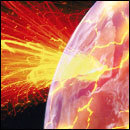
It's only natural that we tend to focus on the human side of earthquakes, tsunamis and other disasters when they happen. But sometimes you have to step back and really appreciate the sheer, unfathomable scale of how these events can change the surface of the Earth itself. The world is a volatile place, and we'd do well to not let ourselves forget it.
With that in mind, consider the earth-shattering power of ...
Krakatoa

In 1883, the island of Krakatoa in the Indian Ocean exploded like a potato in a microwave, except with less delicious Idaho goodness and with more tsunamis. The blast was so powerful that the noise could be heard from more than 2,000 miles away.
Obviously, this did not happen spontaneously -- islands don't randomly explode, or else no one would live on islands. This was the result of a volcanic eruption. Though scientists aren't sure what made the eruption trigger a full island explosion. One theory is that the lighter magma that usually spews out of a volcano mixed with heavier basaltic lava from below, and the island became the sealed bottle containing volcanic Diet Coke and Mentos.

Except spicier.
However it happened, the impact was huge. Unfortunately, there weren't many Johnny-on-the-spot photographers capturing the damage, since it was 1883 and an island in the middle of the Indian Ocean and all. But we do have this illustration of Krakatoa before the eruption:

Aaaaand this one after:

Notice how the 90 percent of the mountain was no longer there. Where there was once an island halfway between Sumatra and Java, there was now three smaller islands and about 40,000 fewer people.

Krakatoa's eruption was the loudest noise in recorded history, heard as far away as Perth, Australia. That's about 2,000 miles -- basically, imagine being in New York City, and hearing something that happened in Utah. You'd probably see it on the news long before you actually heard it since it takes sound nearly three hours to travel that distance.
The blast was the equivalent of 200 megatons of TNT. For perspective, the largest explosion ever made by humans was the detonation of a Russian hydrogen bomb, which was 50 megatons. That blast broke windows in buildings 560 miles away. Krakatoa was four times that; the cloud it generated wiped entire villages off the map 25 miles away and created a tsunami that traveled all the way to South Africa. That wasn't all Krakatoa's neighbors got for their birthday that year; giant pieces of rock and coral reef fell from the sky as well.

No really, "giant piece of coral reef" was literal.
Krakatoa ejected so much debris into the upper atmosphere that it changed the weather for five years. Much of what came out of the explosion was sulfur, which reached the stratosphere and reflected out more sunlight than regular water vapor, dropping the global temperature by just over 2 degrees. And since blowing up and drowning vast swaths of the planet wasn't a big enough screw you, it fell back to earth as rain -- acid rain.
The Missoula Floods

Imagine a huge lake, one that's about half the size of Lake Michigan, but held back on one end with ice. Now imagine that the ice dam holding back all 500 cubic miles of water burst, and the water had to find somewhere to go.
One more thing -- imagine that the water was angry.

Now imagine it happening on 40 separate occasions. Beginning around 15,000 years ago, angry, rushing, ice-filled water stormed across Montana, Idaho, Washington and Oregon at 80 miles per hour, mutilating the land like God's rototiller as it went. The rage started at glacial Lake Missoula in Montana, which no longer exists today, then went crashing across the northwestern United States, rushing all the way to the Columbia River before its thirst for destruction was quenched.
Along the way, the water got up to 400 feet deep and released more energy than 4,500 megatons of TNT. In case you were counting, that is 22.5 Krakatoas. Here's what 4,500 roving megatons of TNT does to the land, by the way:


It scarred up the earth so badly that there is a part of Washington now cruelly referred to as the "Scablands."

Let's put it another way. Look at these boulders:


Those rocks were tossed across the landscape by the floods, either rolled along by giant walls of water or carried on giant aircraft carrier sized ice rafts and deposited on the ground when the waters finally subsided, no doubt covering the remains of woolly mammoths that were flattened like bugs.
The most insane part is that scientists estimate that this happened every 40 to 55 years, for 2,000 years.
The New Madrid Earthquakes

Contrary to its exotic, festive-sounding name, New Madrid is a town in Missouri, of all places. It also happens to be located in the heart of the New Madrid seismic zone -- a hotbed of plate movement earthquakes that can be felt in seven surrounding states. Because Tornado Alley wasn't terrifying enough without having one of America's most powerful earthquake fault-lines running down the middle of it.

In red: all the places the New Madrid has caused people to publicly soil themselves since 1974.
Starting on December 16, 1811, a series of three Haiti-sized earthquakes shook the New Madrid region like a maraca in the hands of a palsied old-timer. One quake caused a freaking standing wave in the Mississippi River, apparently reversing its entire course for a few minutes. It cracked sidewalks in Washington, D.C., and sloshed well water in South Carolina. Soil liquefaction, where solid ground turns into soup during a tremor, caused the earth to up and swallow the village of Little Prairie, presumably displacing Michael Landon and his family.

One long preamble to a Roland Emmerich film.
The two worst quakes hit on December 17, 1811 and then nearly two months later on February 7, 1812, both registering 7.7 on the Richter scale. The shock was felt in New York, and rang church bells in Boston. Sections of the Mississippi River uplifted, causing waterfalls in a giant river in the middle of flatlands, and created the Kentucky Bend:

And sent a wave upstream that created a goddamn lake.

Imagine a cannonball dive so devastating the splash created a second pool.
Paricutin

The worst thing an average person has to worry about growing out of his yard is the occasional mushroom garden or patch of stinging nettles. But in 1943 in Paricutin, Mexico, Dionisio Pulido saw his land open up and suddenly grow a volcano.

Well ... shoot.
Pulido, a farmer, was out plowing his field when a fissure opened up and started burping out ash and stone. After only a week, it was five stories tall. Within a year, it went from a gleam in a volcanic field's eye to a bouncing baby cinder cone 1,100 feet tall that forced the locals to move to nearby non-erupting land.

"I say we just let the volcano have the field, bro."
The volcano was spent by 1952, but not before increasing in violent volcanic activity, topping off the cone at 1,390 feet tall before calling it quits and going to sleep. It is the only volcano birth ever witnessed in recorded history, and it would probably have its own reality show if it happened now. Just try to imagine that you have a corn field behind your house, and a year later it looks like this:

"Dammit! My hat is under that thing." -Dionisio Pulido
The Siberian Traps Reset Earth's Biological Clock

If 1980s movies are to be believed, Siberia is a frozen hellhole suitable only for bears, Russian prisoners and inept American spies. It's nothing but frozen tundra and despair until you get to Alaskan crab waters and reality TV crews. But it was once worse. Way, way worse. About 250 million years ago, Mother Earth experienced a truly epic case of irritable bowel syndrome under what is now Russia's frozen armpit.
Near what was to be the end of the Permian period, Earth was ruled by pre-dinosaur reptiles and giant freaking bugs before Siberia erupted. Not a volcano in Siberia; Siberia itself. Scientists believe a mantle plume, aka "hotter lava," rose up and hit Siberia and, in strictly scientific terms, blew it right the hell up. A piece of earth the size of western Europe exploded, possibly causing an event called the Great Dying.

It was a continent-sized game of "the floor is lava."
While the simple explosion of a continent was probably enough to screw up everything on its own, the Siberian traps had more tricks up their volatile sleeves. They were located next to large coal fields, causing the release of massive amounts of methane and carbon dioxide. This could have triggered a clathrate gun reaction, which in turn would have led to an anoxic event that would have poisoned everything that wasn't exploded or suffocated/baked by the previous two apocalypses that just happened. In other words, it was the perfect storm of "screw you, everything."
Ninety percent of all life on earth was wiped out, and land life took 30 million years to recover.

And eventually evolved into a perfect form.
The expanse of Siberia was "paved over" in basaltic lava, forming the traps, which get their name from the Swedish word for stairs. Here is what a continent-sized apocalypse looks like:

Holy God, it's ... OK, that's actually kinda neat looking.

But this, well this is just ... alright, that's awfully pretty.

OK, so apparently after a quarter of a billion years, even hell is kind of nice to look at.
Don't let the pretty pictures fool you -- the chain reaction started by the Siberian traps spent a million years murdering most of the life on Earth. And the best part? It could happen again.
David writes for Funnycrave, blogs at Death and Other Funny Stuff and is managing editor for Wordplague.
For more bizarre worldly changes, check out 5 Ancient Acts of War That Changed the Face of the Earth and 6 Tiny Things That Have Mind-Blowing Global Impacts.
And stop by LinkSTORM to see the facelift Cracked gave to the Internet.
And don't forget to follow us on Facebook and Twitter to get sexy, sexy jokes sent straight to your news feed.
Do you have an idea in mind that would make a great article? Then sign up for our writers workshop! Do you possess expert skills in image creation and manipulation? Mediocre? Even rudimentary? Are you frightened by MS Paint and simply have a funny idea? You can create an infograpic and you could be on the front page of Cracked.com tomorrow!
