Is Wall-E Really About An Aging Gay Robot?
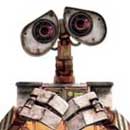
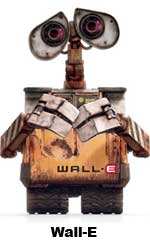
 Like many of you, I took a break from the lavish penthouse parties that are my workaday routine to jaunt to my local imax and see Wall-E this weekend.
And I’m here—at least textually—to tell you that it’s not only a wonder of computer graphics, but also a film that dares to stand for something. Wall-E shines some much-needed light and compassion on a largely unexplored sphere of human existence: that of the elderly gay man.
For years, the elderly gay man has been a ghost, a myth, a tale told to disturbed children. We’ve tried to pretend they aren’t out there, puttering around their one-bedroom apartments in tasteful sweater vests.
But let me tell you something: that flamboyant ball of styled hair and liberal sensibilities you see walking down the streets of Hillcrest today is going to get old one day. And then, like many elderly gay men, he’ll spend his days not bothering people, eating breakfast at curbside cafes, and occasionally meeting for sex at big unmarked warehouses downtown.
Which brings us to Wall-E
Like many of you, I took a break from the lavish penthouse parties that are my workaday routine to jaunt to my local imax and see Wall-E this weekend.
And I’m here—at least textually—to tell you that it’s not only a wonder of computer graphics, but also a film that dares to stand for something. Wall-E shines some much-needed light and compassion on a largely unexplored sphere of human existence: that of the elderly gay man.
For years, the elderly gay man has been a ghost, a myth, a tale told to disturbed children. We’ve tried to pretend they aren’t out there, puttering around their one-bedroom apartments in tasteful sweater vests.
But let me tell you something: that flamboyant ball of styled hair and liberal sensibilities you see walking down the streets of Hillcrest today is going to get old one day. And then, like many elderly gay men, he’ll spend his days not bothering people, eating breakfast at curbside cafes, and occasionally meeting for sex at big unmarked warehouses downtown.
Which brings us to Wall-E Then we see, in quick succession, the facets of existence that comprise the life of an elderly gay man: a befuddled lack of directional sense, a distrust of tools, curious fascination with women’s undergarments, failure at traditional sports and games, love of shiny things, and, finally, an illogical fear of massive explosions.
In the end, Wall-E just wants his way of life understood and respected. As he infiltrates the world of unfashionably obese straights and tinkers with his bonsai, he asks only that we treat him with the kindness he affords us. Don’t judge, he seems to twitter, gently clasping his robot hands.
Then we see, in quick succession, the facets of existence that comprise the life of an elderly gay man: a befuddled lack of directional sense, a distrust of tools, curious fascination with women’s undergarments, failure at traditional sports and games, love of shiny things, and, finally, an illogical fear of massive explosions.
In the end, Wall-E just wants his way of life understood and respected. As he infiltrates the world of unfashionably obese straights and tinkers with his bonsai, he asks only that we treat him with the kindness he affords us. Don’t judge, he seems to twitter, gently clasping his robot hands.
When not blogging for Cracked, Michael is moving heavy boxes as head writer and co-founder of Those Aren't Muskets!
