The Truth REALLY Hurts in ‘The Lowdown’
This fall, TV viewers will have a choice of new shows about the people whose job it is to inform them, in writing, about the world. By far the bigger launch is for The Paper, Peacock’s spin-off of The Office, which fans have been anticipating for more than a year. In that vision of journalism, the daily newspaper for a fairly large municipality exists to report the news; but that gets a lot less play than its main function as a self-actualization vehicle for a former toilet paper salesman, who’s heading a team of inexperienced volunteer contributors. Fortunately, FX is also premiering a show about journalism that seems like it was made by people who think accurately and rigorously reporting the news should be done not by well-meaning idiots, but by people willing to risk a beating — or their lives — to publish the truth.
In an age of rampant misinformation, The Lowdown offers a hero for these times: a righteous loudmouth fuck-up who refuses to quit.
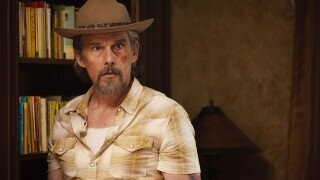
The Lowdown, which premieres its first two episodes on FX tomorrow, comes from Reservation Dogs creator Sterlin Harjo, and stars Ethan Hawke as Lee Raybon. Officially a rare books dealer with a secondhand bookstore, Hoot Owl Books, in downtown Tulsa, Lee is also a freelance journalist. We meet him just after his long-form profile on the Washberg family in the Heartland Press has gotten national pickup, partly because Donald Washberg (Kyle MacLachlan) is running to be the Republican governor of Oklahoma, and the election is imminent.
Don't Miss
And Lee is no snob: He also pitches crime stories to Tulsa Beat, which seems to operate primarily to run local sex workers’ classified ads. Soon, Lee finds out that his big exposé on the Washbergs and his smaller, more sensationalistic piece on havoc wrought by white supremacist skinheads are actually two parts of the same story — and not one that gets any easier to unravel after several principal figures end up dead.
Harjo has said that the inspiration for Lee Raybon is Lee Roy Chapman, with whom Harjo worked at the now-defunct Heartland Press-esque broadsheet This Land. But the show has plenty of other influences. It’s a crime show that’s suspicious of cops, like Terriers or Bad Monkey. It revolves around a protagonist who can’t stop getting into trouble, like Poker Face or Reacher. It’s a Southwest neo-noir, like Better Call Saul or the recently canceled Duster (with which it shares a Keith David performance in common; here David plays Marty, a P.I. working for Washberg). And it revolves in part around the roguish figures who operate in the world of secondhand and antique goods, like Chance and Lovejoy.
Lee lurches from harassment by city cops who don’t want him exposing their shoddy work to an ass-kicking by skinheads in the shabby apartment above his store to chatting with the server at his favorite all-night diner to sending antique dealer Ray (Michael Hitchcock) to get a box of first-edition pulp novels Ray can’t buy himself because his reporting has put him at odds with the seller.
In the lulls when the viewer’s just hanging out with Lee, we can be pretty certain he’s constantly about to talk himself into another hired goon’s car trunk, or another seafood poacher’s shed: What makes Lee the perfect protagonist for a show like this is that he’s probably going to make the wrong decision for the right reason. The more people warn him to back off the Washberg story, the more determined he is to figure out how the scraps on his crazy wall fit together. Token attempts at stealth — tailing one of the subjects in his Washberg story; borrowing a Fish & Wildlife agent’s uniform jacket to search a boat — are quickly found out (in the latter case because his vintage slacks are identified by a target as “Saturday Night Fever pants”).
With his tween daughter Francis (Ryan Kiera Armstrong), Lee tries not to make his life and work seem too glamorous, telling her, “I went to jail so you don’t have to,” but it doesn’t take: Francis still begs Lee to let her help with his investigation and, when he refuses, does a little light trespassing on his behalf. The more stable life Francis’ mother, Lee’s ex-wife Samantha (Kaniehtiio Horn), is seeking with her new dentist boyfriend Johnny (Rafael Casal) can’t compete.
We can hardly blame Francis for falling under her rakish father’s spell when the viewer can’t resist him either. The more Band-Aids Lee accumulates on his face from various subjects’ violent reprisals, the more we know he’s on the right track. The case against the Washbergs isn’t especially complex — a rich family got that way through immoral, rapacious means, and is now seeking political power along with its financial might — and while there are obvious parallels between this story and the Trumps’, it’s also just the story of white Western capitalism. Particularly once we know for sure that Donald doesn’t fear law enforcement, it’s easy to root for Lee’s muckraking journalism to take down the Washbergs. It’s probably the only thing in this world that could.
The cast is filled out by real Oklahoma natives, including Tim Blake Nelson as Dale, the brother Donald would prefer to forget; Jeanne Tripplehorn as Dale’s wife, a former rodeo queen; Tracy Letts as a crooked real estate developer; and Josh Fadem as the owner of a record store on the same block as Lee’s bookstore.
But even those who hail from further away feel like they belong. From the first scene between Lee and Dan (Macon Blair), the estate lawyer whose office is next door to Hoot Owl, and whose patience Lee tests with requests to hide things for him, we can project backwards through the years of their acquaintance and the times Dan’s been grateful that Lee’s scandalous mess has livened up his life. Deirdra (Siena East) works the desk at Hoot Owl; it’s clear she knows she can mooch a security job for her ex-con cousin Waylan (Cody Lightning) by leveraging Lee’s tendency to pay her late. Wendell (Peter Dinklage) shows up to mark a meaningful anniversary in his contentious friendship with Lee. “Did you just take a shit in my bathroom?” is the first thing Lee says to him. “Indeed I did,” Wendell replies. The exchange sets a tone for the rest of their day together; a couple of times when Lee can’t help laughing at a good joke of Wendell’s amid their mutual sniping, it feels like it might be Hawke’s delight showing through.
In the first few episodes, Lee is given to call himself a “truthstorian”; as far as I’ve been able to tell, this isn’t a Lee Roy Chapman nod but a coinage that originated with the show, and one whose corniness I could certainly do without. “Historian” is a perfectly good word that already exists, and if Lee’s assumed objection to it is how biased history can be, just say “writer.” I also wasn’t expecting this show to be one of the many normalizing the “r” slur (in this case, by having a less respectable character use it), but I guess Hershal Pandya’s recent Vulture piece is depressingly accurate and it really is “Comedy’s Safest Slur.”
But The Lowdown does everything I think it set out to do: It made me push up my rewatch of Reservation Dogs; it made me check that my subscription to my local independent news magazine was paid up; and it made me start planning my first-ever trip to Tulsa.
