‘The Paper’ Deserves to Get Flushed
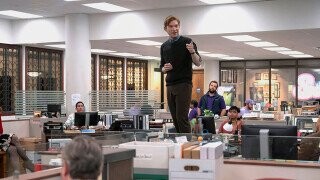
In the U.S., local newspapers are closing down at a rate of two per week. More than half the counties in the U.S. don’t have a local news source at all. The paucity of reliable local news is thought to have sown political divisions among voters. And things aren’t much better at the quasi-national level. At The Washington Post — of “Democracy Dies in Darkness” fame — billionaire owner Jeff Bezos ordered his staff not to publish its planned endorsement of Kamala Harris in the 2024 presidential race. Early this year, the story there was that the paper was “bleeding talent” due to clashes with ownership. This spring at The L.A. Times, another billionaire owner, Patrick Soon-Shiong, rolled out an A.I. tool to contradict his own opinion columnists, then pulled it when it sympathized with the KKK. The Chicago Tribune, formerly the home of nationally known Gene Siskel, recently eliminated the position of film critic entirely, while The New York Times reassigned several culture writers to “expand beyond the traditional review.”
Is any of this funny? Greg Daniels and Michael Koman, co-creators of The Office’s new spin-off The Paper, hope you think it’s hilarious.
In the series premiere’s cold open, the “documentary crew” that made The Office returns, 20 years after they first started the project, to the building where they had spent so many hours filming. Dunder Mifflin, the documentary’s subject, is no longer a tenant there, however: In 2019, a Toledo company called Enervate bought Dunder Mifflin. To Ohio we go, where Enervate executive Ken (Tim Key) tells us Enervate makes a variety of paper products; though its flagship brand is Softees toilet paper, it also puts out the Toledo Truth Teller, a formerly venerated 100-plus-year-old newspaper that once employed over 1,000 people but is now down to four.
Don't Miss
As we join the Truth Teller, that number is about to make a huge jump — to five: Ned (Domhnall Gleeson), a journalism grad who never tried to work in the field because his wealthy father convinced him it was a dead end. Ned was such a success selling Softees in Chicago that he’s leveraged his record to become the Truth Teller’s new Editor-in-Chief. He didn’t come all this way just to put out an ad vehicle filled out with AP wire stories, but his ideas are as big as his budget is small.
How can he realize his vision of a robust local newspaper? By inviting the whole staff, and the Softees employees who work in the same bullpen, to volunteer their time as reporters.
Typically, workplace comedies are staffed with familiar archetypes — the resolute optimist, the arrogant blowhard, the resigned wallflower. The Paper fails to stretch beyond the expected, re-skinning Office characters with small cosmetic tweaks. Mare (Chelsea Frei) is the Truth Teller staffer I hesitate to call an editor; her job is to select the wire stories that will fit best on the print newspaper page. She and Ned are this show’s Pam and Jim, the cuties who know they shouldn’t get involved but probably won’t be able to help themselves. Nicole (Ramona Young), who handles subscriptions, is being set up with ad sales staffer Detrick (Melvin Gregg) as the show’s secondary couple — think Andy and Erin. Ken, a confident boob, is a new Michael Scott. Vain and delusional Managing Editor Esmeralda (Sabrina Impacciatore) is a cross between Jan and Kelly. Accountant Adeola (Gbemisola Ikumelo) has a glare as powerful as Angela’s and the firm opinions of a Ryan. Adam (Alex Edelman), another accountant, is the resident quirk bucket, in the style of Dwight. Softees driver Travis (Eric Rahill) has wild-card energy somewhere between Kevin and Meredith. Barry (Duane R. Shepard Sr.), the one actual reporter, is as senile as Creed. Then there’s Oscar (Oscar Nuñez), who’s actually back playing his character from The Office.
If you’ve watched The Office straight through a dozen times already, you may be excited by the prospect of getting new episodes in the same world. But the chosen setting is an issue straight out of the gate. Ned has arrived with huge ambitions for the paper to be an important news source again, but he also apparently accepted the job without finding out the sizes of his staff or budget. Inviting those who wish to “help out” with reporting suggests that the show’s writers think anyone can do it, and/or that the stories the volunteers will be covering are so insignificant that it doesn’t matter how well they do; whichever is the case, why should the viewer care about their work?
Reporting is, to be clear, a job these Enervate employees will be doing for free on top of whatever job they each already have. I guess we’re supposed to think they’re inspired by Ned’s passion, but no one ever actually tells us what made them want to take a second job for free.
Successive episodes introduce new problems the show’s writers evidently didn’t care to think through. Ken, who has joined forces with the usurped Esmeralda to undermine Ned, discovers that the Truth Teller has to pay for stories or they don’t own their copyrights. A budget line item is identified that can be allocated for this purpose, but we never find out how that actually works. Are the volunteer reporters getting paid now? If so, how much and with what frequency? And how did they react when they found out they would effectively be getting a raise? (There is a character in the show who’s established to have come from wealth such that he wouldn’t care about such matters, but it’s… Ned.)
When Ned has a temper tantrum at Marv (Allan Havey), the big boss at Enervate, he belatedly worries that Marv will retaliate by firing Ned and shutting down the paper. Marv assures him that he wouldn’t do that for such a petty reason; it would only be because the paper was losing money. One guy potentially has the power to disappear a news source for a city of more than 260,000 people. Is the show’s position that this is empirically a bad thing, or that it’s neutral since Marv is a good guy who’s just concerned about the bottom line?
Also: Is the paper losing money since Ned took over? We aren’t told. Has readership gone up or down since Ned has refocused on local coverage? We don’t find that out either. Have readers noticed the changes? Other than one determined troll in the website’s comments, we don’t hear from readers at all. (Even the opening credits are a montage of people doing things with newspaper — taping a window frame to paint it, wrapping food, training a dog — other than reading it.) We sure do hear a lot about an Ohio journalism award Ned is gunning for, though, and the fact that this honor gets more play than the citizens the Truth Teller is supposedly here to inform says a lot about Daniels, who probably hasn’t missed an Emmy ceremony since he started at Saturday Night Live in 1987.
In the season’s best episode, a crisis involving Man-Mitts — a flushable Softees product meant to replace toilet paper — requires Ned to take off his editor hat temporarily and return to Softees sales. Gleeson is clearly having a ball portraying this obnoxious, bro-y version of Ned. (When Natalie and Mare find a sales training video starring Ned in his “Sales God” look, the roasting commences immediately: “You look like if Draco Malfoy had a cocaine problem,” says Mare.) It’s so much more fun to watch these characters goof around in a low-stakes story than it is to endure the feelings The Paper actually sparks: a constant state of dread about the endangerment of real-life journalism, and about the grave real-life consequences of a populace that can’t access accurate news. The Paper has interesting characters and amusing situations — they’re just all in the service of a premise it doesn’t take seriously enough.
The most infuriating part is that the tiniest tweak could have saved it. The show already gave Ned this backstory of tremendous success and skill working in a recession-proof business that’s also inherently funny because it’s directly related to the human butt. The Paper could have been about a hot shot sales jerk sent to shake up the Toledo office of Enervate, which didn’t have to be involved with the Truth Teller at all. Ken and Esmeralda could have still tried to take him down. He could have still had a forbidden crush who worked for Softees. The show could have even used the same title. And every episode wouldn’t have felt like an urgent reminder that democracy really does die in darkness.
