6 Insane (But Convincing) Theories on Children's Pop Culture
We here at Cracked certainly aren't strangers to overanalyzing pop culture. In fact, we once suggested that the Harry Potter books imply that one of the characters was sexually assault by centaurs. But we always assumed that such humorous wastes of time were below actual smart people with, like, Ph.D.s and bow ties.
Unfortunately, it turns out that many well-adjusted, serious academics really are spending their free time running around and ruining the stuff we loved as kids with their brains. Unfortunatelier, when you actually hear their arguments, you almost want to agree with them that ...
Donald Duck Promotes Soulless Capitalism

Aside from being an uncredited creator of Inception, Donald Duck is one of the most beloved cartoon characters in the world. But Ariel Dorfman (an Argentine-Chilean novelist/activist) and Armand Mattelart (a Belgian sociologist) have this crazy theory that the comic book adventures of a violent, pantsless sailor might actually be inappropriate for children.

According to the authors, Donald Duck cartoons might as well be the talking-duck version of Ayn Rand's Atlas Shrugged. In their book How to Read Donald Duck (Para leer al Pato Donald), the Dynamic Deconstruction Duo claim that Donald and friends teach kids that a person's value is dependent entirely on how much money he or she has, and that in the pursuit of money, there is no room for things like family or love, only for blind self-interest.

Why It's Not That Crazy:
Have you ever noticed that there aren't any parents in Donald Duck cartoons and comics? Scrooge, for example, is Donald's uncle, who in turn is an uncle to Huey, Dewey and Louie, a first cousin to Gladstone Gander and a boyfriend (but never husband) to Daisy, who herself has three nieces, April, May and June (because fuck it, picking out baby names is hard). That means that the world these characters live in is essentially devoid of any real families and populated solely by orphans. Without parents and nepotism, each duck is left alone to constantly compete against the others for wealth and status. That's basically an ideal stage for, yes, really sad nightmares, but also capitalism: If you start with what you believe to be a completely level playing field (in this case, a world without parents where everyone starts out with the same chances in an orphanage), those who are strongest and smartest, and work the hardest, have the best chance of succeeding (where "succeeding" here means "making all of the money in the world").

The anti-capitalist characters in Atlas Shrugged are portrayed as spineless, worthless moochers. Likewise, Donald is depicted as an eternal loser because he can't hold a steady job and is always in debt to his uncle. Scrooge, on the other hand, is the richest duck in the world, happily spending all of his free time becoming even richer. In DuckTales, every single episode is basically about Scrooge and the nephews hunting for treasure or protecting Scrooge's money or diving into giant swimming pools of coins (something that almost certainly would have happened in Shrugged had it not been cut to make room for 25,000 words about the tensile strength of railroad tracks).
The comics aren't any better: In Dorfman and Mattelart's analysis, the entire plot of 75 percent of the comics centered around the ducks looking for money and gold. The other 25 percent were about "competing for fortune," which is apparently considered different.

In Atlas Shrugged, extraordinary people demonstrate their extraordinariness by making all of the money in the world and sharing it with no one. The conclusion reached by the end of the novel is that anyone who isn't a superman should either worship the supermen or stay out of their way, and if the unfortunately average people die in the process, oh well.
This must be where Scrooge differs from Shrugged, right? It's not like Scrooge would ever be that heartless, right? What's that? Scrooge acquired his wealth by conducting genocide in Africa? Oh.

Oh.
Everyone in Winnie the Pooh Is a Textbook Example of a Common Psychiatric Disorder

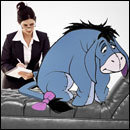
In the December 2000 edition of the Canadian Medical Association Journal, the joint teams of Dalhousie University's Pediatrics Department published a study that diagnosed the characters in Winnie the Pooh with crippling mental problems. No, we also have no idea why would they do such a horrible thing.
This group of trained doctors diagnosed Pooh with ADHD; Eeyore, obviously, with depression; Christopher Robin with schizophrenia ...

The doctors themselves were diagnosed with too much free time.
... and Tigger with hyperactivity-impulsivity, among others.
Why It's Not That Crazy:
It's not like they had to stretch to find the appropriate diagnoses. These are the primary colors of the crazy spectrum, and each character embodies his specific disorder with pretty much every single line.
Let's start with the obvious and look at some Eeyore quotes:
1) "I'm telling you. People come and go in this forest, and they say. 'It's only Eeyore, so it doesn't count.'"
2) "Good morning, Pooh Bear," said Eeyore gloomily. "If it is a good morning," he said. "Which I doubt," said he.
"Why, what's the matter?"
"Nothing, Pooh Bear, nothing. We can't all, and some of us don't. That's all there is to it."
"Can't all what?" said Pooh, rubbing his nose.
"Gaiety. Song-and-dance. Here we go round the mulberry bush."

Holy shit.
Let's take a look at Piglet, who, as the study claims, "Clearly suffers from generalized anxiety disorder." According to the Diagnostic and Statistical Manual of Mental Disorders, some of the criteria for GAD include excessive worry, inability to control said worry and an impairment of occupational/social areas of functioning. Now, here's a quick recap of some of the Piglet-centered episodes from Pooh's animated TV series:
"Pooh Oughta Be in Pictures" -- Piglet becomes frightened that monsters from a movie he saw are real.
"Gone With the Wind" -- Piglet becomes afraid of going outside.
"A Very, Very Large Animal" -- Piglet worries that he is too small so he leaves the forest.
"Goodbye Cruel World" -- Piglet commits suicide.

OK, we might have made up that last one, but it's not that far off, seeing as studies show that generalized anxiety disorder is often a side symptom of major depression and substance abuse.
It's for this reason that Piglet should at all times be kept away from Tigger, who the researchers diagnosed with ADHD of the hyperactive-impulsive subtype, based on his history of risk-taking behavior. For example, when Tigger first arrived in the Hundred Acre Wood, he had no idea what Tiggers normally eat, so he tasted fuck everything he could find, including thistles.

The diagnosis is also based on the fact that he regularly barges into people's houses, commits crimes so he can later play detective ("Tigger, Private Ear") and once even endangered the entire forest by keeping a vicious termite as a pet ("Tigger's House Guest").
To be clear, the researchers aren't just arbitrarily psychoanalyzing these fictional stuffed animals. The point is that each character clearly represents the different extremes in mental illness. It's almost like they're trying to provide children with a way to articulate their own budding illnesses. It's much more likely that a 6-year-old will say "Mommy, I feel like Eeyore today," instead of "Mommy, I fear I suffer from clinical depression."

The Wonderful Wizard of Oz Is a Political Satire

A book as bizarre as The Wonderful Wizard of Oz, with its winged monkeys and self-mutilating cyborgs, had to attract some crackpot interpretations over the years, the most popular of which is that L. Frank Baum's 1900 classic is secretly about the Populist movement.
The late-19th century Populists fought for the rights of the poverty-stricken Midwestern farmers and industrial workers, who are supposedly represented in the book by the Scarecrow and the Tin Man. Dorothy, the only normal character in Oz, was the everyman, and the twister that carried her from Kansas was meant to represent the "storm of Populism" sweeping across the states in the 1890s.

Some people dismiss it as one big straw man argument.
This interpretation has actually been repeated by educators, an assistant professor of history and even a professor of economics from Rutgers University.
Why It's Not That Crazy:
A big part of 19th century Populism was adding silver to the nation's gold standard in order to help the economy, and, well, did you know that in the book, Dorothy's magic slippers were actually silver instead of ruby? And what does the main character do with this silver object of great power? She "walks over" the Yellow Brick (i.e. gold) Road. Right over it.

The economy back then was selfishly guarded by Technicolor dwarfs.
Then there are the little touches, like how "Oz" is actually an abbreviation for an ounce of, for example, gold. And Dorothy walks all over a road of yellow bricks down to a path that is ultimately unfulfilling. The road of gold leads to an empty promise (and also there are monkey attacks).
Then there's this guy:

Sir Thaddeus Snoot von Deadeyes.
That's William Jennings Bryan, a leader of the Populist movement who was occasionally portrayed in the press as a lion.

Because Bryan was also often accused of being "cowardly" for opposing the war with Spain and annexing the Philippines to the U.S., some think that the character of the Cowardly Lion is actually based on him. Conversely, the Wicked Witch of the West is allegedly representing the backers of the gold standard because she controls the winged monkeys with a magical golden cap.

We are the 99 percent! Occupy Oz!
The Smurfs Are Tiny Blue Nazis

In the world of reading too much into children's cartoons, it's a well-known fact that the Smurfs are secretly Communists. But Antoine Bueno, senior lecturer of sociology at Sciences Po University in Paris, decided to smurf that right in the smurf. In his The Little Blue Book (Le Petit Livre Bleu), Bueno claims that the Smurf village is actually a Nazi, totalitarian utopia full of micro-fascists. He additionally accuses the Smurfs of being anti-Semites because, hey, while he was at it ...

Why It's Not That Crazy:
The creator of the Smurfs, Pierre Culliford, aka Peyo, was born in Belgium in 1928, which means that he spent his childhood under Nazi occupation and, according to Bueno, might have consequently reflected the spirit of those times in his later work, whether he was aware of it or not.
We can all agree that a person's early years can have a great influence on his or her later life. It's like how the creator of Mario allegedly based his design on his annoying landlord, except in this case Peyo drew little blue Nazis. It makes sense.
For one, the Smurfs are all united against a common enemy, the sorcerer Gargamel, whose large nose supposedly makes him look like a Jewish stereotype:

Gargamel also has a cat named Azrael -- a name that comes from Jewish mysticism -- and is the creator of Smurfette, who becomes a vision of Aryan beauty after Papa Smurf "fixes" her with magic.

Maybe if the Nazis got laid more often they wouldn't have been so uptight.
The most damning evidence, however, seems to come from a comic titled "The Black Smurfs," where the Smurfs get infected, via bites, with a mysterious disease that turns them black, mindless and aggressive, which Bueno interpreted as concerns for blood purity. The book would not have appeared in the U.S. to this day if the color of the sickness wasn't eventually changed to purple.

Babar Is a Colonial Apologist

Babar the Elephant might not be as famous as other cartoon characters like Mickey Mouse or Bugs Bunny, but he still achieved great success. First created in 1931 by Jean de Brunhoff, the Babar books are published today in over 17 languages with more than 8 million copies sold worldwide.
And -- if you believe experts like Herbert Kohl or Ariel Dorfman (the Donald Duck guy from before) -- that's over 8 million copies of sneaky colonial propaganda, simply because the titular Babar, an African elephant, is raised in France and later returns to his homeland to reform it using the superior power of Western civilization.

We're not sure we'd have gone with bowler hats to symbolize cultural superiority, but hey.
Why It's Not That Crazy:
In the first book, The Story of Babar, we find out that Babar's mother was shot by a hunter, and the small elephant was taken in by an old lady in Paris, given clothes and enrolled in school, like some reverse Tarzan. Later, after the death of his father, Babar is declared king of Elephant Land because he has lived among humans and "learned much," though apparently the concept of representative democracy wasn't part of it.
He then proceeds to civilize the fuck out of his kingdom by introducing it to French culture, much to everyone's excitement.

"Yay, a palace! We'd have preferred a hospital, but still, yay!"
It isn't hard to see why someone would have issues with a story like this. In Babar, the Western culture is presented as obviously superior to the African one, with the regions of the African continent outside Babar's control being populated by spear-chucking political incorrectness.
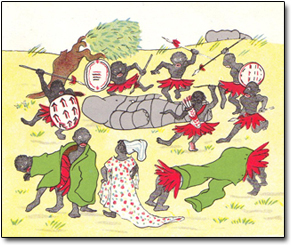
Even the native African elephants are originally depicted as naked and walking on four legs until the bipedal, clothed Babar and his family (who saw the light of European civilization) make them aware and ashamed of their primitive, naked ways. It's as if the books were trying to say, in an almost Biblical sort of way, that accepting Western civilization is akin to finally being human.

A lot of this stuff does make sense, especially considering that the first book came out at the height of French colonialism in Africa, but looking for religious undertones in Babar sounds like the biggest ass-pull since the 2010 Proctology Olympics. We'd definitely need to see something more convincing before we buy into it; something like ...

Thomas the Tank Engine Lives in a Totalitarian Dystopia

Thomas the Tank Engine and Friends, a story about sentient trains learning about responsibility, friendship and all that noise, might possibly be the most sickeningly wholesome children's show in existence. With that in mind, it'd take some pretty massive balls to accuse said show of, say, promoting totalitarianism, fascism and racism.
Shauna Wilton, a professor of political sciences at the University of Alberta, has just such balls. She argues that the world of Thomas the Tank Engine is in reality a fascist, racist hellhole where dreams go to die and where only "useful" elements are allowed to continue to toil away in pointless misery.

Oh yeah. Stick more proles in the carriage and it would totally be 1984.
Or maybe ... maybe someone switched Wilton's Thomas DVDs with Schindler's List.
Why It's Not That Crazy:
Here's a totally hypothetical question: What if one of the trains on the show decided that he wanted to do something else with his life, like travel or star on Snakes on a Train 2: Snake Harder? He'd probably get yelled at and told to get back to work.

You see, on the island of Sodor where the show takes place, there is only room for really useful engines. That's not only the show's catch phrase, but also the basic summary of every episode in the series. That is, the engines are either trying to prove themselves or worrying that they aren't working hard enough (see "James and the Coaches," "Thomas, Percy and the Post Train," "Tender Engines" and many more).
This totalitarian obsession with usefulness is instilled in the engines by the iron fist of Sir Topham Hatt, aka the Fat Controller, who swiftly punishes all those deemed as "useless."

In the episode "Break Van," Hatt has two twin engines, Donald and Douglas, compete against each other to determine which one he will send back to Scotland to be destroyed. In "The Sad Story of Henry," when an engine refuses to go out of the tunnel because of the rain, Hatt actually gives orders to brick him alive in the tunnel.

"Oh man, what the fuck ...?"
You can't really defend any of this by saying that the trains are Hatt's property. They are obviously sentient beings capable of emotions ... one of which unfortunately happens to be racism. In the show, there is a clear feud going on between the steam engines like Thomas and Percy and the diesel engines, who are depicted as stubborn, lazy and shifty.
In the episode "Daisy," a diesel named Daisy arrives on Sodor and flat out refuses to do chores. In "The Diseasel," a diesel called BoCo is accused of stealing trucks. In "Thomas's Day Off," a new, lazy diesel, Dennis, tricks Thomas into doing his work. Even the closest thing the show has to a villain is a diesel fucking named DIESEL.

"BRING ME MORE VICTIMS!"
But maybe there is some perfectly reasonable, nonracist explanation for why the trains that run on clean white steam dislike the trains powered by dirty, black diesel oil. So, if you can think of one, please tell us, because we're just dying to hear it.
Cezary Jan Strusiewicz is a freelance English-Japanese-Polish translator, tour guide and writer. Contact him via email or buy this awesome book about death that he helped write.
For more ways to be that annoying guy at the party, check out The 7 Most WTF Origins of Iconic Pop Culture Franchises and 5 Reasons Pop Culture Is Run by Fan-Fiction.
And stop by LinkSTORM because it's the best thing for Fridays since Steve Urkel.
And don't forget to follow us on Facebook and Twitter to get sexy, sexy jokes sent straight to your news feed.
Do you have an idea in mind that would make a great article? Then sign up for our writers workshop! Do you possess expert skills in image creation and manipulation? Mediocre? Even rudimentary? Are you frightened by MS Paint and simply have a funny idea? You can create an infographic and you could be on the front page of Cracked.com tomorrow!
