5 Famous Hidden Song Meanings (That Are Total B.S.)
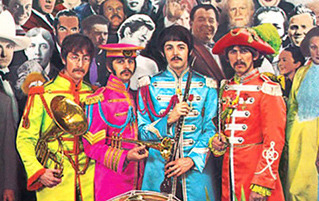
Because songwriters worry more about catchy rhymes than deep meaning, song lyrics can be more abstract and esoteric than Jackson Pollock farting chalk dust into a napkin. The problem is that some fans swear that every nonsensical song has some deeper interpretation just waiting to be decoded. That's why so many classic songs have mythical (and often dark and disturbing) alternate meanings that fans insist are true.
They're almost always wrong. For instance ...
"Hotel California" -- It's About Satanism, Right?
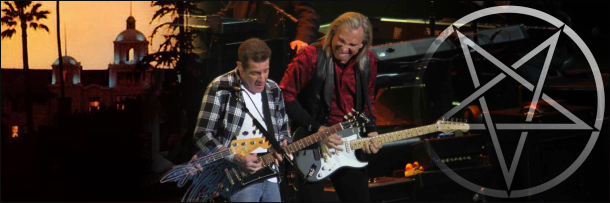
Whether you know "Hotel California" as "that weird Eagles song" or "that weird devil-worshiping song" probably depends on how religious your parents were.
When "Hotel California" was released in 1976, everyone heard it but no one really knew what it meant. The lyrics talked about trying to "Kill the beast" and "Stab it with their steely knives," and included the ominous line, "You can check out anytime you like but you can never leave." Honestly, it kind of sounds like they're singing about using the reference section in a library full of giant monsters, since those are the books you can technically check out but aren't permitted to remove from the building.

"Lookin' it up in the local libraaaary!"
That was when someone noticed something odd about the album cover, which features a picture of the band in some luxury hotel courtyard with crowds of people in the background. Above the crowd, looking out from a balcony on the upper left, is a shape whose face you can't fully see, but vaguely looks bald, goateed and threatening.
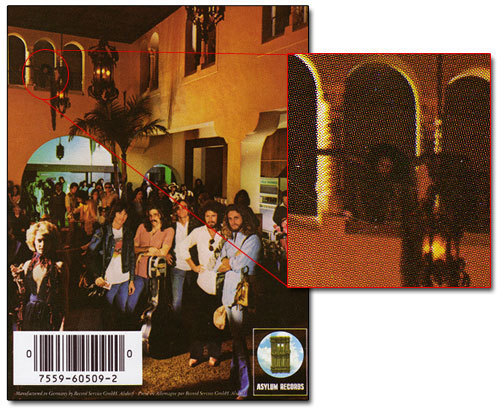
"Hey, sorry everyone, but is the ice machine down there?"
Naturally, people came to the conclusion that the figure on the balcony was none other than Anton LaVey, founder of the Church of Satan, author of The Satanic Bible and proud parent of a son that he freaking named Satan.
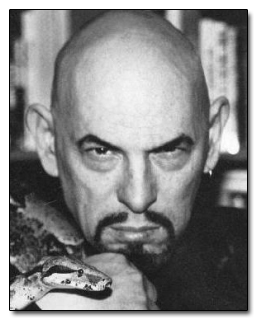
He even had "Anton + Satan = BFFs" tattooed above his ass.
Now that Anton LaVey was found, the lyrics seemed to make sense: "The Beast," "You can never leave" "This could be heaven or this could be hell." "Hotel California" is a song about Anton LaVey converting people to his church of Satanism, from which they could "never leave." The "truth" about the song persists to this day, found in Internet forums, an old issue of The Milwaukee Sentinel and the nothing-if-not-reputable website Jesus Is Savior.

They're on to your globe-spanning Satanist conspiracy, Eagles.
Actually ...
"Hotel California" has pretty much nothing to do with Satanism. The Eagles have admitted it was a way of speaking out against the greed and hedonism of the music industry in the 1970s (i.e., the drugs, money and women they themselves were drowning in). The photographer responsible for the album cover said the picture expressed "faded loss of innocence and decadence," which is pretentious-speak for "a bunch of assholes standing in a lobby."
"What about the face in the window?" you say. "I heard somewhere they didn't even know it was there. Maybe it wasn't Anton LaVey, but really ... a ghost." Unfortunately not. As Snopes points out:
"The shadowy figure was a woman hired for the photo shoot."

That is kind of a lot of hair for a bald man.
Yep. The person mistaken for a bald, goatee-sporting antichrist was, in fact, just some lady who had nothing to do with anything and wouldn't even have been memorable were it not for the poor lighting of the photograph and the bafflingly deliberate decision to separate her from the rest of the group, presumably because she showed up late for the shoot and/or got Don Henley's name wrong.
Isn't "Lucy in the Sky With Diamonds" About an Acid Trip?
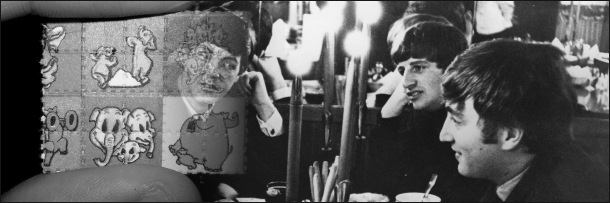
Mention the Beatles song "Lucy in the Sky With Diamonds" to a group of people and inevitably one of them will start talking about LSD. And, in fact, we're wagering that most of the people in our readership who know the song only know it as "That song that's secretly about doing acid." After all, it's coded right there in the title, right? Lucy in the Sky with Diamonds.

In 1967, John Lennon alone accounted for nearly 40 percent of the world's LSD consumption.
And then you get lyrics like this:
"Follow her down to a bridge by a fountain/ Where rocking horse people eat marshmallow pies/ Everyone smiles as you drift past the flowers/ That grow so incredibly high."
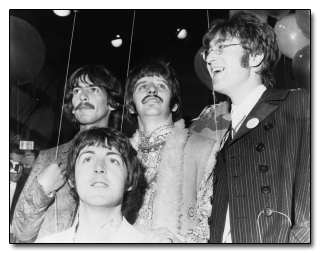
So incredibly high.
Clearly it's alluding to an acid trip. And this isn't exactly a stretch: The Beatles, remember, were a band that wrote songs about an octopus inviting people to the seabed to visit his garden, people who believe they are Arctic blueberry animals and general dick-twisting insanity.

Really, we're not sure that most of what the Beatles did wasn't about goddamned acid.
Actually ...
Shockingly, "Lucy in the Sky With Diamonds" is about a girl called Lucy, in the sky, with some diamonds. See, John Lennon's son Julian drew a picture of his best friend Lucy surrounded by diamonds in the sky, and John liked it enough to name the song after it.
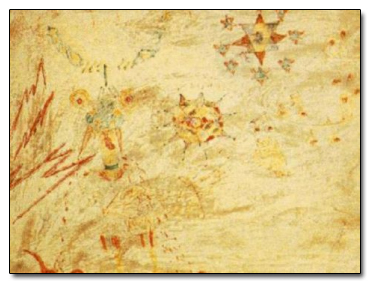
Although to be fair, the kid was clearly on acid when he drew it.
The Beatles freely admit to using drugs as inspiration for songs, and odds are LSD was one of them. But as for this particular song being a metaphor for the drug itself? Sorry, but no. John Lennon said, "It was purely unconscious that it came out to be LSD. Until someone pointed it out, I never even thought of it. I mean, who would ever bother to look at initials of a title? It's not an acid song."
This didn't stop the BBC from banning the song, which, considering they were OK with a song about a child who murdered the fuck out of everyone around him with a goddamn hammer, seems a little hypocritical.

Don't worry, folks. "I Am the Walrus" is still definitely about drugs. All the drugs.
"Puff the Magic Dragon" Is Totally About Smoking Pot ...

Hopefully, you don't need to be told anything about "Puff the Magic Dragon" by Peter, Paul and Mary, but if you do, please click the link. Even for a children's song, it seems overly bizarre and surreal, so of course it wasn't long after its release in the early 1960s when people started trying to dissect the lyrics:
"Puff the magic dragon lived by the sea/ And frolicked in the autumn mist in a land called Honah Lee/ Little Jackie Paper loved that rascal Puff/ And brought him strings and sealing wax and other fancy stuff."

People don't hug like that sober.
Remember, this was the '60s, a time when pretty much everyone was smoking weed. So with "Puff the Magic Dragon," aside from the obvious "chasing the dragon" metaphor, people figured that's what the song was about. "Puff," i.e., to smoke, "dragon," as in "draggin" or "to take a drag" and "autumn mist" being the fog of pot smoke.
"Little Jackie Paper," the little rascal he was, was obviously a reference to rolling papers. Sealing wax, fancy stuff -- bongs, clearly. People have managed to find meaning in pretty much every line in the song, and we must admit, it seems pretty convincing. And it makes sense that a folk rock trio like Peter, Paul and Mary would aim a song at the rapidly growing hippie movement.

Here they are in 2006, looking more like math teachers than doobed-up radicals.
Actually ...
We're sorry to drag you down to earth like this, but "Puff the Magic Dragon's" writers never intended any hidden meanings. In fact, they were pretty upset about the rumors, claiming the song was about:
"... a loss of innocence and having to face an adult world ... I find the fact that people interpret it as a drug song annoying. It would be insidious to propagandize about drugs in a song for little kids."

But what about their 1970 hit, "Hops the Frothy, Full-Bodied Llama"?
"I can assure you, it's a song about innocence lost ... What kind of mean-spirited SOB would write a children's song with a covert drug message?"
Mary goes on to say that if there were drugs to be mentioned, they'd be mentioned up front:
"Believe me, if he wanted to write a song about marijuana, he would have written a song about marijuana."

We look forward to hearing from Peter, Paul and Peter's bong soon.
Actually kind of hard to argue with that.
The "Horse" in "Horse With No Name" HAS to be Heroin ...

Even if you've only heard this song once, chances are you know the chorus by heart:
"I've been through the desert on a horse with no name/ It felt good to be out of the rain/ In the desert you can't remember your name/ 'Cause there ain't no one for to give you no pain."

"My name is Chuck, CHUCK dammit! Nobody fucking listens."
Ridiculous grammar aside, obviously this means something, because nobody writes that kind of line unless there's some deeper meaning behind it. And "horse" is a pretty old and well known slang term for heroin, so naturally that's what a bunch of people figured the song was about. Back in the '70s the song was even banned from several radio stations because of its supposed drug reference.
The most common beliefs are that the band (America) is either singing about doing heroin (hallucinations) or about the effects of heroin withdrawal ("After two days in the desert sun/ My skin began to turn red"). Honestly, it all fits together nicely if you think about it: The desert symbolizes the effects of the withdrawal, the horse symbolizes the heroin and the ocean/river at the end symbolizes the clarity of rehabilitation. Perhaps America are skilled wordsmiths that deserve more credit. After all, it's not like their band name is trite and obvious.

AMERICAAAAA!
Actually ...
This couldn't be more pulled from the ass if it were literally torn from the anus of a donkey. Let's save time here by going straight to Dewey Bunnell, the man who actually wrote the song:
"I wanted to capture the imagery of the desert, because I was sitting in this room in England, and it was rainy."

"I fingerpainted this desert and then I wrote a song about it."
"I had spent a good deal of time poking around in the high desert with my brother when we lived . And we'd drive through Arizona and New Mexico. I loved the cactus and the heat. I was trying to capture the sights and sounds of the desert, and there was an environmental message at the end. But ... I see now that this anonymous horse was a vehicle to get me away from all the confusion and chaos of life to a peaceful, quiet place."
So, back when he was a kid, Dewey was playing around in the desert, found it interesting and years later wrote a song about it with a message about the environment. No heroin-induced hallucinations or allegorical desert, but real, actual desert.

Dewey Bunnell, human cipher.
But "Turning Japanese" Is Definitely About Masturbation, Right, Guys?

English band the Vapors released a song in 1980 called "Turning Japanese," much to the chagrin of the current status quo. You see, in addition to being vaguely racist, "turning Japanese" is a slang phrase for masturbation, specifically referring to how one's eyes become screwed up and narrow at the climax of a particularly feverish hand shandy. Now this could easily be a coincidence in name, but listen to the lyrics (or read them, your choice):
"I've got your picture of me and you/ You wrote 'I love you' I wrote 'me too'/ I sit there staring and there's nothing else to do."

Not pictured: Jergen's.
So he has a picture of his girlfriend and finds he has "nothing else to do."
"I've got your picture, I've got your picture/ I'd like a million of you all round my cell/ I want a doctor to take your picture/ So I can look at you from inside as well."

We're still not seeing the Japanese.
He mentions a cell, so this must mean he's in prison. Also, he seems to want an X-ray of her, for some reason. Or photos from her colonoscopy.
"No sex, no drugs, no wine, no women/ No fun, no sin, no you, no wonder it's dark/ Everyone around me is a total stranger/ Everyone avoids me like a cyclone ranger/ That's why I'm turning Japanese/ I think I'm turning Japanese/ I really think so."

The Vapors, demonstrating every stage of the mullet life cycle.
It would seem that this trail of lyrical bread crumbs leads to but one place: Fistopolis. Population: This guy's wiener. Just take a look at the people interviewed in this video, at about 2 minutes 20 seconds. It's a pretty popular interpretation, and any sites mentioning the song on the Internet eventually come to the same conclusion.
Actually ...
We really wanted this one to be true, but the only thing this song has in common with spanking it in a darkened room is that it's about feelings of shame and loneliness. If you watch the end of that video linked above, the band finally tells us what it's really about:

Hint: Nothing Japanese.
"The Americans seemed to think it was written about that. That it was an English phrase about masturbation. It wasn't. The song was a love song about someone who had lost their girlfriend and was going slowly crazy -- turning Japanese is just all the cliches of our angst... turning into something you never expected to."
So no, the Vapors' song isn't about dick-whittling (masturbation/penis joke quota met). It's simply about a man who has taped hundreds of pictures of a woman he's obsessed with around his tiny room as he plots to see her insides, and whose emotions can apparently transform him into a Japanese man like the Incredible Hulk.

As illustrated here.
See? It makes perfect sense.
For more misconstrued meanings, check out 6 Pieces of Music That Mean The Opposite of What You Think and 8 Romantic Songs You Didn't Know Were About Rape.
And stop by LinkSTORM to discover the true meaning of "Wonderwall."
And don't forget to follow us on Facebook and Twitter to get sexy, sexy jokes sent straight to your news feed.
Do you have an idea in mind that would make a great article? Then sign up for our writers workshop! Do you possess expert skills in image creation and manipulation? Mediocre? Even rudimentary? Are you frightened by MS Paint and simply have a funny idea? You can create an infograpic and you could be on the front page of Cracked.com tomorrow!
