6 Shocking Ways Robots Are Already Becoming Human
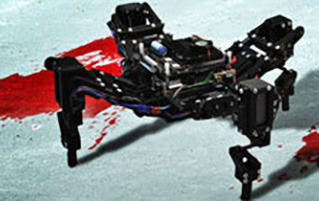
We all know the inherent strengths of robots: They do not tire, they do not question and they do not hesitate to crush our babies with their powerful, uncaring metal claws. But we're also well aware of their weaknesses: They cannot feel, cannot emote, cannot create and, perhaps most tragically of all, they cannot love. That's how we're going to beat them, when the inevitable robot apocalypse descends upon us -- with our humanity. You just can't engineer a soul.
Except you totally can. Scientists have already gotten a running start at it with these six robots that are treading all over the formerly exclusive domain of mankind.
Robots Are Getting Reputations as War Heroes

The military is leading the way in robot-human relationship-building, and that's not entirely surprising. The bond between soldiers runs deep, and it doesn't matter if the fellow soldier happens to be made of metal and plastic.
One colonel ordered a minefield-clearing robot (it was programmed to walk through the field, set off a mine, lose a limb, then drag itself onward until the next explosion) to cease its duties because he couldn't stand watching it anymore. He considered the treatment of this robot ... "inhumane." More than one soldier was brought to tears when their beloved battle 'bot comrade was destroyed by an IED. But the first place award for BRFFs goes to a group of soldiers who, after acquiring some much needed down time, took their robot fishing with them -- because they felt the robot had earned a day off, too.

Is that ... is that a beer in its claw?
In case you're thinking it was all a wry joke on the soldiers' part, and they don't really respect and revere their robot brothers-in-arms, think again: Sgt. Talon, a bomb disposal robot with the 737th Ordinance Company, has been awarded no less than three honorary Purple Hearts and a battlefield promotion to staff sergeant by the soldiers. It now holds a higher rank than the average soldier. If so inclined, it could give human beings orders that may put their lives at risk, and technically, they would have to obey.

"When I tell you to suck it, you will damn well suck it!"
Robots Can Create Art

Robots are hard-wired. A robot's actions are purely the sum of its programming. It is literally impossible for a robot to go against its code. A robot is, by its very essence, the direct and polar opposite of creative.
Or at least it used to be.

Robots are now not only expressing themselves in a variety of ways, but they're also doing it so well that their creative works are standing alongside those of professionals. Emily Howell (yes, the robots have people names now) was fed the works of every single classical composer in existence and told to analyze the music for patterns. She dutifully examined each piece with the cold, metallic and joyless disposition of a music history professor. Then, when she was finished, she composed her own music, presumably while one of the researchers worked the turntables with ruthless and scientific efficiency.

Here's David Cope, the not-crazy-at-all guy who created it, in his totally sane workspace.
Whether or not you think her results are any good is beside the point: The point is that we have programmed the ability to create art -- wholly original pieces, not remixes or covers -- into a machine.
And by adding this addendum, you're probably thinking we're going to say Emily's music is an awkward flailing mess of failure.
They're not. These are her jams:
Her compositions aren't just coherent, they're actually considered on the same level as the works of many professional composers ... to the extent that those same composers have publicly expressed worries that "Emily may one day overtake in field." By which we assume they meant to say they feared she would "overtake us in a field, where nobody might hear our screams."
The cruel, merciless domination of creativity isn't limited to music. While most art programs take a picture and filter it through pastels, pencils and paints, the Painting Fool has been taught how different painting styles and colors can stimulate moods and emotions. When the time finally came for the machine to create some original paintings of its own, one would assume it malfunctioned and printed out some photographs of circuit boards, followed by two pages of questions marks and one page left blank, save for the words "What is ... love?" printed in tiny text at the bottom. But it actually did this cityscape:

And this flower:

That's the full-size on the left; the close-up is on the right.
So OK, maybe the Fool isn't exactly on the level of Jackson Pollock. Hell, it's not even on the level of Kevin Pollak ... 's niece, Penny Pollak, who once gave a stirring Vagina Monologue at an open-mic night, but mostly just coasts off the meager family name.
But again, that's not the point: The point is that this program did not go the expected route and paint realistic landscapes or still lifes. It skipped past millennia of art history and leapfrogged right to the Modern Art phase. If it keeps up its artistic progression at this accelerated pace, it will revolutionize the art world in two months, become a tired parody of itself in three and burn out and succumb to a drug addiction in four. Six months from now it will be dead from auto-erotic asphyxiation, and all of its former critics will be writing tearful odes to The New Yorker saying that they don't know about everybody else, but they thought the Fool's later work was actually the best.

Robots Can Be Altruistic

Swiss scientists conducted an experiment with robots where the machines were simply tasked with collecting discs that represented food. At the end, the individuals that collected the most "food" were allowed to "reproduce" via hot metal-on-metal bonin'. (OK, so "reproducing" just meant their instructions were mixed together and copied onto the next generation of robots, but our way sounds way more fun). Now, if you're a Swiss robot inexplicably programmed to feel hunger, you've got two options: As you go about looking for resources, you can either opt to hoard what you find (selfish behavior) or share with the rest of the group (altruistic behavior).

"Fuck the group -- must have food discs ...".
Faced with this same dilemma, nature mostly responds by inventing new and horrible ways to murder. But astonishingly, the robots learned to cooperate and share resources, thus ensuring a greater chance to procreate for all, despite reducing their own individual chances to reproduce. The primitive AI put the good of the whole above its programming, and by doing so, has shown machines to be capable of altruism -- arguably the most complex and rare trait found in any society.

Not too scary now, but wait until they learn to hunt.
Hell, we actually are human beings -- the creatures who defined the word "altruism" -- and come lunchtime, we'll step on the neck of an old lady if she's between us and the last burrito. These robots are practically saints in our book.
Robots Can Be Empathetic

Although it's supposed to be soothing, whenever you find yourself being led through a series of wrong turns, that stoic, emotionless voice in your GPS unit is anything but. To help cool off your festering road rage, Cambridge professor Peter Robinson has created a GPS system that can detect your mood and adjust the way it speaks to you. The system, named Charles, analyzes your face, tone of voice, body language and posture to determine your current emotional state -- a skill that, let's face it, many of us humans have yet to master.

"What? Is something wrong? What is it? Is it gas? It's gas, isn't it?"
Also, added bonus: Charles comes in the form of a terrifyingly inhuman head modeled after English inventor Charles Babbage ... if somebody drowned him in doughnut glaze and left his sugary corpse to rot in the sun for a month. So sure, go ahead and mount that to your dashboard and ask it give you directions; you'll soon find every destination is a psychiatric hospital.

"Turn left ... into terror. ERROR: Return route unfound."
Incorporating 24 motors, Charles' head moves, talks and just generally orchestrates an intricate mockery of human expression. As you're driving, it will calmly offer directions while cameras in its eyes watch you to figure out exactly what you're feeling at the moment, and presumably also your greatest fears and weaknesses. Professor Robinson asserts that Charles represents the "future of how people are going to interact with machines."
And he's right, in the sense that they will be giving us orders and telling us where to go. And there will be a lot of severed human heads rolling around.
In the Pursuit of Knowledge, They Can Outrun Us

Scientists keep inventing robots to take our jobs, but now it's their turn: A robot named Adam is a scientist in its own right. It collects data and finds explanations in the patterns it detects, then performs experiments to confirm or repudiate those patterns. It carries out this entire process without any input from a human being. The scientific method, maybe the single most important concept in the advancement of human civilization, has been mastered to a "T" by a computer.

That's the giant metal thing that isn't human.
Robots used to just do the legwork that backed up human thought, but Adam builds a hypothesis, tests it and proves or discards it, entirely without human interaction. Now, we don't want to come off as fear mongers here, but how long until it decides to test the "human beings look better stabbed" hypothesis?

Finally, a world where art and science is interchangeable.
It's not just a novelty act, either (like those displays where humans play chess against a computer). Adam is actually producing usable results. Human scientists plan on using its findings in future experiments. Do you know what that means? It means that a robot, a thing created by man, has come to an entirely original conclusion and contributed, meaningfully, to the sum total of human knowledge.
H ... have you guys done that lately? Because we totally have not ever done that. So Adam, a robot, has -- purely in terms of value to the race -- surpassed most human beings, whose greatest contribution is that one time they farted and it sounded kind of like Elvis.

Got $75 for it on eBay, though.
Yep, They're Self-Aware, Too

"I think, therefore I am," is perhaps the most compelling self-definition ever written. We are intelligent because we are aware of ourselves and our own thoughts. That may not encompass every nuance of what it is to be a thinking, feeling creature, but it's a good, solid start.
And now, the phrase applies to robots as well.
The simplest test for self-awareness is the ability to recognize oneself in a mirror. It sounds basic, but only a handful of animals have ever passed it. A handful of animals, and a robot named Nico.

And now it refuses to do any more science on the grounds that its wires look funny today.
A robot recognizing itself is unsettling enough, but Hod Lipson disagrees with that statement, so he made this:

GAH!
Lipson and his team have created a self-aware robot called Starfish, which taught itself basically everything with no outside assistance -- to walk, navigate difficult obstacles and even adjust to injury (when scientists shortened a leg of the robot, it changed its gait to compensate). But it's the method by which it makes these decisions that's so worrying: Starfish doesn't just blindly follow schematics. It judges what actually needs to be done by constructing a conception of itself in its "brain," then makes structural decisions based on what it thinks it is, fundamentally, as a robot. The scientists say it's not exactly conscious yet, in that it is not "thinking about itself thinking," but it is independently moving "in the direction of consciousness, like a cat -- that kind of level."

Yep. Exactly like a cat.
Lipson claims that he's not worried, because if these self-aware, self-replicating, evolving robots ever get out of hand, "we just pull the plug out of the robot. That's all."
Jesus.
That's the exact line you give a character named Dead Scientist No. 1 in a sci-fi apocalypse movie, right before the special effects really start kicking in.
When Eric Axt isn't manufacturing EMP grenades for the coming war, he helps his brother run the web comic Donuts for Sharks. Check out Dennis's musings on life and love here. Or take shots at some bad metaphors here. Karl normally selfishly links to his own work; show him you think this is totally not cool by buying this awesome book written by other, more handsome Cracked writers. That will teach him.
For more on robots that probably want to destroy us, check out The 7 Robots Most Likely to Rise Up Against Humanity. Or learn about some machines that should've already done that in The 6 Most Badass Robots (Invented Before Electricity).
Agents of Cracked is up for a Telly Award! If you love DOB and Swaim as much as the staggering amount of nude fan pics they receive says you do, then vote for them here and here.
And don't forget to follow us on Facebook and Twitter to get sexy, sexy jokes sent straight to your news feed.
Do you have an idea in mind that would make a great article? Then sign up for our writers workshop! Do you possess expert skills in image creation and manipulation? Mediocre? Even rudimentary? Are you frightened by MS Paint and simply have a funny idea? You can create an infograpic and you could be on the front page of Cracked.com tomorrow!
