7 Classic Disney Movies Based On R-Rated Stories
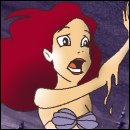
As happy as they were to give us the occasional nightmare, Disney's favorite way to misshape our world view was to coat classic stories in a suffocating saccharine wrapper, damning us all to a lifetime of naivety.
But all you have to do is look at these (very real) original endings to tales Disney sanitized to be thankful for their protection, and baffled that they chose to adapt such horrifying stories to begin with ...
The Jungle Book: Everybody Dies
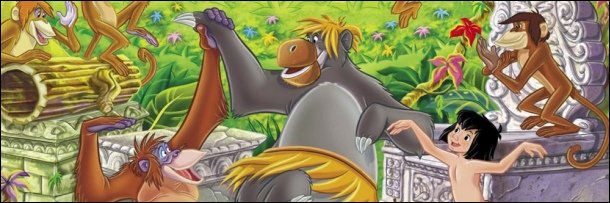
The Disney Happy Ending:
The film follows Mowgli, a baby who winds up in the jungle and is befriended by talking predators. After avoiding the human world for years and spending most of his childhood being awesome in the jungle, Mowgli stumbles upon a village and is instantly smitten with some doe-eyed floozy. The girl bats an eyelash and Mowgli disappears into the village forever, living happily ever after with his own people and leaving Baloo the Bear and Bagheera the Panther in the dust. Roll credits!
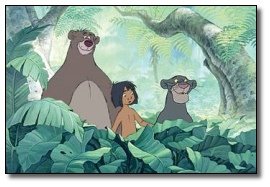
"Y'know, in hindsight we probably should've just eaten him."
The Original Ending:
The original "Jungle Book" was a short-story by Rudyard Kipling, a man with surprisingly little tolerance for anything resembling Disney bullshit.
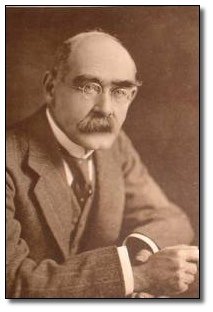
His mustache would not allow it.
In Kipling's version, when Mowgli decides to return to polite society, polite society isn't so certain it wants him back. The village Mowgli tries to return to in the short story re-banishes him to the wilderness, and the family that was kind enough to take him in gets tortured as sorcerers.
In response, Mowgli recruits Hathi the Elephant for help. But the thing is, the book's Hathi isn't the cuddly, forgetful old Major of the film.
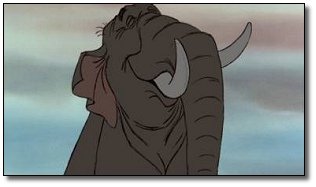
No, he's a bloodthirsty, scarred old elephant who likes nothing more than seeking revenge on humans for an old wound he received in a spike pit. The "help" Mowgli gets from his old friend is in destroying the entire goddamned village. That's right. The lovable kid protagonist whose goofy antics you grew up laughing at recruits his elephant friend to, along with Bagheera and a bunch of wolves, storm in and raze the freaking village to the ground.
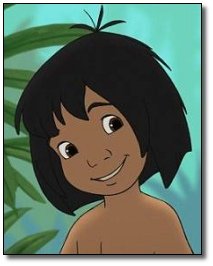
"LEAVE NONE ALIVE!"
All the houses get stomped into dust, supplies are destroyed, the wolves chase away the cattle and good old Bagheera kills the horses. Damn, we're thinking this franchise is due for a gritty reboot.
The Little Mermaid: Blood, Heartbreak, Death
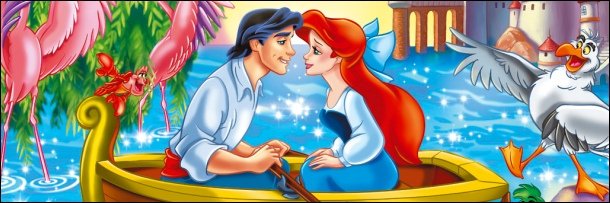
The Disney Happy Ending:
After an entire movie of trying to turn from a mermaid into a human girl so she can marry a prince, things aren't looking good for Ariel. Due to cunning contractual stipulations, the evil witch Ursula winds up with Ariel and Triton's magical crown and trident.
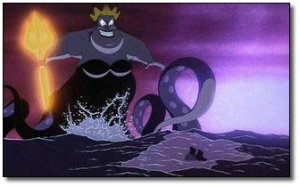
Really, she has all the ingredients for a prog-metal album cover.
Springing into action for the first time in the entire movie, Prince Eric drives a ship's broken bow right into her stomach, like that time we attempted to use chopsticks at a sushi bar. The day is saved, the crown is restored and Ariel gets to marry her prince as the unicorn of happiness explodes into gooey rainbows.
The Original Ending:
After having her tail split in two by the evil sea witch's potion, the mermaid goes upon land and proceeds to bleed absolutely everywhere.
The prince, finding this delightfully amusing, commands her to dance for him while she grins and bears the excruciating pain.
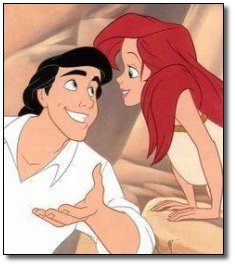
"And maybe later I can choke you while we have sex!"
Afterward, the mermaid finds out that the Prince is to marry another woman, and that if he does so she will dissolve into sea foam, but all can be saved if she can somehow persuade the Prince that she was the one who saved him from drowning. But she doesn't, and he gets married anyway. The sea witch tells the mermaid that in order for her to survive, she must kill him.
Instead of descending upon his sleeping body with an X-Acto knife, she instead chooses to believe in the power of love.
Unfortunately, this does the complete opposite of "work," and the mermaid dissolves. And since mermaids don't have souls (at least according to Hans Christian Andersen), she has to do 300 years of good deeds in order to earn one, only every time a child cries, she has to do an extra day for each teardrop.
Damn, Old Yeller probably tacked on about 500,000 years alone
Pinocchio: Chewed Up by Dozens of Ravenous Fish
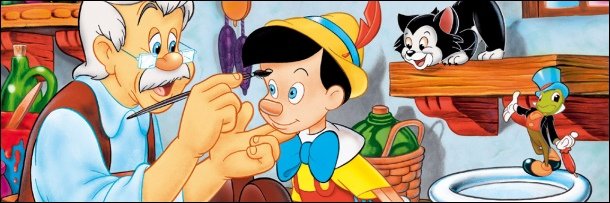
The Disney Happy Ending:
Pinocchio is a tale about the humanity of a little wooden puppet as he is led through the trials and pitfalls of growing up. He learns many important moral lessons along the way.
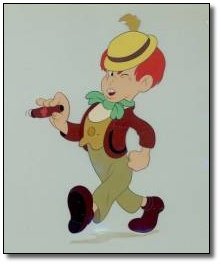
Such as how to deal with assholes like Lampwick.
After experiencing wage slavery, peer pressure, gambling, alcohol and donkey transformation, he gets swallowed by a whale, presumably representing teenage pregnancy. He rescues his father from the whale but dies in the process, prompting the Blue Fairy to resurrect him as a real boy before she moves on to Haley Joel Osment in Spielberg's A.I.
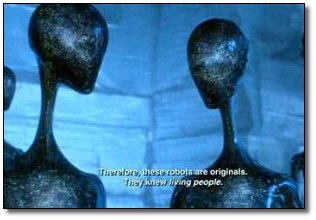
Along with some aliens. Because in case you forgot, A.I. was stupid.
The Original Ending:
After Pinocchio is turned into a donkey, he gets bought by a musician who wants a new drum head made out of donkey skin and tosses Pinocchio into the sea to drown him, presumably because there were no knives or heavy rocks available at the time. Fortunately, Pinocchio is saved by a school of fish that proceed to devour his flesh, reducing him to wooden bones.
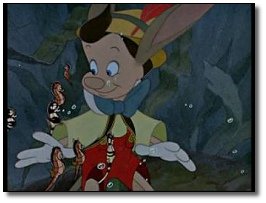
In five seconds this is going to get bloodier than a GWAR concert.
Not only that, but in the Disney film, Gepetto is rescued from the whale in a relatively snappy time frame. In the original story, Gepetto is eaten by a shark and lives there for two years before Pinocchio finally gets off his splintery ass and does something about it.
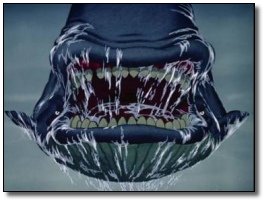
On second thought, we're with Pinocchio on this one.
The Fox and the Hound: Everybody Dies (Again)
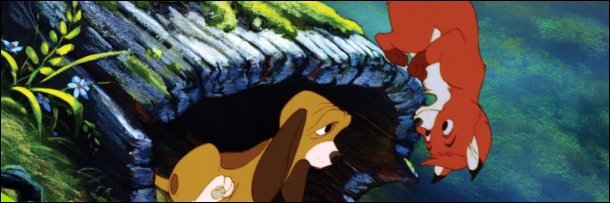
The Disney Happy Ending:
Despite it being a story of unlikely friendships and insurmountable obstacles, Disney nevertheless finds room in The Fox and the Hound for a happy ending and a kickass bear fighting sequence.
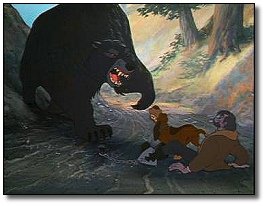
The scene ends with Copper the Hound protecting his childhood friend Todd the Fox from his master, achieving a mutual respect and understanding between species. Todd settles down with a vixen and Copper goes on with his life as a working dog, presumably ripping apart foxes he didn't grow up with.
And eating cat poop from the litter box.
The Original Ending:
Daniel P. Mannix, the author of the original story, probably hadn't met a child before writing The Fox and the Hound. In his version, the Hound is a bloodthirsty killer out for revenge against the Fox for the accidental death of another hound on a previous hunt. Once he discovers the Fox's lair, his master proceeds to gas the hell out of it, killing both the vixen and her cubs. At this point, the author obviously didn't think the book was depressing enough, so he threw some rabies into the mix, and then a child dies from an infected bite.
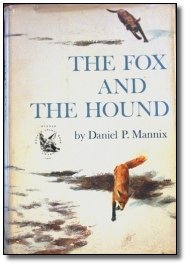
Not the obvious choice for a children's film.
The story reaches its climax with a chase longer than the one in The Matrix Reloaded in which Todd the Fox collapses and dies of exhaustion. The Hound and the Master go home to celebrate, a term which here means "the master shoots the hound in the face and then gets sent to a rest home."
And they all lived happily ever after.
Hercules: Murders His Children
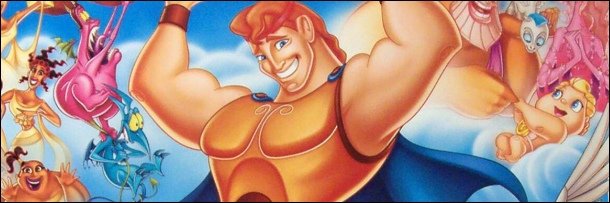
The Disney Happy Ending:
In the Disney version we have our hero Hercules versus Hades, who tries to take out Hercules by sending Meg, a woman whose job it is to find Hercules' weakness. As she is a moderately attractive 18- to 25-year-old woman, she falls in love with him instead as required by Disney law.
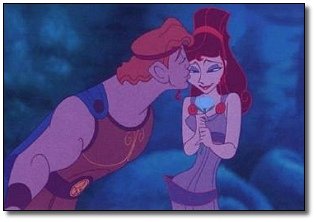
Since his first plan failed so miserably, Hades gets Hercules to give up his powers in exchange for Meg's safety, which seems like a reasonable trade until you remember that Hades is like Satan with more gold trim, so he predictably goes back on his word.
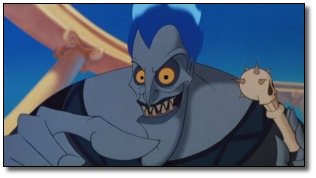
He seemed like a decent guy.
As Hercules is fighting a Cyclops, Meg pushes him out of the way of a falling column and is killed, which restores Hercules' powers just in time for him to save the world and bring her back to life.
The Original Ending:
First of all, the Greeks depicted Hercules as a rampant sexual beast, taking whatever woman he liked before hitting a mid life crisis and being told to settle down. He got married to Megara, but without the help of Hades, a Cyclops or a Motown-inspired soundtrack. They do live happily ever after, right up until he gets driven insane by the goddess Hera and heroically murders the shit out of Megara and all his children.
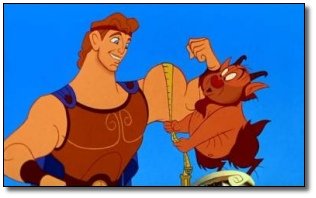
"Do you see this arm? They didn't stand a goddamn chance."
After regaining his senses, Heracles is consumed by guilt, which is understandable after killing your entire family for absolutely no reason. To try and make amends, he engages in 12 trials that include defeating powerful monsters and shoveling shit out of some horse stables, until he eventually gets killed by a blanket. Maybe they're saving all of that for one of those direct-to-DVD sequels they do.
Tarzan: Doesn't Get the Girl, Everyone is Miserable
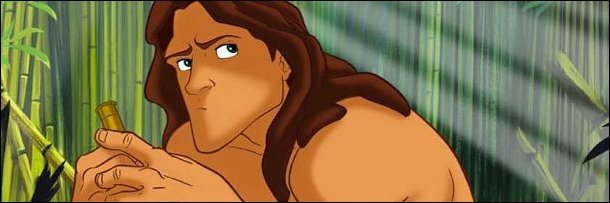
The Disney Happy Ending:
The evil Clayton, out for some good old fashioned monkey-snatching, locks up Tarzan and Jane on his ship. But Tantor the Elephant crashes through and rescues them, both from Clayton and from the fact that a five-ton animal probably couldn't safely trample all over the deck of a rickety 19th century boat.
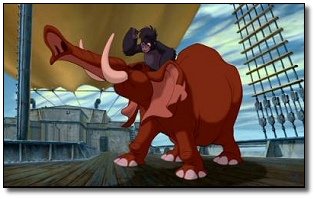
We can spot at least three glaring inaccuracies in this picture.
Tarzan rushes to the aid of the gorillas and vanquishes Clayton in the most disturbing fashion since,well, since the last Disney animated feature actually.
In the end, the prim and proper English girl Jane is on her way back to Victorian Britain when she has a change of heart and dives into the ocean. She reunites with Tarzan where we can safely assume she feeds him tea, makes him wear an ascot and claims the island under the Queen's rule. Chalk another one up for the Empire.
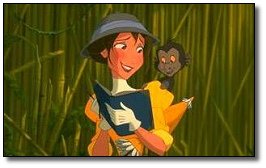
"And here's the part where we annex India for 200 years!"
The Original Ending:
Jane is surrounded by plenty of potential suitors (including Clayton himself) who aren't hulking ape men, yet she still falls for Tarzan. Before she can admit it to herself, though, she leaves for America and considers marrying another man to pay off her father's debts.
Meanwhile, Tarzan suits up and follows her across an entire continent to rescue her from a forest fire that was presumably waiting around until the plot required it. Afterwards, he confesses his undying love for her, and Jane admits she feels the same way. But by this time she's engaged to Clayton, and because this is the 19th century there is absolutely nothing she can do about it.
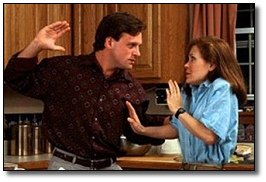
Left on his own, Tarzan receives a telegram that reveals him as the rightful heir to Clayton's estate and all the property that comes with it (which includes Jane, because women are things). Instead of saying the word, kicking Clayton out of his own house and claiming Jane for tax purposes, he chooses to stay silent, thinking that Jane is happy being with Clayton. And... that's it. He simply sacrifices his happiness for Jane's misery.
The Hunchback of Notre Dame: Necrophilia
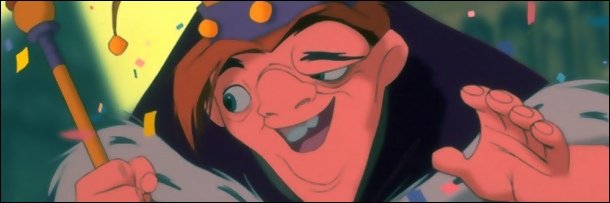
The Disney Happy Ending:
Children learn an important lesson in the actions of the celibate antagonist, Frollo: If you are sexually frustrated by a wayward gypsy, just set her on fire and everything will work itself out.
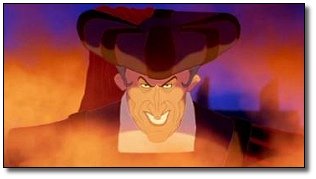
There's no way he doesn't have a boner right now.
Meanwhile, Quasimodo the hunchback watches from his bell tower, held back by chains but also by his crippling lack of self worth.
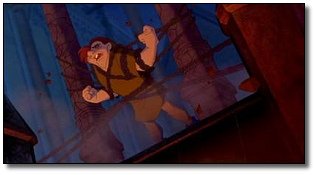
He busts free and rescues Esmeralda while Phoebus, the nearest Aryan man, starts smashing shit up and generally being the hero that all the pretty ladies will swoon for. The evil Frollo is cast into the flames that somehow always appear at the end of Disney films to consume the bad guys and Quasimodo gives Esmeralda to Phoebus, teaching us that a good heart and noble deeds don't mean shit if you're uglier than the inside of a hotdog. He is raised aloft by the crowd and carried through the streets in celebration.
The Original Ending:
Like Kipling, Victor Hugo wasn't big on that Hollywood bullshit.
In the original, Esmeralda has three potential suitors waiting to bump uglies, while Quasimodo is just some deaf, ugly retard watching her from his tower. She makes it very obvious to our hero that she finds him a hideous mess but he's smitten. One of the suitors, Phoebus, shows up and has his way with her. He then gets stabbed in the back by Frollo, who pins the attack on Esmeralda.
Instead of setting her on fire, Frollo arranges to have her hung in the public square. Then at the last minute she is rescued by...
...Nobody. She just dies.
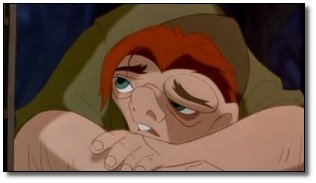
After her death, Quasimodo tosses Frollo off the top of the goddamn cathedral before he sneaks into Esmeralda's grave and curls around her body. He lays there like that until he eventually dies of starvation.
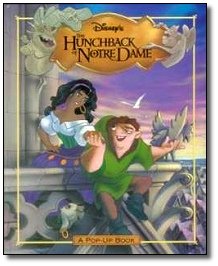
Romance!
Do you have an idea in mind that would make a great article? Then sign up for our writers workshop! Know way too much about a random topic? Create a topic page and you could be on the front page of Cracked.com tomorrow!
For more reasons to distrust Disney, check out 6 True Stories About Disneyland They Don't Want You to Know and The 9 Most Racist Disney Characters.
And stop by our Top Picks (Updated 06.21.10) to see what Walt Disney's secret porn stash.
And don't forget to follow us on Facebook and Twitter to get sexy, sexy jokes sent straight to your news feed.
