6 Famous Explorers Who Shaped The World (With Insane Lies)
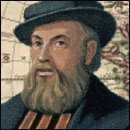
If you take a list of history's greatest explorers, and hold it up to a list of history's greatest bullshitters, you quickly find out they're the same list.
That's right; guys like Magellan and Marco Polo opened up new frontiers of human exploration and when they returned, told stories that were laugh-out-loud ridiculous. Why? Just for the hell of it, apparently.
Ferdinand Magellan Names an Entire Country After Giants

Who?
Ever hear of a little thing called the world? Yeah, Magellan discovered that. Well, maybe that's a slight exaggeration but between 1519 and 1522, Ferdinand Magellan did lead the first successful expedition to sail around the damn thing.

This damn thing.
We use the term "successful" loosely, since he didn't exactly "survive" it, but he was still pretty close. And since history books are like horseshoes and hand grenades in that "close enough" usually counts (we're looking at you Thomas Edison), Magellan gets full credit. He not only found a route to the East, he also took invaluable surveys of his route, documenting things like the Strait of Magellan and the Magellanic Penguin. He, uh... he really took advantage of that whole "if you're the first to see it, then you get to name it" thing didn't he?

Please Magellanites, throw down your Magellan sticks and get off of Magellan Beach!
So What Did He Lie About?
Giants. A race of giants.
While traveling around the southern tip of South America, Magellan and his men claimed that they came across "a naked man of giant stature" who was "so tall that we reached only to his waist."

He was also FABULOUS!!
Not only was the alleged native freakishly tall, he was also "dancing, singing, and throwing dust on his head," which is probably a 16th century euphemism for "acting totally stupid." So Magellan and company recorded meeting the world's first tribe of gargantuan naked ravers and, because the world was a "simpler" place back then, everyone just took his word that enormous dirt-heads populated the tip of South America. And they continued to take his word for 200 years. It gets better when you find out that Magellan dubbed this fictional race of huge idiots the Patagons, a name that stuck for the entire area for quite some time. As in, to this very fucking day.

Patagonia: It's like a whole country of Karl Malones.
What really gets our goat is that Magellan probably did meet a tribe of natives on the tip of South America, but they already had a name. They were the Tehuelche tribe and they probably averaged a towering 5'11. That was slightly tall by European standards of the day, but by no means giant. However, when you came back from traversing the great unknown, and all you have to regale the court with are your tales of people who were "kind of tall" and "didn't have an exceptional amount of dirt on their heads," you're going to lose your audience pretty fast.

Francisco de Orellana Invents Female Amazon Warriors

Who?
The Amazon River is the largest river in the world. It was once surrounded by a rainforest full of hostile natives, not to mention some of the most horrifying creatures ever designed by the twisted hand of a mad God. So surely the first person to navigate the entire river was some sort of big-cajoned Adonis, right?

Oh! That actually wasn't disappointing! All right then!
This grizzled motherfucker right here is Fransisco de Orellana. Charged with exploring the Coca River, Orellana and his men decided, much like The Grateful Dead, to just keep on truckin' even when the Coca ran out. As a result of their audacity, they navigated the Amazon River in two months.
So What Did He Lie About?
His violent encounters with characters from Greek mythology.
In ancient Greek stories, the Amazons were an entirely female nation of warriors who disposed of male children and cut off their right breasts in order to shoot bows and spears better. So how did a river on the other side of the planet get named after Mediterranean femi-Nazis? Simple. Francisco de Orellana fought some dudes with long-hair on his voyage.

Not large, one breasted women. Not even a tribe composed entirely of women. Likely not even a single woman, actually. The warriors that he mistook as savage tribes of mythological female warriors were most probably Icamiabas, a tribe of South American natives who didn't take kindly to white guys establishing a Spanish colonial presence on their river. Which wasn't, obviously, called the Amazon at that point. Orellana named it that later, because he was the kind of guy you didn't fuck with. Because if you did, he'd convince the entire world that your band of fierce, macho warriors were just angry Greek lesbians.

"I'm sorry, did you say something? I can name this river Fagtonia if you want. Yeah? Thought not."
Sir Walter Raleigh Makes All of Europe Believe That South Americans Don't Have Heads

Who?
Are you from America? Do you speak English? If so, you have Sir Walter Raleigh to thank.

English, motherfucker! Doth thou speaketh it?
In 1584, Sir Walter Raleigh decided that it was England's turn to get a piece of the Americas. He was given permission to establish the colony of Roanoke, the first English settlement in the New World. Despite being a hilarious failure, America may have been completely taken over by the Spanish or French without it.

Oh dear God, no!
So What Did He Lie About?
A race of freakshow monstrosities, and a city made entirely out of gold.
Once he was done adventurin' in the Colonies, Raleigh wandered down to Orellena's River of Fancyboys, the Amazon. Rolling with the joke, he confirmed de Orellana's fantasy that the forest was populated by one-breasted man-haters, then straight made up his own creatures to get the folks at home super excited about the strange and magical place he hoped to get lots of funding to visit over and over again.
The people he reported finding there were equal parts Marvel Comics' Modok and Clive Barker's Cenobites; he called them the Ewaipanoma and described them as having "eyes in their shoulders, and their mouths in the middle of their breasts, and that a long train of hair groweth backward between their shoulders."

And lo, did they loveth BDSM as much as they hateth Captain America.
To compare:

An example of a modern South American. Notice the existence of a head and absence of horror.
On top of headless, chest-faced Humpty Dumpty looking aberrations, Raleigh's account of his expedition was riddled with El Dorado references. As in, "he was totally there and saw it" kind of references. As in, the kind that might just send royalty into a voyage-funding greed-frenzy.
John Smith Pulls The Legend of Pocahontas Completely Out of His Ass

Who?
In the 17th century, John Smith was eager to make a (less generic) name for himself, so he decided to go to America and colonize in England's name. Unlike Raleigh, however, Smith was actually successful in creating a permanent settlement in the Americas: Jamestown. It wasn't easy, though. Four-hundred and thirty-nine of the original 500 settlers died. And even as more settlers came in, they just kept dying.

Welcome to Jamestown.
That's where our hero comes in with all of his heroic heroism: By courageously working with the savage natives who begrudgingly respected his noble spirit, he single-handedly turned life around and helped Jamestown lose their reputation as the settlement where everybody went to die.

Like Florida is now.
So What Did He Lie About?
Basically everything.
His most well-known story is that of Pocahontas. According to Smith, he was kidnapped by hostile natives who were preparing to kill him when, at the last (and most dramatic) moment, the chief's daughter, Pocahontas, threw herself in front of Smith at her own peril, saving his life. She was also a super-model. She goes to a different colony, though; you wouldn't know her.

As we're sure you've inferred by now, historians call it a bunch of hogwash. It also doesn't help his case any that he didn't actually write the tale in detail until about 20 years later, after Pocahontas (the only person who could corroborate) was dead.
But Smith established himself as a crackerjack liar well before he even got to the New World, with a story that's just as disputed and 100 times more ludicrously badass. Before he was a colonizer, Smith was a womanizer. Also, a full on pirate. During his "adventures," he claimed he was captured by some Turks, where he immediately did what we'd all do: behead three of them. Also, a Transylvanian prince rewarded him for their severed noggins with the title of "English Gentleman" (because Transylvanian princes totally had that kind of influence over England).

Oh, and then Smith was sold into slavery! Oh no! But he for reals ex-scaped by like, totally seducing his lady master, and then, and then he like, he fought and killed her brother (probably with like, this sweet jumpkick!) and escaped! God he's so cool! The only reason he didn't go to prom (a bunch of girls asked him) is because he was under arrest for illegal motorcycle racing (which he won).

Calvin Klein asked him to be an underwear model but they didn't have ones with a big enough package flap, so he said no.
Marco Polo Lies About Pretty Much Everything

Marco Polo was a 13th century merchant and explorer who went to China where he invented and refined the popular swimming pool game. Also, some other things.

Mostly pool games, though.
In 1271, Marco, along with his father and uncle, went on a 24-year trip to China, Mongolia and the Middle East. Alone, this isn't that much of a feat (everyone kind of already knew China was there; especially the Chinese). The real accomplishment was his book, The Travels of Marco Polo, which was so wildly popular that over 150 copies still exist today.
So What Did He Lie About?
All of it. Maybe.
As it turns out, much like John Smith, Polo's description of his travels may have been just a little too awesome. According to his book, he did a lot of really cool stuff like play the hero in an important battle, become a personal emissary for Kublai Kahn, and even govern a large Chinese city.
And all this stuff was generally accepted, until historians started thinking about it. At all. So when they decided to verify his claims and began looking at the Chinese records, they realized that his story had more holes in it than a teenage girl trying to get her parents to notice her.

"I want one right through my eyeball!"
Hey, you know what? Chinese people, being one of the most advanced societies on Earth at the time, actually wrote stuff down! As it turns out, Polo places himself in a battle that ended one or two years before he got there . He also claimed he was the governor of Yang-Chou for three whole years, so surely somebody recorded his name--even once--on a payroll or a check or a diary or... no? Nothing? Not one single record of Marco Polo in Yang-Chou, or in China, period?

Marco Who?
In fact, when experts began considering all the utterly Chinese things that Polo didn't mention, like calligraphy, tea, the printing press and the Great fucking Wall, it started to look like Marco Polo never even went to China at all. He's probably just a guy who heard a lot of stories about the place and put them into a book. Then made himself the main character, a hero, a ruler and a badass, stopping just short of dutifully recording the time he single-handedly beat back the Mongol hordes with his giant, giant dong.
John Mandeville Inspires The Greatest Discoveries On Earth...With Lies

Who?
If you lived in the 14th century, you would know who John Mandeville was: For about 35 years Mandeville traveled around Northern Africa and Eastern Europe, but like Polo, Mandeville didn't actually claim to discover anything. His world-altering contribution is also the book that he wrote. And that book was insanely influential.

To the left, to the left...
There wasn't exactly a New York Times bestseller list back then (or even a paltry Amazon ranking), but if surviving copies are any indication of original production, he was much more popular than Marco Polo. His book still has over twice the amount of surviving copies than Marco Polo's, and it was so respected that even Leonardo Da Vinci studied it, and it's thought to have been the central inspiration for Christopher Columbus' entire career.
So What Did He Lie About?
All of it. Definitely.
Everything in The Travels of John Mandeville was a lie. But they weren't just low-key sexy Indian Princess lies. No, his fabrications were so multitudinous and hilariously stupid that some less dedicated, lazy hack could have filled this article with them alone.

It's running next week.
So let's start with the MOUTHLESS PYGMIES, shall we? According to Mandeville, there was an island in the Indian Ocean populated exclusively by tiny people who had tiny holes in their tiny heads where their tiny mouths should have been. So they had to suck all of their meals through straws (and we are not going to make a pygmy blowjob joke here; we're better than that). Another tribe had mouths, but they didn't use them for eating, because all they needed nutrition-wise was the smell of wild apples. Not the apples themselves, mind you, just the smell. Without that smell, they would immediately die. Talk about having a weakness: Their kryptonite was not having apples in their faces at all times.

Finally, someone we can take in a fight!
Mandeville's lies didn't just make him popular, they changed the course of human history. According to some historians, he was literally the driving force for Columbus to undertake his own Voyage of Untruths to the New World. But that's nothing! Mandeville's biggest lie of all... was that he actually existed. Because he didn't! The book was likely nothing more than stories compiled by some guy, who just needed a main character. How's that for a twist?

He himself was a lie! And he was a killer plant! And he was allergic to water!
And it wasn't the 14th century; it was 1986! And I suck!
Want to write articles like this for Cracked, get internet famous and make cold, hard cash? Go here and say you want in. No experience necessary, but you must awesome.
For more ridiculous untruths that people believed, check out The 5 Ballsiest Lies Ever Passed off as Journalism. Or discover the truth behind some crazy stuff you thought was just make believe, in 6 Ridiculous Sex Myths (That Are Actually True).
And stop by our Top Picks (Updated 3.10.2010) to who really discovered the Internet (turns out it's not the hobo we let into the office yesterday).
And don't forget to follow us on Facebook and Twitter to get dick jokes sent straight to your news feed.
