The 7 Most Powerful Wizards (Too Lazy to Use Their Powers)
Wizards have been an essential element of fantasy movies since the dawn of the cinema. Essentially, you can't hope to have a universe of dragons, trolls and adventurous men with names like "Numedor" without including a powerful wizard who is there to lend a magical hand when the going gets tough.
Unfortunately, not every wizard in film history has stepped up, and some seem to flat-out prefer cashing in their wizard pensions and spending the rest of their 2,000-year lifespan as the door greeter at Walmart than perform their expected duties.
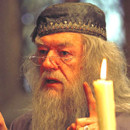
Albus Dumbledore (the Harry Potter series)

Dumbledore is the headmaster at Hogwarts School of Witchcraft and Wizardry, and basically the most powerful damned wizard in the Harry Potter universe. He's a kindly old man, which is a good thing because he can turn invisible, create objects out of thin air, read minds, shoot fire, whatever. He's pretty much a god.
Unfortunately, most of the time he gives kind of boring speeches and makes a teenage boy do everything that he, being nearly all-powerful, should probably be doing instead.
The case against him: Fans of the Harry Potter series have uttered the phrase "Where the crap is Dumbledore during all of this?" more than once. He's usually away on business when Harry and his friends are in imminent danger of attack, and the three of them are usually left to either figure out difficult riddles or single-handedly fight humongous snakes, a giant troll, an army of gigantic spiders--pretty much every horror imaginable. And when he says he's away on business, you know he's probably just hanging out in his apartment in his wizard underpants watching the wizarding equivalent of Frasier reruns.
Consider Prisoner of Azkaban, where in order to save a friend he casually advises Hermione to use a "Time Turner" device, which lets you effortlessly go back in time and change any thing you want.
Wait, what? Why didn't he go back in time and deal with it? Or better yet prevent all those things from happening with his wizard powers? Why not go back and prevent the birth of the wizard Antichrist, Voldemort? And in the 6th book, he actually dies. The man can travel through time, but he couldn't prevent his own freaking death?
Skeletor (Masters of the Universe)
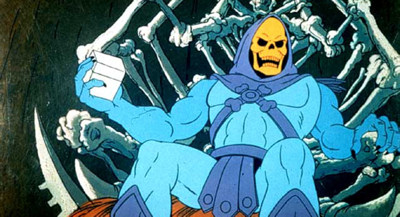
Skeletor is He-Man's main nemesis in the Masters of the Universe TV show, comics and films. Essentially a nude, muscular Smurf with a yellow skull for a head, Skeletor is a highly-skilled sorcerer who wields one half of the "Power Sword." He-Man has the other half, and whoever unites the two will become, dare we say, the Master of the Universe.
The case against him: If you're into nude men who like to ride around on giant cats then your entertainment options were pretty much limited to He-Man and the Masters of the Universe. As a fan you know that Skeletor was possibly the baddest guy on this or any other planet.
He was blue, wore nothing but some legwarmers, a mini-skirt and a pair of suspenders, and had an entire mysterious magical arsenal at his command. He could fire lasers out of his eyes, teleport and shoot lightning out of his hands. But most convenient of all, was that he possessed the power of 'remote viewing' which enabled him to sit around in Snake Mountain and cackle at a vision of He-Man and his fellow semi-nude male friends, remarking to henchman Beast Man how He-Man was 'about to fall into' a devious trap he'd set (devious in this case meaning "easily escapable").

Unfortunately, most of the time He-Man escapes from Skeletor's snares by either tricking him or overpowering him. Often the two would wind up dueling with their Power Swords, and He-Man would usually win by cutting a rope that would cause a chandelier to land on Skeletor, binding his arms as he hopped up and down, cursing He-Man and vowing revenge.
Why Skeletor during these encounters would not rely on his eyeball lasers or finger lightning is not known. Skeletor also demonstrated, on several occasions, an ability to teleport himself as well as other people across great distances.
The fact that He-Man does not find himself whisked away to Bismarck, North Dakota every time he engages Skeletor is a question for the ages, or at the very least the screenwriters.
Profion (Dungeons and Dragons)

The case against him: As far as evil wizards go, Profion is about as evil as they come. You can tell he's evil because he laughs at his own jokes a lot and hams up every scene he's in. Since he was portrayed by Academy Award-winning actor Jeremy Irons, you'd think there would be some semblance of craft going on, and you would be wrong.
Anyway, Profion seems to be the most knowledgeable wizard in all the land--the only real competition we notice in the movie is in the form of a highly inexperienced apprentice wizard named Marina, who throughout the film relies almost entirely on Marlon Wayans and some other guy to rescue her. Magically speaking, Profion could pretty much have his way with everyone in the entire D&D universe and there isn't a damn thing anyone could really do about it.
Instead, Profion spends the entire movie laughing at something he just said and looking out from his tower of doom at the destruction he has wrought while, again, cackling wildly at what a hoot the whole thing is to him. He also refuses to do any actual work and sends his lackey, Damodar, to chase the good guys, as if standing around and chewing all the scenery is a full-time job.
Merlin (Merlin's Shop of Mystical Wonders)

Merlin has returned after centuries of absence to open up a shop in modern day America, circa 1984. With his bulky wife, Zurella, Merlin gives away or loses a number of magical artifacts which wreak havoc ranging from summoning Satan to causing plants to die.
The case against him: As legend has it, Merlin is one of the greatest and most powerful wizards who has ever lived. Part human, part demon, he is a being of supreme skill and wisdom. Various writings have shown Merlin to have the power of prophecy, telepathy, necromancy, the ability to conjure realistic and terrifying illusions, and even an Obi Wan Kenobi-like "force ghost" power to revisit the living after death.
For being the keeper of all magical knowledge in the world and for supposedly being all-seeing and all-knowing, the Merlin in the '90s made-for-TV Merlin's Shop of Mystical Wonders would seem not up to the task of working the graveyard shift at a 7-11, much less raising the dead.
Lacking a basic knowledge of economics, Merlin gives away items in his store free of charge to anyone who decides to stop in, and he relies exclusively on a puppet, uh, we mean dragon, named Gwendelin for his security system. When a street hoodlum foils Gwendelin and makes off with an evil toy monkey, Merlin recovers the item not via a location triangulation spell but by handing out 'have you seen me?' flyers bearing the monkey's picture. Why not summon the monkey back using his powers of teleportation? Why not travel back in time and beef up his store's security? Why not rain hellfire down upon the earth, destroying the monkey and most of the planet's inhabitants? Unfortunately, we may never know.
Gargamel (The Smurfs)

Gargamel is a hermit "wizard" who is the Smurfs' main antagonist. At various times he either wants to capture the Smurfs and use them as part of a potion that creates gold, or he wants to eat them. The Smurfs are a versatile resource for Gargamel.
The case against him: If successful wizarding were baseball, Gargamel would be the White Sox. His only goal in life is to capture the Smurfs and since all Smurfs are roughly the size of squirrels and subsist almost entirely on a diet of Smurfberries, one would conclude that a basic knowledge of mousetraps would do the trick.
Instead, Gargamel, with the entire arsenal of potions from the wizarding world at his disposal, launches infuriatingly complicated Rube Goldbergian magical schemes, and completely fails every single time.
Being outsmarted by a Smurf is like being outsmarted by one of your shoes. The Smurfs each fulfill a specific function in their little communist utopia, such as being bashful, vain or gay. Take them out of that element and they have no idea how to cope outside of screaming their blue heads off to get Papa Smurf to rescue them. The fact that Papa Smurf usually does rescue them by using his own magical powers means that Papa Smurf is actually a far greater wizard than Gargamel. By extension this probably also means that one of your shoes is likely a far greater wizard than Gargamel.
Ulrich of Craggenmoor (Dragonslayer)

In this 1981 cult classic, Ulrich of Craggenmoor is the only wizard left in the world, or at least the world known as the Kingdom of Urland in which the film takes place. He is almost immediately killed while showing off for a knight named Tyrian.
The case against him: You might think it's a little unfair to pick on a wizard who dies right at the beginning of his film, and we'd have to agree with you in most cases except this one. When Ulrich dies, no one remains to defeat the evil dragon, Valerian, except Ulrich's doofy apprentice, Galen Bradwarden. The entire movie passes by before you find out Ulrich died on purpose so Galen could bring him back to life at the end, thus saving Ulrich from an entire movie's worth of walking around.
That's right--he'd rather die than exert himself a little. Here we're not even discussing wizarding powers-Ulrich is simply an extremely lazy human being. As a wizard, you'd think there would be an easier means other than causing one's own death to span distances or time. Cryogenic freezing would be one. Carbonite would be another. As would turning one's self into some kind of winged creature and gliding to wherever it is you're going.
Any decent wizard should have any number of these options at his fingertips, and by all accounts Ulrich was a more-than-decent wizard. Then again, if part of Ulrich's decision to die was to get out of having to hang out with that dumbass Galen for the entire movie, we have an entirely new respect for him.
Gandalf (The Lord of the Rings)

Gandalf is a wizened old wizard beloved by Hobbits and various other things in part due to his curmudgeonly nature and propensity for smoking weed while lighting off trippy fireworks. In the films, he has a working knowledge of Middle Earth geography, has a number of decent contacts amongst the ruling parties of the land and is there with his glowing staff whenever anyone needs a flashlight.
The case against him: In the books, Gandalf is a being of extraordinary magical prowess. Immortality, for starters. He also happens to be able to disappear at will, is apparently impervious to injury, can conjure and control fire, has limitless knowledge of spells, potions, and sorcery, and is all but unequaled in the wizard world.
In the films, though, we primarily see his ability to speak ominously when any Hobbit gives him any lip, and for being able to produce light from the end of his decorative stick. Without warning, he'll flash real ability, such as when he went toe-to-toe with the massive fiery Balrog (complete with a cool-ass invincibility bubble that would have come in handy on about 200 other occasions).
That he chooses to use those skills so rarely with all of Middle Earth at stake must have been incredibly frustrating for the people who had to work with him. If he can defeat a Balrog, why does he spend 12 hours sitting around trying to figure out the password to the Gates of Moria? Why not just blow them up with a silent rock-exploding spell? Why is a super-powered wizard with unlimited magical ability doing fighting orcs hand-to-hand?
This is like melting ants with a magnifying glass when you have access to an M1 Abrams tank. The same guy who can make magical force fields that will block a giant demon sword in the first film, goes charging into battle in the third by smacking people with his staff.
Gandalf's laziness as a wizard is cemented by his perpetual spankings at the hand of Saruman, who one-ups Gandalf time and again.

Gandalf shoves Saruman with his stick, Saruman then makes Gandalf spin wildly on his head and then levitates thousands of feet to the top of Isengard Tower. Gandalf speaks to butterflies, Saruman creates a new race of super-monsters. Gandalf makes fireworks, Saruman creates an avalanche from hundreds of miles away.
It kind of makes it hard to root for Gandalf to be top wizard in Middle Earth. Saruman sort of earned it.
If you'd like to read us bitch and moan about other movie conventions that probably didn't bother you until now, check out our rundown of The 6 Movie Formulas That Must be Stopped. Then, read about one movie in particular that's pissing Wayne Gladstone off (It should be noted at this point that Wayne gets pissed off about celebrity nanny hiring criteria and Spice Girls reunion tours, so he might just be an angry man)
.