80 Moments That Make Steve Martin An Absolute Legend
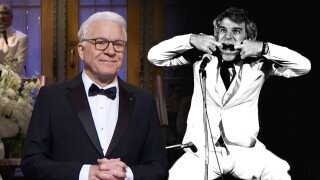
Whenever Steve Martin is asked for advice on how to make it in show business, his answer is always the same: “Be so good they can’t ignore you.”
Decade after decade, in medium after medium, Martin has climbed to the top. He began as a stand-up whose groundbreaking, deconstructionist humor made him the biggest comic of his day. Then he conquered film with movies like The Jerk and Planes, Trains and Automobiles. He’s also been no slouch on TV with his hit show Only Murders in the Building and as arguably the best SNL host of all time.
In recognition of his 80th birthday, we decided to single out 80 peak moments from his storied career — all of which are so good they can’t possibly be ignored.
When He Won the Dating Game (1968)
On its own, being a winning contestant on The Dating Game isn’t worthy of “legendary” status, but it’s pretty cool to see a dark-haired Martin winning a date on his first TV appearance.
The Time His First TV Job Scored Him An Emmy (1969)
Martin’s first professional job in show business was as a writer on The Smothers Brothers Comedy Hour, for which he and the rest of the writing staff won an Emmy.
His Appearances on ‘The Smothers Brothers Comedy Hour’ (1968-1969)
The Smothers Brothers Comedy Hour also served as the first place on television where Martin could show off some of his many talents, like juggling and stand-up.
His First Appearance on ‘The Tonight Show with Johnny Carson’ (1972)
During it, he performed classic bits from his act like “The Incredible Shrinking Man.”
His Appearances on ‘Sonny & Cher’ (1971-1973)
He pulled double duty here, too — writing and performing on The Sonny & Cher Comedy Hour.
That Time He Performed Stand-Up for Dogs (1973)
In 1973, Martin returned to The Tonight Show to perform an act specifically aimed at dogs, even bringing a handful onstage to perform for them.
When He Played the Banjo on ‘The Tonight Show’ (1975)
Not just stand-up this time — he played banjo, too.
The First Time He Hosted ‘SNL’ (1976)
In addition to performing some of his stand-up material, Martin hosted the sketch “Jeopardy 1999!” which roasted stars of the 1970s. One of its best “answers” was “Comedian whose career fizzled after leaving NBC’s Sat-Nite” to the “question” of “Chevy Chase,” who was in the sketch and had announced his upcoming departure.
When His First Album Went Platinum (1977)
By 1977, Martin was the biggest stand-up on Earth — as evidenced by the album sales for Let’s Get Small.
When He Was a ‘Ramblin’ Man’ (1977)
One of the most memorable tracks from Let’s Get Small was the opening song, “Ramblin’ Man,” which he performed many times on-stage and on television.
When His First Album Created a Catchphrase (1977)
Martin’s iconic “Excuse Me” came from a track on Let’s Get Small.
When He Won His First Grammy (1978)
Let’s Get Small won for Best Comedy Album.
The Second Time He Hosted ‘SNL’ (1977)
Martin returned to SNL during the show’s second season. Among many memorable sketches, he played an IRS agent interviewing the Coneheads.
And the Wild and Crazy Third Time (1977)
Martin kicked off the third season of SNL when he hosted for a third time. It was in this episode that he and Dan Aykroyd first played the Czechoslovakian Fenstruck Brothers, better known as the “Wild and Crazy Guys,” who would party and try to pick up women. The characters became SNL icons.
When He Began His Film Career with An Academy Award-Nominated Short Film (1977)
The Absent-Minded Waiter, a seven-minute film written by and starring Martin, would go on to be nominated for an Oscar for Best Short Film and serve as a proof-of-concept for The Jerk, Martin’s breakout film.
When He Hosted ‘The Muppet Show’ (1977)
The premise of the episode was that Kermit canceled the show without notifying Martin and was auditioning new acts instead. As a result, Martin keeps getting up on the stage to perform his act.
When He Made Balloon Animals for The Muppets (1977)
Martin appeared many times on The Muppet Show, but one of his most memorable segments involved a purposefully terrible balloon animal act.
The Year He Hosted ‘SNL’ Three Times (1978)
Over these three stints, he played Theodoric of York, the Medieval barber and, of course, his half of the Fenstruck Brothers.
When He Became Egyptian Royalty (1978)
When Martin hosted SNL on April 22, 1978, he did his famously nonsensical King Tut dance.
When He Went Double Platinum (1978)
His second album, A Wild and Crazy Guy, sold even better than his first.
When He Won His Second Grammy (1979)
He got another Grammy for it, too.
When He Guest-Hosted ‘The Tonight Show’ (1977-1979)
He did so several times in the late 1970s, during which he interviewed other comedy legends like Andy Kaufman and Richard Pryor.
When He Asked ‘What the Hell Is That?’ (1979)
On October 13, 1979, Martin hosted Saturday Night Live for the seventh time. Among his memorable sketches was “What the Hell Is That?” with Bill Murray.
When He Cameoed in ‘The Muppet Movie’ (1979)
His part as a rude waiter to Miss Piggy and Kermit turned out to be one of the film’s most memorable celebrity appearances.
When His Third Album Went Gold (1979)
Yep, Comedy Is Not Pretty! sold an impressive number of records, too.
When He Proved Himself As A Film Star (1979)
He became a movie star thanks to The Jerk.
The Way He Opened ‘The Jerk’ (1979)
The opening of The Jerk is iconic. As Martin’s Navin Johnson explains, “I was born a poor Black child.”
When He Said ‘He Hates These Cans!’ (1979)
The Jerk contains dozens of memorable moments, among them is the scene in which Navin works as a gas station attendant who gets shot at and mistakenly thinks the shooter is aiming for the gas cans.
When He Went Hitchhiking (1979)
Martin says his favorite joke in The Jerk is when Navin is hitchhiking and a trucker pulls up and asks, “St. Louis?” To which Navin replies, “No, Navin Johnson.”
When He Took a Big Risk With His Second Movie (1981)
Not wanting to get typecast, Martin’s sophomore feature film was a romance musical called Pennies from Heaven. It wasn’t successful upon release, but it retained a cult audience and proved that Martin is a capable dramatic actor and never one to play it safe.
When He Quit Stand-Up (1981)
Following the release of his fourth album, The Steve Martin Brothers, Martin retired from stand-up to focus exclusively on his film career. As he explained decades later, “My act was conceptual. Once the concept was stated, and everybody understood it, it was done. It was about coming to the end of the road. There was no way to live on in that persona.”
Winning His First Writers Guild Award (1981)
He won it for his television special All Commercials... A Steve Martin Special.
When He Continued to Challenge Himself With Movie Number Three (1982)
Dead Men Don’t Wear Plaid — a comedy/mystery that parodied noir films — marked his return to comedy, but was still a departure from The Jerk.
And His Fourth (1983)
The Man with Two Brains was a broad dark comedy directed by Carl Reiner, who also directed Dead Men Don’t Wear Plaid and The Jerk. It was another box-office flop for Martin, which jeopardized his film career at the time.
When His Film Career Bounced Back (1984)
After The Lonely Guy also flopped, his film career rebounded with All of Me, in which a dying woman’s soul ends up inhabiting Martin’s body.
The Time He Wrestled with Himself (1984)
Martin’s abilities as a physical comedian were obvious ever since his stand-up comedy days, but the physical comedy in All of Me, particularly the scenes in which he wrestles for control of his own body, are legendary.
When He Co-Created a Couple of ‘80s Sitcoms (1984, 1986)
Neither series lasted beyond one season, but Martin did help co-create The Domestic Life (with Martin Mull and Craig Kellem) and Leo & Liz in Beverly Hills (with Paul Perlove).
When He Starred in ‘Three Amigos!’ (1986)
You know this one by heart: Martin, Chevy Chase and Martin Short play silent film stars who end up being tasked with saving a Mexican village that’s being harassed by banditos.
That Salute (1986)
Maybe the most memorable thing about Three Amigos! is the trio’s crotch-thrusting salute.
When He Discovered Tequila (1986)
The reactions here are priceless.
When He Said, ‘Oh Great, Real Bullets!’ (1986)
The funniest scene in Three Amigos! is when they first meet the banditos and believe they’re only fellow performers. When Martin’s character, Lucky Day, is shot, he still hasn’t caught on and just criticizes the banditos for using real ammunition, chiding them by telling them, “Oh great, real bullets!” And: “You’re in a lot of trouble, mister!”
A Very ‘Three Amigos!’ ‘SNL’ (1986)
@imhostingsnl
To promote Three Amigos!, Martin, Chase and Short co-hosted Saturday Night Live in 1986. It was Martin’s ninth time hosting and his first since 1980.
When He Was A Dentist (1986)
In 1986, Martin played the hilariously sadistic Orin Scrivello D.D.S. in the comedy musical Little Shop of Horrors starring Rick Moranis.
When He Adapted ‘Cyrano de Bergerac’ (1987)
Martin once again found success on the big screen with Roxanne, an adaptation of Cyrano de Bergerac in which he co-starred with Daryl Hannah.
When His Nose Was Gigantic (1987)
With Roxanne, Martin had written a solidly funny romantic comedy, but the film’s most iconic feature was Martin’s huge prosthetic nose, which he used to great effect.
When He Won Another Writers Guild of America Award (1988)
This one was for Roxanne.
When He Starred in a Timeless, Beloved Holiday Classic (1987)
Planes, Trains and Automobiles is a buddy movie in which Martin’s cantankerous businessman is paired with the lovable-yet-annoying salesman played by John Candy. Directed by John Hughes, the movie is hilarious and full of heart and has since become a Thanksgiving tradition.
That Epic F-Bomb Scene (1987)
Maybe the best scene in Planes, Trains and Automobiles is when Martin goes to rent a car and epically curses out the rental car attendant.
When He Snuggled with John Candy (1987)
Another classic scene from Planes, Trains and Automobiles is when Candy and Martin are forced to share the same bed in a hotel room. They wake up in each other’s arms with Candy’s hand between Martin’s ass cheeks.
His 10th Time Hosting ‘Saturday Night Live’ (1987)
In one highly memorable sketch, he hosts a common knowledge quiz show.
When He Teamed Up with Michael Caine (1988)
In 1988’s Dirty Rotten Scoundrels, Martin and Caine play a pair of con men competing to swindle an heiress out of $50,000.
That Dinner Party Scene (1988)
During it, Martin’s character adopts the persona of Ruprecht, an eye-patch-wearing moron who wets himself at the table. It’s peak Martin.
When He Got An Honorary Doctorate (1989)
In 1989, Martin was awarded with an Honorary Doctor of Humane Letters degree from California State University, Long Beach, which he attended before transferring to UCLA, where he would eventually drop out of college altogether.
When He Let A Cat Drive (1989)
He hosted SNL for the 11th time on May 20, 1989, which featured the debut of Toonces the Driving Cat.
When He Paid Tribute to Gilda Radner (1989)
Also on May 20, 1989, original SNL cast member Gilda Radner lost her battle with cancer. She frequently starred in sketches with Martin in the show’s first five years, and he offered up a touching tribute to her in his monologue.
When He Successfully Went Soft (1989)
In the late ‘80s, Martin moved into more family-fare with the coming-of-age film Parenthood. It was a big box-office success and spawned two TV adaptations.
The Time He Joined the Mob (1990)
At the same time, Martin never stopped playing with how people pictured him. In 1990, he starred in the solidly funny movie My Blue Heaven in which he played an ex-gangster based on Henry Hill (the same character Ray Liotta played in Goodfellas).
When He Borrowed from the Bard (1991)
In 1991, Martin wrote and starred in L.A. Story, a satirical romantic comedy influenced by the works of William Shakespeare.
When He Was the Father of the Bride (1991)
He was actually the father of the bride twice, as the 1991 remake also spawned a sequel in 1995.
That Time He Didn’t Phone It In (1991)
In 1991, Martin hosted SNL for the 12th time and performed the hilarious opening number “Not Gonna Phone It in Tonight.”
When He Became a Playwright (1993)
In 1993, Martin completed Picasso at the Lapin Agile, a full-length play about a fictional meeting between Einstein and Picasso.
The Time He Sold Penis Creme (1994)
For his 13th SNL hosting stint, Martin starred in a commercial for Steve Martin’s Penis Beauty Creme.
When He Closed Out the ‘90s with a Banger (1999)
After a string of less notable — and less successful — films in the ‘90s, Martin wrote and starred in the hilariously dark and funny show-business satire Bowfinger with Eddie Murphy in 1999.
When He Was Acknowledged As An American Comedy Legend (2000)
In 2000, Martin received a Lifetime Achievement Award in Comedy from the now-defunct American Comedy Awards.
When He Became a Novelist (2000, 2003)
After publishing two books of short stories — Cruel Shoes (1979) and Pure Drivel (1998) — Martin wrote the novella Shopgirl in 2001, which he later adapted into a 2005 film. He also wrote the 2003 novel The Pleasure of My Company.
The Times He Hosted the Oscars (2001, 2003 and 2010)
He did it solo in 2001 and 2003 and then with Alec Baldwin in 2010.
His Other Grammys (2001, 2010 and 2014)
He played banjo on Earl Scruggs’ 2001 recording of “Foggy Mountain Breakdown,” which earned him his first Grammy for music instead of comedy. His banjo playing would earn him two more as well — one in 2010 and another in 2014.
When He Was Awarded the Mark Twain Prize (2005)
Kinda hard to argue with.
Plus the Kennedy Center Honors (2007)
Two years later, he was recognized by the Kennedy Center.
Plus Many, Many More (2011, 2013, 2015)
Martin has been recognized by the International Bluegrass Music Association as 2011’s Entertainer of the Year, he received an Honorary Oscar in 2013 and was awarded with a Life Achievement Award by The American Film Institute in 2015.
When He Wrote a Fantastic Memoir (2007)
In 2007, Martin released Born Standing Up, which Jerry Seinfeld called “one of the best books about comedy and being a comedian ever written.”
When He Became a Traitor (2008)
Ever unpredictable, Martin came up with the story that became the 2008 thriller Traitor.
When He Was a Trigger-Happy Quarterback (2009)
In 2009, Martin hosted SNL for the 15th time. His biggest laughs came from an ESPN Classic parody in which Martin played a football player named Billy “The Gun” Van Goff, who always brought a gun on the field.
The Time He Got a Coffee with Jerry Seinfeld (2012)
Martin and Seinfeld gave thoughtful examinations of each other’s comedic craft on Seinfeld’s show Comedians in Cars Getting Coffee.
When He Conquered Broadway (2016)
About a decade ago, Martin’s bluegrass musical Bright Star debuted on Broadway. It was nominated for several Tonys and won a Drama Desk Award for Outstanding Music.
When He Co-Created A Hit Sitcom (2021)
In 2021, Only Murders in the Building debuted on Hulu. The hit true-crime parody series was co-created by Martin and John Hoffman and stars Martin, Martin Short and Selena Gomez.
When That Show Won Some Awards (2021-Present)
In addition to several other awards, Only Murders in the Building has won seven Emmys.
When He Brags About Brazzos (2021-Present)
Among the likes of Navin Johnson from The Jerk and Neal Page from Planes, Trains and Automobiles, the egotistical past-his-prime actor Charles-Haden Savage is a top-level Martin character who allows for plenty of self-parody.
The Last Time (So Far) That He Hosted ‘SNL’ (2022)
This time, he co-hosted with Short. Like so many other times throughout their careers, the duo was wonderful together.
When He Offered Up This Sage Advice (2007)
In a 2007 interview, Martin offered this advice on how to make it in show business: “When people ask me, ‘How do you make it in show business?’ or whatever, what I always tell them — I’ve said it many years and nobody ever takes note of it because it’s not the answer they want to hear. What they want to hear is ‘Here’s how you get an agent,’ or ‘Here’s how to write a script.’ But I always say, ‘Be so good they can’t ignore you.’ If somebody is thinking, ‘How can I be really good,’ people are going to come to you. It’s much easier doing it that way than going to cocktail parties.”
