The 6 Most WTF Moments From Shakespeare Plays
Shakespeare. The Bard. His name evokes poetry, love and the terror of memorizing 10 whole lines of "To be, or not to be" for your high school English class. Sure, his plays have some action, but it's mostly tragic romance like Romeo and Juliet, or boring history like Henry VI, right?
Wrong. In addition to being the "greatest English writer in history," Billy Shakes was also one of the most insane, violent, out of left-field wackos who ever picked up a pen. For example ...
Out of Nowhere, a Bear Eats a Guy

The Setup:
In A Winter's Tale, King Leontes orders the death of his own wife Hermione and the couple's two children. His subject, Antigonus, is given the unsavory job of taking the King's infant to the beach to leave her there to die. Seems like typical Shakespeare so far.

"Wait, so do I get brutally disemboweled now, or do a soliloquy?"
While Antigonus is standing on the shore, wishing he'd put his resume up on Monster.com sooner, he is dispatched with Shakespeare's most famous stage direction:
"Antigonus exits, pursued by a bear"
-- The Winter's Tale, Act III Scene iii, Line 58
Wait, WTF?
Seriously, that's all we get in the way of setup or explanation. One second, our buddy Antigonus is giving a soliloquy; the next, he's chased into the wings by a gigantic ursine beast, never to be heard from again. Shakespeare abandons his minor characters without explanation all the time, but for whatever reason, Antigonus went out with a little more of a bang.

Shakespeare's Mad Libs period.
It also makes one wonder how exactly they accomplished the whole "get a bear to pursue someone off the stage" thing back in Shakespearean times. Maybe they just put out a casting call for "really hairy guy." It's not like they had CGI they could whip up, and we're assuming that even back then, you could be sued if a real-life bear ran loose in your venue and ate the audience. That's just not the sort of thing that happened back in Elizabethan England. Well, unless you count Queen Elizabeth's favorite form of entertainment: bear baiting.

Probably not The Winter's Tale, Act III Scene iii, Line 58. Probably.
Shakespeare Goes Full Hostel

The Setup:
Titus Andronicus revolves around a revenge cycle between Titus and Tamora, who decide to take turns killing each other's children.

Throw a six to start!
In the second act, Tamora surprises Titus' daughter Lavinia and her fiance, Bassianus, in the forest. Tamora has her sons kill the fiance and throw him in a pit. Then they drag Lavinia offstage to violently rape her. And that's when the mutilation starts.
Wait WTF?
Tamora only wants to kill Bassianus to get back at Titus and has nothing against Lavinia -- but, hey, she's a professed virgin, so she figures, "As long as she's around, why not encourage my sons to gang-rape and mutilate her too? It's early in the day."
Lavinia: O, keep me from their worse than killing lust
And tumble me into some loathsome pit,
Where never man's eye may behold my body:
Do this, and be a charitable murderer.
Tamora: So should I rob my sweet sons of their fee?
No, let them satisfy their lust on thee.
-- Titus Andronicus, Act II Scene ii, Lines 175-180

"Bye now! Don't be a stranger!"
To be clear, Lavinia begs Tamora to kill her and keep her much-valued chastity intact -- but Tamora doesn't want to gyp her sons for the great job they just did of stabbing her fiance to death and throwing him in a pit, so she gives them the OK to rape her. Remind us not to hire Tamora and Sons Contractors anytime soon.

"OK, so the total comes out to the flayed corpse of your first-born, and a three way with your mother."
And that's just the beginning. The sons (Demetrius and Chiron) drag her offstage to her horrendous fate, and in the next scene they reveal how they're going to keep her quiet. If you guessed "cut off her hands and tongue and leave her alone in the middle of the woods, then engage in a pun-battle about what they just did to her," you guessed right!
Demetrius: So, now go tell, an if thy tongue can speak,
Who 'twas that cut thy tongue and ravish'd thee.
Chiron: Write down thy mind, betray thy meaning so,
An if thy stumps will let thee play the scribe.
Demetrius: See, how with signs and tokens she can scrowl.
Chiron: Go home, call for sweet water, wash thy hands.
Demetrius: She hath no tongue to call, nor hands to wash;
And so let's leave her to her silent walks.
Chiron: An 'twere my cause, I should go hang myself.
Demetrius: If thou hadst hands to help thee knit the cord.
-- Titus Andronicus, Act II, Scene iii, Lines 1-10

Shakespeare's gift lay in pointing out the humor in everyday life.
But it turns out the Bard had a thing for mutilation ...
Cornwall Goes Reservoir Dogs on Gloucester

The Setup:
The title character in King Lear is a man who has grown senile in his old age, and splits his kingdom amongst his two oldest daughters, Goneril and Regan. But corrupted by power, the two daughters decide to go after the old man.

"I'm a terrible father! Woo!"
At this point, Regan's husband (Cornwall) gets a hold of one of Lear's friends (Gloucester). He then ties Gloucester to a chair and plucks out his eyes with his bare hands.

Later productions would do it with a ballpoint pen, as hands are so old fashioned.
Wait, WTF?
As if this wasn't bad enough, Cornwall and Regan are guests in Gloucester's house when they do this, making every time your brother crashed on your couch and ate all your Hot Pockets seem like Christmas morning.
Though Cornwall might not have even gone this far if his wife and her sister weren't standing on the sidelines egging him on like a couple of deranged cheerleaders:
Regan: Hang him instantly!
Goneril: Pluck out his eyes!
-- King Lear, Act III Scene vii, Lines 4-5
Cornwall takes one out, but this is only half a job for Regan.
Regan: One side will mock another, t'other too!
-- King Lear, Act III Scene vii, Line 70

"Well thank God they took both out, Lear, or I'd really regret what I was seeing right now."
In the end, Cornwall finishes Gloucester's amateur optometry session by plucking out his other eye, untying him and sending him out into the English countryside where a huge storm is brewing, effectively ending Gloucester's plans of opening a bed and breakfast in the East Wing.

"We were going to have a CHAMPAGNE BRUUuuunnnch ..."
Everyone in The Merchant of Venice Hates the Jews

The Setup:
In The Merchant of Venice, Shylock is a successful Venetian merchant and rival to Antonio, another merchant. After being unable to pay Shylock back for the terms of the loan he agreed to, Antonio and his friends use disguises, deceit and an insane legal loophole to steal all of Shylock's money, give it to his son-in-law and force Shylock, a devout Jew, to convert to Christianity.

And exit, chased by small children.
Wait, WTF?
Antonio and his buddies hate Shylock for the mere fact that he's Jewish, but also because he charges usury, or a fee on money he lends out. You might recognize this as an interest rate, or, what every bank in the world has charged on loans for hundreds of years.

Banks are evil. Who knew?
As if spitting on Shylock in the street and undercutting his business practices (Antonio lends money interest-free at a loss just to screw with him) aren't bad enough, Antonio is stupid enough to agree to Shylock's terms when he needs a loan: pay the sum back in full, or Shylock gets a pound of Antonio's flesh. Let's just be glad that Shylock's descendants didn't start credit card companies.
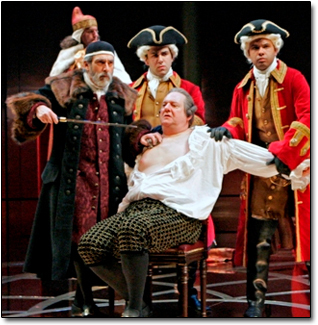
We like how he's unspecific about which pound. Here, it's obviously his nipple.
When the day comes for Antonio to pay up, Antonio has a friend's girlfriend pose as a lawyer and take control of the proceedings. On a technicality, she declares Shylock is in contempt of the court and therefore all of his assets are forfeit. To add insult to injury, Shylock is forced to convert to Christianity on the spot, even though Shylock begs for death before losing his religion.

"Didn't you see the description of the play? It's a comedy, asshole. Convert."
Incidentally, this plot point was inserted as a happy ending for Elizabethan audiences, who would see the degradation and destruction of the faithful Shylock and his subsequent conversion to Christianity as evidence of Shylock's soul being saved.
Mortal Enemies Decide to Just be Gay Instead

The Setup:
The titular character in the play Coriolanus is one of Rome's most popular generals, and the bravest, most bloodthirsty warrior in the military. After being driven from Rome in a political coup, Coriolanus decides to take advantage of the "Outside the Box Military Solutions" conference he went to at the Roman Marriott and show up to his mortal enemy's house half-naked to try to form an alliance.

"I got myself all oiled up too, just in case you, er ...still want to fight."
Aufidius, who spends the first three Acts of the play trying to kill Coriolanus, throws his arms around his enemy's body and launches into the most homo-erotic speech in Shakespeare, describing among other things the various wet-dreams he has had about Coriolanus.
Wait, WTF?
The play states that Coriolanus is driven out of Rome in "mean attire," basically meaning the rags of a beggar. Underwear wasn't a huge priority in ancient Rome, so he free-balls it to Aufidius' house and throws himself at the mercy of his sworn enemy. This is Aufidius' response:
Aufidius: Know thou first
I loved the maid I married; never man
Sigh'd truer breath; but that I see thee here,
Thou noble thing! More dances my rapt heart
Than when I first my wedded mistress saw
Bestride my threshold.
-- Coriolanus, Act IV Scene v, Lines 116-121
Or, translated into bro-speak: Dude, I'm totally into my wife and all, but looking at your sick abs and rockin' body, I'm seriously hornier than I was when I had sex with my wife for the first time.

"Take my hand, and maybe we'll get out of a Shakespeare play without being horribly mutilated."
He continues:
Aufidius: Thou has beat me out
Twelve several times, and I have nightly since
Dreamt of encounters 'twixt myself and me;
We have been down together in my sleep
Unbuckling helms, fisting each other's throat
And waked half dead with nothing.
-- Coriolanus, Act IV scene v, Lines 124-129
Translated: You've beaten me out ... in combat 12 times, and every night afterward I had raging boner wet dreams about you and me getting our sweat-wrestle on, fisting each other's ... throats, and afterward I woke up "half-dead" (post orgasm) "with nothing" (boner depleted, covered in my own love-juice).

Now imagine Ralph Fiennes and Gerald Butler doing this scene come November this year.
They vow to attack Rome together, and literally leave the stage hand in hand. This is basically like if Batman and the Joker decided about two hours into The Dark Knight to call their whole blood feud off and open a day spa together.

Shortly after this scene, they go get some champers, go to the steam room and have a giggle about women.
Titus Tricks Tamora Into Cannibalism

The Setup:
For our final act of horror, we go back to Titus Andronicus. After the events earlier which leave Titus' daughter Lavinia disfigured -- the woman responsible, Tamora, convinces Titus to cut off his own hand to save his sons. Then she kills them anyway.

"Hands up all those who want them to live!"
Titus, driven mad, invites the few remaining living characters to a dinner party, where he goes completely bananas and no fewer than six people are killed.
Wait, WTF?
Titus captures Tamora's sons and kills them. These are the two who did unspeakable horror on his daughter, so that's cool ... wait, he then hangs them upside down, drains their blood and bakes them into a pie. What is this, Sweeney Todd?

He could at least give him a proper haircut first.
He then invites Saturninus (the Emperor of Rome), Tamora and Lavinia to a dinner party where he serves the pie to the guests. As they munch away on the other other white meat, he asks Saturninus what one should do with a daughter who has been defiled. Replying in the characteristically sensitive manner of the time, he replies one should kill the daughter. Titus obliges, stabbing Lavinia to death, which, considering her condition, was probably OK with her. He then tells Tamora the extra-secret ingredient in the dinner ...
Titus: Why, there they are, both baked in this pie,
Whereof their mother daintily hath fed,
Eating the flesh that she herself hath bred.
-- Titus Andronicus, Act V Scene iii, Lines 59-61
... and before she can spew her son's tasty flesh all over the wallpaper, he stabs her in the face before being brought down by Saturninus, who in turn is also stabbed to death.

"Last one alive gets to finish off the pies!"
This is an orgy of violence that would make Eli Roth stain his Inglorious Basterds underwear! you think to yourself. If only there was a film version as catastrophically violent as the play! Well move Glitter out of the No. 1 spot on your Netflix queue, because there is one, and it stars Anthony "Hannibal Lecter" Hopkins.

He went full Smurf for this role.
The most recent film version was directed by Julie Taymor (who is responsible for Broadway smash hits like The Lion King and Broadway flop-tastic disasters like Spider-Man: Turn Off the Dark), and it is notable for its graphic interpretations of the violence of the play, and for being completely, utterly insane -- the characters use horses and swords next to modern day cars and assault rifles, and the movie starts and ends with a young boy playing with real life toy soldiers. This all somehow makes Spider-Man: Turn Off the Dark make a lot more sense:

Both are quite similar, in that they depict a slow, horrible death on stage.
For more ways old-timey folks were ca-raaaazy, check out 9 Inventions that Prove Leonardo da Vinci Was a Supervillain. Or learn how you channel Shakespeare every day, in 10 Words and Phrases You Won't Believe Shakespeare Invented.
And stop by Linkstorm to discover Shakespeare's secret porn stash.
And don't forget to follow us on Facebook and Twitter to get sexy, sexy jokes sent straight to your news feed.
Do you have an idea in mind that would make a great article? Then sign up for our writers workshop! Do you possess expert skills in image creation and manipulation? Mediocre? Even rudimentary? Are you frightened by MS Paint and simply have a funny idea? You can create an infograpic and you could be on the front page of Cracked.com tomorrow!


