7 Insanely Advanced Weapons History Somehow Forgot About
As we have mentioned before, technological breakthroughs aren't always built upon or improved -- oftentimes they're just outright forgotten, destroyed or lost to some ridiculous accident.
The same goes with military technology. Some ancient weapons were literally centuries ahead of their time yet wound up in the trash when society decided they were simply too awesome for their time. Like ...
14th-Century Cruise Missiles

As you're about to find out, the Chinese have a knack for inventing truly awesome things and then forgetting all about them. One of these things was the Chinese Flying Crow with Magic Fire, not to be confused with the band of the same name.

The Chinese also invented tofu, but that's barely interesting enough to deserve a caption.
These 14th-century weapons took inspiration from another weapon, fire-birds, which were actual birds that were outfitted with small pouches of smoldering embers around their necks and released into enemy cities. The red-hot embers would either fall out or burn through the pouches and land on rooftops, starting massive building fires.
The problem with fire-birds was that the birds were alive and would fly not only into the defending city but also to the tents and siege works of the attackers, where they would burn down the camp and shit on everything.

But seriously, birds are the worst.
The Chinese tried to get around this problem with devices that are detailed in the awesomely named Fire Dragon Manual. The Flying Crows were dummy birds constructed with bamboo frames and paper skin, and each one contained an explosive warhead. They were launched into the air via a rocket with a range of more than 1,000 feet. When one crashed into its target, be it a ship or some building in a besieged city, the warhead detonated. While this is a terrific idea, we have to question why the bird disguise is even necessary.

Hopefully it was a little less conspicuous than this picture would have us believe.
The resulting explosion could apparently be seen from miles away. A smaller version, called the free-flying enemy-pounding-thunder-crash bomb (awesome) had internal timers and when launched would explode at a predetermined height, raining down spikes dipped in "tiger-poison."

Made from real tigers.
Forgotten Until ...
This type of winged bomb wouldn't become popular in the Western world until the early 1900s -- nearly 600 years later. And it will probably be another hundred years before they achieve the pure aesthetic awesomeness of the Chinese papier-mache rocket birds.
Fu Go: Japanese Balloon Bombs

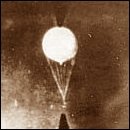
In World War II the Japanese looked to strike the American mainland, but no plane of that period could fly across the entire Pacific, and American naval power prevented any Japanese aircraft carriers from getting close enough. In response to this challenge, the Japanese developed the Fu Go, or the balloon bombs, which were basically ICBMs that were a fraction of the cost and were developed decades before long-distance flight-guidance technology existed. The unmanned balloons could navigate the whole Pacific before dropping their payloads via an incredibly simple system of weights and altimeters.
The Japanese knew that only some of the balloons would reach America, but if they were lucky, the balloon would drop its payload on a well-populated city. Otherwise it would hit a rural area and start a massive forest fire, which we're pretty sure can still be considered a win.
In late autumn of 1944, the Japanese released 9,000 balloons, of which about 1,000 managed to reach the United States, some flying as far as Detroit. One even threatened the American nuclear project when the balloon landed on a high-tension line carrying power to a nuclear reactor.

Shooting them down was exactly like blasting womp rats.
At first the Americans were stumped as to the balloons' origin, but closer investigation of some of the debris revealed Japanese characters, which is pretty incriminating. Not wanting the Japanese to know that the balloons were actually working, the U.S. embarked on one of the most enterprising censorship campaigns of the war and covered up evidence of the damage the balloons had caused, presumably attributing all the random explosions to atomic monsters.
Due to the media blackout, Japanese agents monitoring American newspapers thought their balloon high jinks were a bust and halted the program in 1945, when in reality the balloons were considered a serious threat. The Americans were also worried about reports of Japanese biological weapon technology that would be perfectly suited for use as a payload for the balloon bombs.

Fortunately, an alliance of elderly men, farmers and dowdy teachers managed to fight off the Eastern Scourge.
Forgotten Until ...
Because of the extensive media blackout, the balloon bombs were forgotten for the next half-century, until specials on The History Channel brought them back to light.

The History Channel: If It Exploded, We'll Give It a Special.
As for the ability to launch unmanned strikes from an ocean away, the Americans and Soviets both would spend the next 15 years and many billions of dollars developing the intercontinental ballistic missile (ICBM), a weapon far more accurate and deadly yet not a fraction as festive as a huge cloud of fire balloons.
Ancient Torpedoes

In the history of naval battles, there were limited means of sinking a enemy ship. You could storm it, smash it with some sort of artillery, ram it with one of your own vessels or smuggle George Clooney in as its captain.

"Let's sink this bitch!"
All of these meant getting dangerously close to your target and consequently risking getting sunk yourself. More than 700 years ago, the Muslims saw the folly in this and developed torpedo boats that would be able to sink a ship from a safe distance.

They looked suspiciously like something designed by Cobra Commander.
Sometime between 1270 and 1280, Hasan al-Rammah wrote The Book of Military Horsemanship and Ingenious War Devices. In the book, he describes a torpedo powered by a built-in rocket that could be launched against enemy ships. Using unmanned fire ships had been part of naval strategy for centuries, but they were difficult to aim and required a ship that would have to be sacrificed, sort of like a maritime suicide bomber.
The al-Rammah, as the torpedo was named, was a point-and-fire weapon way cheaper and more efficient than a fire ship. When activated, the torpedo's built-in rockets would propel it through the water, and tail stabilizers would direct it to the target. A spear on the front would impale itself in the hull of an enemy ship, and then the whole damn thing would explode.

Forgotten Until ...
The torpedo, even in a primitive form, wouldn't be invented for another 500 years. If you think about it, it's kind of amazing that boat technology continued to advance by leaps and bounds for centuries, but the technology of strapping a bomb to a piece of metal and making it blow up said boat slowed to a crawl. You'd think the latter would be way easier.

Boats have the advantage of mixing well with musical theater.
And while we're on the subject ...
Naval Mine

Around the 14th and 15th centuries, the Chinese had already mastered land mines but were getting increasingly angry at enemy junks floating safely up and down their rivers. So, as described in the aforementioned Fire Dragon Manual, Chinese warlords added sea mines to their arsenals.

Supposedly, this is a picture of one.
Called "submarine dragon-kings," the sea mines were submerged wrought-iron cases packed with explosives enclosed in watertight ox bladders -- basically, a grenade made from the urinary tract of a beast of burden. The explosives would stay dry, but with no oxygen, they couldn't be ignited.
To solve this problem, the ancient Chinese developed an extended fuse that would run from the mine's payload through a snorkel made from goat intestines to a float on the surface disguised with duck feathers, proving that above all else, the ancient Chinese wanted their weapons to be absolutely hilarious.

Case in point: the "flying-cloud thunderclap-eruptor."
Another Chinese war manual describes a later model wherein the timed fuse was replaced by a remote ignition device. By using a cord pulled from the shore, the mine was activated by a flint-and-steel firing mechanism that created a spark in the submerged payload and destroyed any nearby target. Presumably the person hiding on the shore holding the other end of the cord would then blow an air horn and launch into an M.C. Hammer end-zone dance.
Forgotten Until ...
Somehow the technology was forgotten by the West, probably because of that whole Dark Ages thing, and there wasn't another recorded use of sea mines until the Battle of the Kegs in 1778 during the Revolutionary War -- more than 300 years later.

It was totally worth the wait.
Fire-Resistant Clothing

Around the 12th and 13th centuries, battles in the Middle East often involved the use of chemical explosives and flammable liquids. Early warriors were especially vulnerable to these fire weapons, as they were either scantily clad or their clothing was made of flammable fabrics, and humans are not as effective at fighting when they are engulfed in flames.

Which is why napalm is such an unpopular party favor.
To combat this glaring strategic oversight, Muslim fighters developed fire-retardant clothing for battle. The fireproof suits consisted of a silk tunic, a cotton robe and a top-layer tunic that protected against fires and chemical gunpowder explosions, similar to the layers used in modern NBC suits today.
How effective was this protection? Muslim soldiers would strap small gunpowder charges to their bodies and light themselves on fire as they charged their enemies. As the flames burned the gunpowder, charges would explode, effectively making the soldiers look like taint-blasting fire beasts while still being protected by their ancient fireproof armor.

Forgotten Until ...
It wasn't for another 600 years, in the 19th century, that modern firefighters rediscovered the idea of fire-retardant clothing. Today, Formula One drivers wear silk undergarments underneath their Nomex suits as an extra layer of protection. Or at least that's what they claim.
Obsidian Knives

For thousands of years, the native peoples of North and South America used stone implements for all their cutting needs. This involved making knives from obsidian that are among the sharpest blades known to exist.

Next to lightsabers.
The Aztecs used these super-sharp blades on the edges of their maquahuitl swords, which were essentially big wooden paddles with obsidian razors stuck in them for maximum chopping. Supposedly these swords could "chop the head off a horse with one blow."

"You! Go find me a horse!"
When European traders started making contact with the natives, the convenience of dull metal tools and blades took precedence, and the obsidian knives fell out use, as did the knowledge of how to make them, because back then Europeans dealt in ignorance like a currency.

"Everything you do is stupid."
Forgotten Until ...
It wasn't until 500 years later, in the middle of the 20th century, that an anthropologist named Don Crabtree rediscovered the knife-making technology that was almost lost to time, presumably using it to strike fear into the hearts of all the naysayers in the university faculty lounge.

"We'll see who's laughing when I hide one of these in the muffins."
Greek Fire

In the year 678, the Arabs had the harbor city of Constantinople under siege for the fifth year in a row.

"We really should've seen this coming by now."
To combat this annual threat, the Byzantine navy introduced giant fucking flamethrowers known today as "Greek fire" and incinerated the Arab fleet as it prepared to attack the city. The Arabs didn't try again until 717, when they received the same treatment.

"We really should've seen this coming by now."
The Byzantine secret weapon was so secret that they compartmentalized each part of the Greek fire weapons system, with only the royal family and the descendants of the guy who invented it knowing the whole picture. For 500 years, the secret was held safely in the capital and passed on from generation to generation.

Sort of like the Colonel's recipe.
Forgotten Until ...
We still don't know how it worked. Unfortunately, the Byzantine empire was prone to coups -- 29 of the 88 total emperors had the shit murdered out of them in violent uprisings. At some point during one of these uprisings, the secret of the Greek fire was lost, because the new emperors tended to kill the entire royal family and the families of any close advisers. The last recorded use was in the naval battle against the Pisans in 1099.

Also known as "The Farewell Tour of the Flaming Death Ship."
For more of Eric Yosomono's writing, visit Gaijinass.
For more awesome old-school ideas, check out 11 Modern Technologies That Are Way Older Than You Think and 6 Depraved Sexual Fetishes That Are Older Than You Think.
And stop by Linkstorm to see Brockway's attempts to recreate Greek fire (and the Colonel's recipe).
And don't forget to follow us on Facebook and Twitter to get sexy, sexy jokes sent straight to your news feed.
Do you have an idea in mind that would make a great article? Then sign up for our writers workshop! Do you possess expert skills in image creation and manipulation? Mediocre? Even rudimentary? Are you frightened by MS Paint and simply have a funny idea? You can create an infograpic and you could be on the front page of Cracked.com tomorrow!
