5 Real Historical Death Stars (Complete With Baffling Flaws)
Every child reaches a point in his life where he asks a grown up, "Why did the Empire spend all that time and money building the Death Star, only to leave that vulnerable exhaust port wide open?" That question marks the end of your naive childhood and the beginning of your life as a cynical adult.
But Star Wars was more true to life than you think. History is full of unstoppable super-weapons and fortresses that tended to have one, ridiculous flaw the enemy could take advantage of.
The Helepolis

The Helepolis was the largest siege engine ever constructed in the ancient world. It was essentially a huge, rolling fortress--about 13 stories tall and weighing around 180 tons. It was used by Demetrius I of Macedon in his siege of Rhodes, about 300 years before the birth of Christ.
The name Helepolis literally means "destroyer of cities," which is badass enough, but it was also being driven by Demetrius, who had the nickname "Poliorcetes," which meant "The Besieger" in ancient Greek. Either Rhodes was in deep shit, or this was a case of gross false advertising.

Behind each of those windows up there was a catapult capable of launching an object heavy enough to turn a man into a puddle of spilled spaghetti. In total, it had two catapults on the first floor capable of launching 180-pound projectiles (basically picture them throwing refrigerators at you) and one catapult launching 60-pound ammo. On the next floor up were three more 60-pound catapults, then the next five floors featured 10 catapults that could rain down hundreds of 30-pound projectiles until nobody on the ground felt much like fighting any more. Finally there was a pair of dart throwers on the roof to kill any defender on the walls of a city.
Oh, and it was covered in iron plates, making the structure fireproof.
The Fatal Flaw:
Building-sized vehicles tend not to be all-terrain.
If you're ever facing something that 1) is on wheels; and 2) weighs 360,000 pounds, you can bet on one thing: It's not going to be worth a shit in the mud.
The Rhodians made an educated guess about where the attack would come from, and before the rolling tower of badassery could get there, they channeled water and sewage from the city and turned the whole area into a bog of mud and human poop. When the Helepolis moved in for the kill, it got bogged down in the mire and a tower full of soldiers realized there probably weren't enough horses in the world to drag the their rolling fortress to dry land. They abandoned their superweapon.

History does offer an alternate, equally sad, version of the story where defenders were able to simply run up to the thing and pry off the iron plates, aka Luke Skywalker bringing down a walker by knocking a hole in it with his lightsaber. Everyone agrees the outcome was ridiculous either way.
The Outcome:
Without the Helepolis, the siege of Rhodes failed. The so-called "Destroyer of Cities" was abandoned, having never destroyed a city. The Rhodians tore it down and used parts of it to build the Colossus at Rhodes, which was not in fact a big-ass superweapon, but just a huge statue of the Greek god Helios positioned so that every passing ship would be forced to look up at his junk.

The Mary Rose

The Mary Rose, launched in 1511, was possibly the most badass warship the world had ever seen up to that point. It was in fact one of the first ships built solely for war--up until then, navies would just take merchant vessels and stick some guns on them. On the sides of the Mary Rose was a new invention: gun ports. Doors you could stick cannons out of. These allowed the Mary Rose to broadside other vessels and obliterate them. The ship had up to 91 heavy guns and several more anti-personnel guns, designed to take out an opposing ship's sailors.

The ship was ordered built by Henry VIII, motivated by one of the most powerful emotions known to man: hatred of the French. England was always threatened by the massive French Navy and the Mary Rose was intended to be the equalizer.
The Fatal Flaw:
It was a boat with big-ass holes in the side.
We're guessing you've never designed and built a boat before, let alone a warship, but you probably can guess the problem that comes from building a boat with lots and lots of holes in its hull. Those gun ports were placed really close to the water, and if they tried to turn (which causes the boat to tilt) without sealing up the ports, water can come rushing in.
And that is how the Mary Rose managed to sink without the enemy firing a single shot.

Recently named "The M. Night Shyamalan Effect."
It happened during the Battle of the Solent, fought between French and English fleets. If eyewitnesses at the time are to be believed, the Mary Rose fired all of her guns on one side, and went to turn around to aim the loaded cannons on the other side at the french. A sudden gust of wind caught the sails and tipped the boat over a little more, and much to the surprise of a whole bunch of British sailors, water came pouring in her starboard gun ports. Most of the ship was under water before anyone could figure out what the hell had just happened.

Now, there are accounts by the French claiming that their guns sank the ship, but why would the British invent a version of the story that makes them look stupider?
The Outcome:
Out of the 400 men on board the Mary Rose, only 35 escaped the ship. Along with the crew, the pride of the Royal Navy was gone.
Babylon

The city of Babylon was essentially a giant fortress back in the fifth century B.C. The city had two layers of walls, so if the first layer was taken, a second wall would stop any attacker. In between these two walls was a moat that made taking the city even more impossible. Watchtowers filled with archers jutted from the walls, allowing them to rain down arrows on anyone who tried to approach them.

Herodotus, a Greek historian, estimated the walls to be 300-feet high, 80-feet wide and 55-miles long (though modern estimates peg them at 90-feet high and 10-miles long, so either Herodotus liked to embellish, or he was horrible at measurements). Also, the city of Babylon was bisected by the Euphrates River, which made sure the city had a constant supply of water in the event of a siege. This will be important later.
Babylon was the heart of the Neo-Babylonian Empire that stretched from the Mediterranean to the Persian Gulf, and in 539 B.C., Persia, under King Cyrus, came calling (this would be about 60 years after the events of 300).

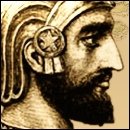
Cyrus, rockin' a sweet beard of power.
The Fatal Flaw:
The river.
Cyrus marched toward the city with his army. The soldiers of Babylon were so unconcerned about the city being taken that they were busy partying during a harvest festival, paying little attention to the Persians.
We mentioned that the city straddled the Euphrates river. The massive walls of the city also went across the river, with underwater gates allowing the current to flow through. Babylon had no defenses at these gates because, what would the enemy do, send an army of dolphins after them? Nobody could hold their breath long enough to go down there and break through the gates.

Not even this could help.
Cyrus's plan? Get rid of the water. He diverted the Euphrates itself into canals and reservoirs, which lowered the river's water level in the city. The gates were suddenly exposed and, in the darkness of night a few Persian soldiers were able to swim/wade through the openings and open the city gates for the rest of the Persian army.
The Outcome:
By the time the Babylonians figured out what was going on, it was too late. They mounted a counterattack but they were drunk from partying and were quickly slaughtered.
King Cyrus continued his conquest of the region and eventually the Persian Empire became the largest empire in the ancient world.
Singapore

Before the battle of Singapore in World War II, the British were pretty sure their stronghold was invincible. To the north of the city were impassable swamps and jungle that no one was crazy enough to try to march an army through. The south was protected by five 15-inch guns (that is, the shells were 15 inches across) that would turn approaching ships into Swiss cheese, and 85,000 British troops to meet anyone who landed.

The British called it the Gibralter in the Far East and their main concern was that it was too untouchable. As one officer in the British army was quoted as saying, "I do hope we are not getting too strong in Malaya because if so the Japanese may never attempt a landing."
The Fatal Flaw:
Bicycles.
The whole defense of the city was dependent on the idea that the attack would come from the south sea. After all, you'd never get an army through the jungle to the north. How would you get your heavy artillery or tanks through it? What were they going to do, put their troops on bicycles or something?

Yes. Thousands and thousands of bicycles. The Japanese came pouring through the jungles with alarming speed. The British turned their coastal guns around and bombarded the Japanese attack, but it accomplished nothing. They were designed to punch holes in ships, not repel a gigantic militarized Tour De France.
The Outcome:
The Japanese were able to attack several areas of the island from the north. Fearing the speed of the BMX-riding Japanese, the British detached forces to all these places to avoid encirclement, which spread their lines too thin. These lines were soon broken and they were surrounded. By February 15, 1942, the British had no option other than surrender. The 80,000 men became the largest surrender of British personnel in history.

When recounting the Battle of Singapore, One Australian officer stated, "The whole operation seems incredible: 550 miles in 55 days - forced back by a small Japanese army of only two divisions, riding stolen bicycles and without artillery support." Well, damn, when you put it that way...
Chateau Gaillard

During the 13th century, England and France were having one of their many, many wars with each other. To protect his holdings in Normandy, Richard I of England wanted to build the most badass castle imaginable. Six thousand laborers worked for a year to build the fortress. When the castle was completed, Richard called it a "gaillard castle" (translated: "well built"). Yes, Richard sucked at naming things.

The castle presumably rested on "Green Mountain."
It was in the perfect spot, on a high plateau with steep cliffs to the sides and rear. The only approach was by the well-armed front, and that sucked even more: it featured a moat, 30-feet wide and 40-feet deep, with a retractable drawbridge. The whole time you're trying to cross the moat you'd be getting pelted with arrows and barrels full of burning oil. Once you make it across, you're facing walls 10-feet thick.
The Fatal Flaw:
The poop chute.
King Richard was sure he'd never see his castle taken. And he didn't. He died less than a year after it was finished. Richard's brother John became king and made one minor addition: an extra toilet in the chapel. The toilet fed the waste into a chute, which emptied outside the walls.

"It's good, but what if I have to poop in church?" - King John
It seemed like a really specific modification to request but maybe they served nothing but Indian food during the services. Anyway, when Philip II of France heard that John was now King of England, he felt it was time to take the castle. Philip marched his army to the castle and laid siege. The soldiers inside the castle were well equipped, with vast stores of supplies that could hold out for an entire year--easily until long enough for re-enforcements to get there.
After a few attempts at taking the castle failed, Philip sent his soldiers out to find a weakness. One of those soldiers was called Ralph the Snubnose. While examining the castle walls, Ralph noticed the latrine chute. He also noticed it was just wide enough for somebody to crawl through.
Ralph, a braver man than any of us, volunteered. He and a couple of soldiers, climbed up the castle's proverbial large intestine, getting covered in excrement all along the way. Once Ralph and his comrades made it through 30-feet of shit tube and reached the top, they opened the gates for the rest of the army and the castle was taken.
The Outcome:
After the castle fell, Philip marched through the rest of Normandy. The military failure of the English forces under King John that started at Chateau Gaillard eventually led to him signing the Magna Carta.

Thanks, poop chute!
Do you have an idea in mind that would make a great article? Then sign up for our writers workshop! Know way too much about a random topic? Create a topic page and you could be on the front page of Cracked.com tomorrow!
For more battlefield monstrosities, check out The 6 Most Gigantic Everything in the History of War. Or learn about some more mistakes made in the Star Wars universe, in 7 Classic Star Wars Characters Who Totally Dropped the Ball.
And stop by Linkstorm (Updated 08.06.10) to discover the weakness in Brockway's cardboard "fortress." (It's actually his house.)
And don't forget to follow us on Facebook and Twitter to get sexy, sexy jokes sent straight to your news feed.
