6 Great Novels (Hated in Their Time)

Raise your hand if you ever had to read a classic novel in school, only to come away hating it. And keep your hand up if at some point an adult turned up their nose at you for failing to recognize genius when you saw it.
Well, here's their dirty little secret: Many, if not most, of the books you were handed in high school as required reading were hated by critics and readers alike when they first hit shelves.
Brave New World by Aldous Huxley
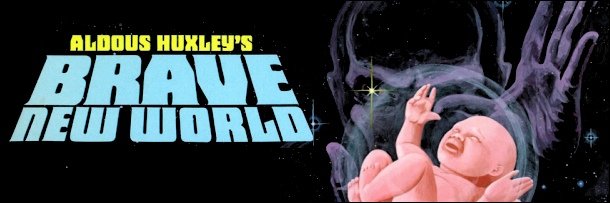
The Story You Know:
It's Aldous Huxley's chilling 1932 tale about a future centered upon sex, drug, and assembly-line worship, depicting humanity caught in an endless cycle of buying gizmos, working trivial jobs and taking drugs to make the depression go away.
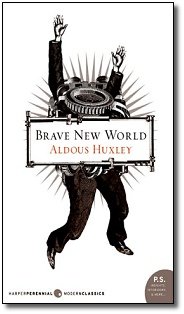
Unfortunately, its main characters do not look this awesome.
How Poorly it Was Received:
Critical reaction to Brave New World was "largely chilly," which is the short way of saying that it did to the literary world what Willy Wonka's boat ride did to your childhood.
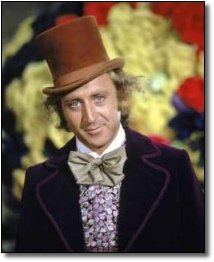
Gaze into the face of madness.
The result was an outright panic of literary criticism which resulted in the book getting universally panned, and ultimately selling only a few thousand copies upon its release in the U.S. Why? Everybody hated Huxley's vision of the future.
Even fellow futurists like H.G. Wells were shocked by the book's dystopian landscape. Despite being the same man who wrote War of the Worlds, Wells describe Brave New World's bleak future as "a betrayal." As for the book's more forgettable critics, i.e. everyone else, responses ranged from dismissal to childish name-calling.

Sources tell us that Mr. Huxley has cooties.
After all, he's talking about a future where mankind is pacified, not by a totalitarian dictator, but by infinite distractions, trivial entertainment and bullshit? Ridiculous!
Preposterous!
However, it can truly be said that Aldous Huxley got the last laugh. Brave New World has gone on to become one of the most celebrated and influential works of the 20th century, and its author one of the most equally respected/creepy intellectuals on the planet. After redeeming both his and his World State's reputation, Huxley died on November 22, 1963--the same date as C.S. Lewis and the Kennedy assassination--just so he could mess with us one last time.
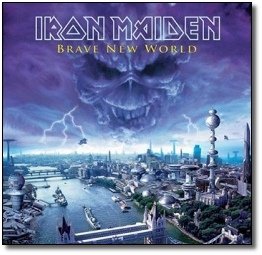
Thirty-seven years later, he would be awarded the ultimate achievement for a work of literature: having an Iron Maiden album named after it.
The Grapes of Wrath by John Steinbeck
The Story You Know:
The definitive American story about the Great Depression, the Dust Bowl and how hard life sucks if you're anyone in a Henry Fonda movie.
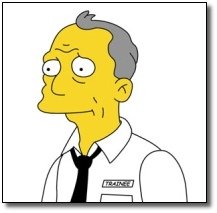
Henry Fonda.
Also, there's a famous scene in the story where a young woman breastfeeds a dying old man, which we're totally not going to make fun of because it's seriously that beautiful.
How Poorly it Was Received:
Imagine if Inglourious Basterds was released in 1929. Something like that.
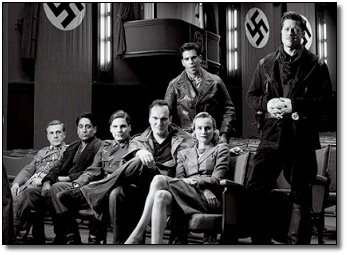
"A new talkie from Q. J. Tarantino."
Despite boasting what was clearly the classiest case for lactivism since Ancient Rome died, The Grapes of Wrath received less than a warm welcome when it was released.
Since "Fuck the Poor" had pretty much been America's policy all the way from the Gilded Age to the Roaring Twenties, Steinbeck's devastating depictions of American poverty, plight and migrant camps came off as "depressing" to most readers, and by depressing we mean part of a communist/socialist conspiracy.

Get off our streets you Red Commie bastard!
The Grapes of Wrath was denounced as a "pack of lies" and "a libel" from both the left and right wing of the political spectrum. The book was censored, banned and even burned in towns across the United States including Steinbeck's own hometown.

Note how they couldn't afford gas or even matches
because they were seriously that fucking poor.
Despite the treatment The Grapes of Wrath received, Steinbeck eventually benefited from the support of Eleanor Roosevelt, filmmaker John Ford and reality, once people found out that most of the book was based on true events. In fact, Steinbeck had actually downplayed the horrific conditions of the Dust Bowl--which included an explosion in black widow and tarantula populations...
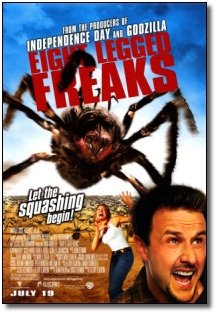
As evidenced by David Arquette's unflinchingly accurate Dust Bowl docudrama.
...because he was more interested in telling a story than scaring the nation into a communist frenzy.
Sure enough, the book ended up becoming really important and helped Steinbeck win the 1962 Nobel Prize in Literature, which at the time actually kind of meant something.
Lord of the Flies by William Golding

The Story You Know:
It's what you get if you combine the first season of Survivor, Swiss Family Robinson and Saw. Also, for extra fun, the whole book starred children.
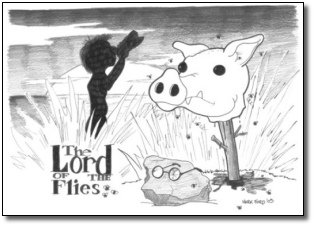
Something tells us it's a good thing there were no girls on the island.
How Poorly it Was Received:
William Golding's brilliant work of social commentary and symbolism was a complete commercial failure when it was released, but the truth is Golding was lucky that the book even made it that far. More than 20 publishers passed on the Lord of the Flies, no doubt due to the "excessive violence and bad language" Golding smacked his audience with like a blackjack upside the head.

Literature!
The book sold less than 3,000 copies before going out of print in the 50s. In other words, there's probably a hobo making copies of his manifesto on the Xerox machine at a public library who has sold more copies. We can't imagine why. After all, the book was just showing a complete collapse of faith, philosophy and society. With children.

This also happened.
However, in what we notice had become a trend in 20th century literature The Lord of the Flies, despite its unpopularity, had all the workings of a Nobel Prize winner. The book was eventually reprinted, assigned in classrooms throughout the United States and Golding was dubbed a Nobel Prize Laureate, then a freaking knight.
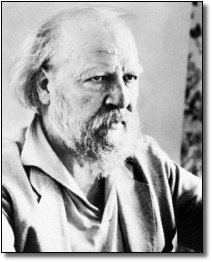
Though, he probably wasn't invited to speak at any Boy Scout ceremonies.
So keep that in mind should your first dabble in science-fiction/fantasy not go over so well when you post it on your LiveJournal. You're just a few years from a Nobel Prize in Literature, so start planning now what to do with your millions of dollars and your new knighthood, baby!
The Catcher In The Rye by J.D. Salinger
The Story You Know:
It's the magnum opus of the Baby Boomer Generation. The book about every kid who ever bitched and moaned his way through adolescence just so he could get drunk, molested and have his ass handed to him by a pimp.

It was a rite of passage.
How Poorly it Was Received:
About as warmly as that bottle of vodka in your grandmother's freezer box. The book was so controversial that even critics who liked it were afraid to show their names. The Catcher In The Rye was written in the "vulgar" tongue, which was common vernacular for the time. However, since the vulgar tongue does tend to involve lots of curse words and pussy jokes, the book kind of took a wrecking-ball to the social norms of Greatest Generation, and thus cemented the book's reputation as one of the most infamous works of the 20th century.
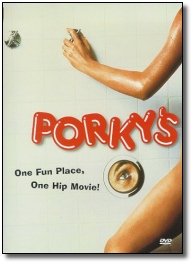
Alongside Porky's
Critics panned the book as "disappointing," a "near miss," "too long," "wholly repellent," "amateur," "monotonous and phony" and "predictable and boring." Since we assume most people probably know what it's like to get in a fight with an underage prostitute for charging extra for non-sex, we're going to have to agree with the critics on this one.
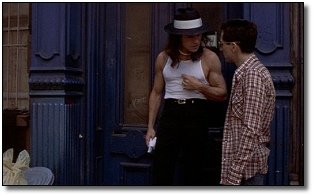
Oh, and then there's the whole controversy over the book inspiring high-profile murders because of the whole "catcher in the rye" analogy its main character Holden uses. However, since that argument makes about as much sense as the ending of Children of the Corn, it's probably safe to say that the dude who shot John Lennon was, in fact, a nutcase.

Not sane, and possibly an Elvis impersonator.
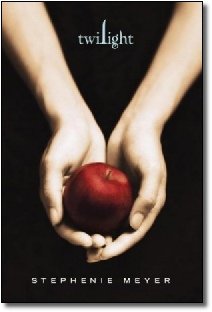
The public, as it is often wont to do, eventually ignored the critics and embraced the book to the tune of now 65 million copies sold since its first publication. That's more than any of the Twilight novels, kids.
Moby-Dick by Herman Melville

The Story You Know:
It's like Jaws, only with an enormous, albino sperm whale and lots of metaphors instead of a shark and bad hats. Also, Richard Dreyfus is slightly more badass in this version: Instead of the single most annoying ichthyologist on the planet, he's a South Pacific cannibal named Queequeg.
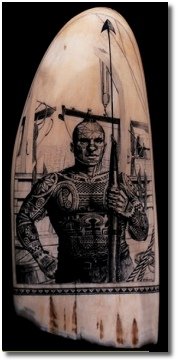
How Poorly it Was Received:
Contemporary reviews for Moby-Dick were harsh. Very, very harsh. Think Son of the Mask meets Battlefield Earth.
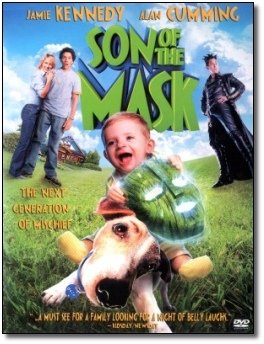
If you liked this movie, then you probably don't exist.
Despite introducing the world to some of the most original characters in literary history, not the least of which were Captain Ahab, Queequeg or the God-like Moby-Dick, Melville's poetic prose completely went over everyone's head. Part of this was due to one publisher accidentally omitting the book's crucial epilogue, which kind of tied the book together not unlike a fine Persian carpet in a lazy man's apartment. The other reason for its bad press was that most critics just flat-out didn't like it.
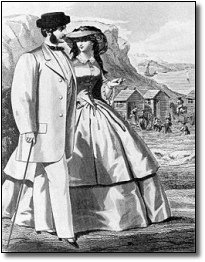
"Harumph."
One of the most esteemed literary magazines in England dismissed the book as a "catastrophe." One Methodist publication slammed the book as "unfit for general circulation." Some of the more dickish critics went so far as to attack Melville himself, along with what they took as "his rhetorical contortions, all his declamatory abuse of society, all his inflated sentiment and all his insinuating licentiousness."
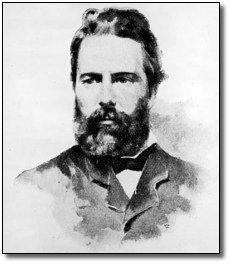
All his unkempt facial hair.
In other words, the book was hated by the type of people who think "insinuating licentiousness" is a good way to insult something. Granted, readers will find it tough to read Moby-Dick these days without reaching for an online dictionary now and then, but you can't fault Melville for being smarter than most modern readers. After all, the book was dedicated to Nathaniel Hawthorn; it's not like you can expect to find the word "pimpmobile" in every chapter.
Fortunately, Melville won the long, long, long war for literary appreciation, and is now considered one of the finest writers in American history. After all, the dude wrote Moby-Dick.
The Lord of the Rings Trilogy by J. R. R. Tolkien

The Story You Know:
In the Lord of the Rings trilogy, the many races of the weed-smoking lands of Middle-Earth put aside their mutually-shared racism to sit down and have a very serious discussion about jewelry. What follows is Tolkien's epic tale about the One Ring, the 19 Rings of Power, the Necklace of the Evanstar, the Ring of Barahir, the sweater-vest of Mithril, the Crown of Gondor, and other luxury items that Saruman "the Many Coloured" probably has stashed away in his closet.
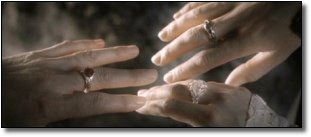
The trilogy has gone on to sell over 200 million copies, spawn an entire generation of grown men who cry over "Grey Havens," get adapted to film a few times and usher an entire sub-culture of nerds the likes of which we may never see again.
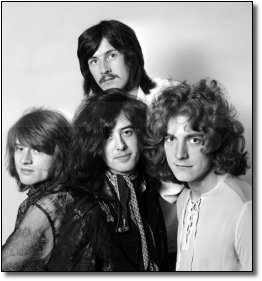
Zeppelin never sang a song about Spock. Take that, lesser nerds!
How Poorly it Was Received:
According to the J.R.R. Tolkien Encyclopedia, "No 'mainstream critic' appreciated The Lord of the Rings."

Apparently "mainstream critics" of the time were all Armond White.
The reasons for Tolkien's negative feedback were numerous, not the least of them being that he was a career linguist, not a professional writer. The New York Times described Tolkien's writing as "high-minded" and "death to literature itself."
The New Republic described the book and its characters as "anemic, and lacking in fiber" which was apparently a real burn back then in the pre-Cheerios days. Even heavyweights like Isaac Asimov weren't sold by the book's whole industry versud the environment message, retorting that modernity "or perhaps the modern world... wasn't all bad."
Hell, not even Tolkien's friends were all that big on it. Tolkien had to stop reading samples of the book to them on account of negative feedback/hurt feelings. One member of Tolkien's circle, Hugo Dyson (H.V.D. Dyson in geek) once famously moaned from a sofa during one reading: "Oh, fuck! Not another elf!"

H. V. D. Dyson.
Nevertheless, the book's popularity in the United States exploded in the 60s because of none other than the hippie movement. A healthy cocktail of the Vietnam War, environmentalism and an event horizon of substance abuse caused a renewed appreciation for what was described as "mellow freedom like that of the Shire."
Coupled with a totally unauthorized paperback printing of the book which beatniks purchased to "stick it to the man"--being Tolkien--"the man" had no choice but to re-release the book for America's drugged-out audiences.
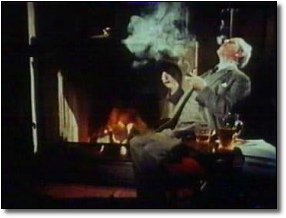
Sure enough, the old man celebrated the only way he knew how.
So if you've read a fantasy novel or played a video game recently that has magical elves and dwarves in it, thank a hippie.
Do you have an idea in mind that would make a great article? Then sign up for our writers workshop! Know way too much about a random topic? Create a topic page and you could be on the front page of Cracked.com tomorrow!
Now check out some elves and hobbits that blew it, in 6 Lord of the Rings Characters Who Totally Dropped the Ball. Or learn about the naughty tales behind your favorite children's movies, in 7 Classic Disney Movies Based On R-Rated Stories.
And stop by Linkstorm because it's way better than church.
And don't forget to follow us on Facebook and Twitter to get sexy, sexy jokes sent straight to your news feed.
