When Lobster Was Spam: 5 Gourmet Foods That Used to be Cheap

So the economy has been canceled, and no one can afford to eat anything other than canned soup and the occasional box of macaroni and cheese. But you can cheer yourself up with the knowledge that some day, people in fancy restaurants will pay top dollar for the food found in the average dorm room or trailer park.
How do we know? Because many foods that we now consider to be classy and/or expensive were at one point the foods that meant Timmy probably wasn't getting that new foot for Christmas. So in a couple of generations we'll see who is laughing about our tower of Noodle Cups.
Lobster
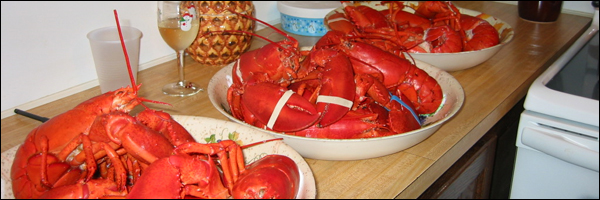
It's no surprise that lobster didn't use to have much of a reputation. It is, literally, a sea insect. The lobster belongs to the same animal group as both the spider and the common bug, which should be your first clue. They were initially thought of as giant hassles that got in the way when fishermen were fishing for, you know, fish. You know in Forrest Gump when they first pulled up their nets and a bunch of junk fell out? The lobsters were the equivalent of that toilet seat.
The lobsters they presumably found crawling around the bottom of the fish bucket were originally what fishermen gave to their indentured servants to eat. People were so averse to eating it that they ground it up and used it as fertilizer, instead. Being seen as someone who had to eat lobster was something you generally didn't tell anyone until at least the third date.
British POWs during the Revolutionary War supposedly revolted over being fed too much lobster, after having apparently developed culinary Stockholm Syndrome from British food. Some states actually had laws against feeding lobster to inmates more then a few times a week, on the grounds of cruel and unusual punishment, as it was seen as the equivalent of eating rats.
Then How Did it Get So Fancy?
Somebody went and invented the railroad. Soon, rich people from the middle of the country--who were painfully unaware of what was cool--were tricked into buying the sea insects. But after tasting them, they realized that they must have discovered the long lost gatekeeper for butter.

Ironically, lobster is now a commonly requested food for prisoners receiving a last meal before execution, where as back in the day who knows how many last meal requests were something to the effect of, "Anything but more freakin' lobster, ya cruel bastards!"
Oysters

The oyster is a cousin of the snail, nature's glue stick. Oysters also hang out with, and look like, rocks; further proof that giving in to peer pressure is an important survival technique.
Furthermore, in the olden days, eating one required you to be really committed to the task of eating something that looked like a rock. If you succeeded in prying them off of rocks without just giving up and eating a baby, you still had to get that sucker open, because they have to be eaten when they're as close to alive as possible. This involves cracking open a shell that is the animal kingdom's equivalent of a medieval chastity belt.

Eating one you've found to be already even a little bit open (and therefore dead) is pretty much booking a two-night stay at the nearest bathroom, where you'll have plenty of time to wonder why it was you thought that it'd be a good idea to eat a rock.
So you can see why the abundance of oysters in the 19th century led to their being mostly eaten by the working poor in the U.S. and the U.K. (also, they're not very nutritious). Dickens even mentions them derisively in The Pickwick Papers, making them certified riff-raff food even in a literary universe where people are willing to start shit over gruel.
Then How Did It Get So Fancy?

The industrial age brought a population boom and many, many oysters were eaten. Coupled with the kind of pollution you normally only see in dystopian 80s movies about 1999, many of the oysters were killed off, driving up price and demand, and therefore catching the interest of rich people.
To fix this problem, foreign oysters were brought in to replenish the population. Unfortunately, 19th century medical science was still in its Flintstone's car stage, and nobody thought to point out that the local and foreign oysters might carry diseases that the other might not be immune to, leading to tons of oysters eventually becoming rocks for real.
Thus oysters were made permanently scarce and pricey, and as Beanie Babies proved, rich people will spend money on anything if doing so means that you can't have it.
Foie Gras

Foie gras goes back to ancient Egyptian times, when man discovered that the liver of a really, really fattened goose was a lovely primeval combination of tasty and gross. Getting the goose to prime hedonistic conditions requires feeding it to the point of the liver growing to 10 times its normal size. Which means that you can continue eating those Hot Pockets secure in the knowledge that at least when you die, at least part of you will be great on toast.
The dish almost died out during the Middle Ages, when most people were chiefly concerned with trying to stay away from the burning piles of plague victims. Geese were probably able to stop having nightmares about waking up in bathtubs full of ice.
But the Jews, with their constant address changes (due to constantly being banished from one country after another), needed a source of cheap, kosher fat. It was kind of a disgusting necessity, and the first written document about foie gras is actually written by a Jewish religious leader admonishing his people for how gross the whole thing is.

In fact, this advanced-degree having lady goes so far as to postulate that bans on foie gras are anti-Semitic because they attack a necessity of medieval peasant Jewish cuisine. However, this is assuming that most people in favor of a ban on foie gras (now usually made with duck) express an argument more complex then "Hey, I remember thinking that ducks were cute last Easter, which was the last time before now that I have thought about them."

"Aww, aren't you temporarily sympathetic!"
Then How Did It Get So Fancy?
The Renaissance brought back interest in things other then just conquering people, which meant that royals were getting back to the business of conquering their arteries. People traveled to the Jewish ghettos in Rome to buy lobes of foie gras; these lobes found their way into the kitchens of royals, who were getting frustrated waiting for the deep-fried Twinkie to be invented.
Then, word got around that foie gras was off-putting and awesome, the French started putting it in everything and charging $10 an ounce.
Polenta

Polenta is basically gruel, the food with the world's worst PR team.
But polenta is the gruel made from corn. Which meant that instead of looking forward to a case of the rickets and being forced to waste valuable calories on bursting into song, you instead got pellagra: a disease that takes something forgettable a like Niacin deficiency, and turns it into a disease that is also forgettable because it causes dementia... and death.

Much like gruel, working class families in Italy and Latin America largely depended on this corn mush, which can take an upwards of three hours to cook from scratch, has to be stirred constantly and tastes like something you'd feed to cattle.
"Polentoni" is actually an insult that means "polenta-eater" in Italian. While it's actually intended to describe Northern Italians as boring and flavorless, we suspect it's probably as a dig at the nasty skin condition they might have developed with their pellagra.
Have we mentioned pellagra also causes diarrhea?

It also steals your wallet!
Then How Did It Get So Fancy?
Celebrity chefs. Fairly recently, polenta went from being the dish that every rags-to-riches person thought they'd never have to eat again, to the dish that is costing them $25 in a restaurant run by the only person left on Earth not getting shit for wearing Crocs, Mario Batali.

This fine dining restaurant even did an all-polenta meal. But make no mistake, fine dining polenta is mostly still plain old peasant polenta that is sexed up for rich people. The Food Network's Rocco DiSpirito even has a special recipe for polenta in which the only special ingredient is that Rocco Dispirito is telling you about it.
You could take a few pointers, gruel.
Sushi

The idea behind sushi is that you've got fish, plus stuff wrapped around it to preserve the fish. The fermentation of the rice kept the fish from giving you the types of illnesses you've only experienced through Oregon Trail. So originally sushi followed the formula of fish = "yum"; rice = "silica packet."

Back then the boozy, fermented rice was discarded, presumably because they were already pretty busy with all the opium. Then a 17th century Japanese doctor, Matsumoto Yoshiichi, hit upon the idea of adding vinegar to the rice to make it an edible part of the dish. This would be like if someone decided that a jar of pickle slices was now a soup.
Like most Japanese things, Sushi eventually became pocket sized. Sushi's portability, cheapness, as well as the allure of eating both a food and its wrapper at the same time turned sushi into the hot dog of the Japanese Edo period. The popular Sushi street stalls were the original fast food joints..

Then How Did It Get So Fancy?
Post-WWII, sushi arrived in the U.S. with the word "exotic" attached to it, which means Americans treated sushi the way that hipsters with asymmetrical haircuts treat anime.
Now there are sushi restaurants that charge up to $400 a meal (before booze) with a straight face. Masaharu Morimoto, best known for being the Iron Chef that makes Bobby Flay look like Richie Cunningham, writes in his cookbooks about the short, specific time limits he has eating pieces of sushi.
This seems reasonable until you remember that this is like a century from now reading a celebrity chef talking about how he can only eat his Chicken McNuggets exactly 236 seconds after they've left the fryer.
Lola subsists on a diet of flavored lip gloss and old pets, and she snarks football over at QuarterRack.
Next, check out the poor man's booze that will become tomorrow's new rich fad, in Nectar of the Broke: The World's 5 Worst Ways To Get Drunk. Or find out about some drinks that will never be sought out by the insanely wealthy, in Yogurt Pepsi: 14 Horrifying Soft Drinks Around the World.
And visit the rich man's Internet in our Top Picks section.
