5 Ways Your Brain Is Messing With Your Head
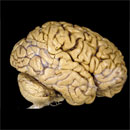
We accept on a regular basis the premise that our minds are being screwed with. Advertisers, politicians, magicians; we accept that they know the tricks to pull the wool over our eyes. But as it turns out, the ways in which your head is being truly and royally messed with the most, are coming from inside.
Please be advised that your brain does not want you reading the following list, and may kill you to protect its secrets. These include...
Change Blindness

What is it?
It's your inability to notice changes that happen right in front of you, even if they're hugely obvious... as long as you don't see the actual change take place.
Um, What?
Consider Alfonso Ribeiro.

Now, if suddenly that image of Carlton blinked and changed to a different image, you'd notice it. The change would draw your eye. But if you got up and left your computer, then came back and found the image had changed, odds are you almost certainly would not notice, even if you were only gone for seconds. Science has proven it.

In fact, if the entire text of this article--and the whole color and layout of this website--changed while you were gone, you probably wouldn't notice. We could switch it to a wallpaper of dicks. You might not believe it but, as you're about to see below, the experiments they've done on this get truly bizarre.

A scientist named George McConkie started working on this in the 70s. He'd introduce changes in words and text right on the page that someone was reading. By tracking the movement of their eyes, he was able to change the text right in front of their damned faces without people noticing.
Why Does the Brain Lie About it?
Change blindness is usually related to something called inattention blindness. If you tried to process everything in your visual spectrum you would go insane, so your mind picks and chooses what to focus on. If Carlton grows a mustache while your brain isn't paying attention, when you look back at Carlton, your brain tells you he's had the 'stache all along.
It's like your brain is sitting in class, staring out the window at a cloud that sort of looks like a boob. When you call on your brain it does the same thing you do when a teacher calls on you in those circumstances: Start bullshitting. It doesn't really know what Carlton looked like a second ago, but it's not going to tell you that. Since it has no visual memory of the image, it just tells you it's always looked the same. Even when that's a lie.

Where it Really Gets Weird...
What's truly amazing is just how often your brain isn't paying attention. Scientists decided to take the idea to a ridiculous extreme. They ran experiments where they'd have a guy manning the counter at an office serving students, while another guy was hidden below the counter. A student would walk up and request a form, and the guy would say sure and duck down behind the counter to get it.
But then second guy, the one who had been hiding, would pop up and say, "ah, here it is." This second guy would look completely different, and would be wearing completely different colored clothing, and most of the students would not freaking notice it was a different guy than the one they had been talking to five seconds ago.
Here is a video of such an experiment. Far creepier is the bit magician Derren Brown does where he'll approach a stranger on the street, ask for directions, and in mid-sentence have somebody walk past carrying a large object. While the object is disrupting the view for half a second, he'll swap out another guy who looks and sounds nothing like him--and the stranger will carry on the conversation with the second man as if nothing had happened.
This is probably what made the producers of Bewitched think they could just switch out Darrins on us.

Saccadic Masking
What is it?
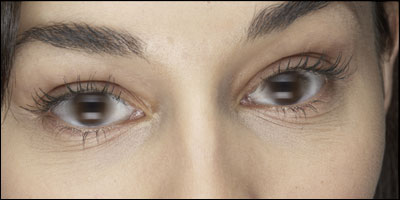
It's the 40 or so minutes per day that you're effectively blind.
Um, What?
Quick, look at the wall to your left. When you flicked your eyes over there, for just a moment, you were blind. And you didn't even know it.
Why Does the Brain Lie About it?
Ever watch a movie that gave you motion sickness, due to the camera whipping around too fast? This is what has some people puking during movies that use the "shaky handheld camera" gimmick (see: Cloverfield and The Blair Witch Project). Your brain doesn't like those rapid, blurry changes in vision.

This is either Cloverfield or a picture of John Candy with a Motion Blur filter.
But eye movements are even faster than those shaky camcorders. Flick your eyes over to the wall again. Notice you didn't get that nauseating, blurred image of the room zooming past your eye? That's because of saccadic masking.
In order to bring you this completely awe-inspiring view of what we're guessing is your cubicle wall right now, your brain rapidly moves your eyes without asking, in the neighborhood of three to five times per second. That's in addition to the times you move your eyes consciously, to look at the clock or the wall just now. To prevent your world from looking like the jerky Cloverfield camcorder all day, your brain shuts down your optic nerve while your eye is in motion.
Where it Really Gets Weird...
The spooky part is the way your brain prevents you from noticing the blackness that occurs several times a second, every moment you use your eyes. Estimates vary somewhat, but it's likely that you're spending somewhere around 40 minutes a day with your eyes wide open, and totally blind.

Your brain.
Look at the wall one more time. If you make an effort, you can sometimes see a "flash" of darkness during a particularly long eye movement, one of those periods of blindness your brain insists isn't happening. But for the most part, your brain suppresses these flickers.
And here's where saccadic masking and change blindness team up to have rough sex with your mind. Remember, the first scientist to experiment with change blindness was making changes to the page while people were looking directly at it. He was able to do it by introducing the changes during saccadic movement. If a change occurs during that fraction of a second when the brain is dodging calls like the optic nerve was an ex-girlfriend, you tend not to notice it. Even when it happens right in front of your damned eyes.
Proprioception

What is it?
It's your brain's map of your body, and it screws up on a regular basis.
Um, What?
Your sense of proprioception is your brain's ability to sense where your limbs are. Nothing strange about that, right? This is how you can put a sandwich in your mouth while your eyes are focused on the TV. Your brain knows where your hand is in relation to your face, thanks to proprioception.

Why Does the Brain Lie About it?
It may not be lying necessarily, just easily confused. You know this if you've ever taken a field sobriety test.
Your proprioception is like your underwear: it's pretty much the first thing to disappear when you're any kind of fucked up. Basically, the cops doing the roadside test are trying to see if your brain knows where your fingers are in relation to your nose.
Even though your brain carries around a detailed awareness of exactly where your body parts are at all times, when it's handed a contradictory stimulus, essentially it says, "Oh, well. Guess I've been wrong about the length of your nose all these years."

It's either that or your brain is a sadistic son-of-a-bitch that likes playing tricks on you.
Where it Really Gets Weird...
The best example we've found so far is "the Pinocchio illusion." Scientists have found they can have the subject touch the tip of their nose with their finger, and have their bicep or triceps electrically stimulated at the same time. Your brain "feels" your arm muscle extending, but also feels that you're maintaining contact with the tip of your nose, and leaps to the immediate, yet fully sober, conclusion that your nose has suddenly grown to be about three feet long.

Science.
Incidentally, we know exactly which illusion you're about to try to induce, figuring all it'll take is a girl, a dark room and the right equipment. Don't do it. It will lead to eventual disappointment.
Cryptomnesia

What is it?
It's sometimes called subconscious plagiarism. It's what happens when your brain rips off someone else's ideas and doesn't tell you, knowing nobody will believe you when you get caught later.
Um, What?
Among the many things your brain isn't good at is correctly remembering where your ideas come from. Cryptomnesia happens when your brain finds a really good idea, but doesn't bother remembering that, oh, yeah, it's not yours.
Despite what has to be an enormous temptation for people to jump all over that shit and claim it for themselves, Carl Jung discovered it.
Although occurrences are pretty rare, there are still some famous cases: Nietzche accidentally didn't write quite a bit of Thus Spake Zarathustra, George Harrison was forced to shell out almost $600,000 over a song he "borrowed," and an early incident with cryptomnesia permanently ruined the celebrity-author career of Helen Keller, who wrote up a fairy tale that it turned out had been told to her years before--much to her surprise.

Sad, because she never got to write Harry Potter and the Miracle Worker.
Why Does the Brain Lie About it?
Like so many of the other items on this list, explanations are pretty thin on the ground. Cryptomnesiologists seem to think that, for some reason, your brain retains enough memory of the event to recall the event, but not the origin of the event, leading to the mistaken impression that you're the originator.
You may be wondering at this point how we know cryptomnesia exists at all. After all, how do we know those cases of "accidental" plagiarism weren't all intentional?

The answer: we don't. If you haven't experienced it for yourself, you have no way of knowing it's not just a big fat scam. If you have experienced it, good luck trying to convince that first group.
Where it Really Gets Weird...
Studies show cryptomnesia is more likely to happen when the originating source is of the same sex. Scientists think this is because when the actual source is more similar to you, your brain is more likely to confuse you with the other person. Yes, because the brain is actually a drooling idiot, next week some woman is going to write a book called Mary Shelley's Frankenstein and think it was her own idea.
Subconscious Behavior aka Best Guessing
What is it?
It's precognition.
Um, What?
Okay, fine. It's not exactly precognition. But there is evidence that your brain makes predictions (oftentimes incredibly bad ones) about what's either happening or about to happen in the future.

Once your brain has a good idea of what it thinks is about to go down, it acts on that prediction, and--here's the weird part--there's evidence that it acts before you've made a conscious choice to act, either by moving parts of your body, or just by fucking with your perception.
Why Does the Brain Lie About it?
Because, otherwise, we'd be the clumsiest creatures on the planet. Our brains are lots of things, but they aren't necessarily that bright, and they particularly aren't good at coping with entirely unexpected situations. We deal with almost everything that happens to us by comparing ongoing events with past experiences, mostly in our subconscious. Our minds pay much more attention to comparisons with past experiences than they do with the events facing you at any given moment. It's why "practice makes perfect."
Where it's less useful is when your brain gets confused and starts fucking with you, like in the starburst illusion.

The starburst illusion takes advantage of the fact that your brain (and eyes) have LOTS of experience with converging horizon lines. When we "see" the background starburst pattern in real life, we're generally traveling towards the point of convergence. Your brain can't tell the difference between reality and fantasy, so it assumes you're traveling towards the center of the image, and adjusts your perception by enlarging and distorting the center, as though you were moving towards it.
So when we say "adjusts your perception," we mean "fucking lies to you. AGAIN."
Where it Really Gets Weird...
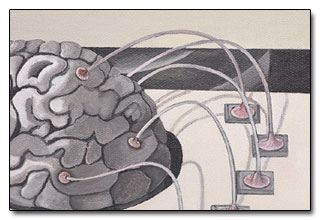
Scientists recently found out that if they hook your brain up to a scanner and then ask you to make a decision, a part of your brain lights up to take action several seconds before you consciously make the decision. So when you're working out in your head whether or not to go to work tomorrow, a part of your brain has already decided to call in sick, several seconds before the voice in your head arrives at that same conclusion.
I'm calling the shots, here.
That's right: If somebody had electrodes hooked to your brain, they could tell you--with 100% accuracy--what decision you'll make a few seconds from now. Now think about what that means for free will, and prepare to have your mind blown.
In case it wasn't enough that you're brain is fucking with you, check out how advertisers and other unsavory characters are messing with you, in 6 Brainwashing Techniques They're Using On You Right Now. Or find out about some things your body isn't telling you, in 6 Of Your Favorite Things That Are Secretly Making You Fat.
Or, visit Cracked.com's Top Picks to beat your brain back into submission (with boobs).
