5 Retarded Space Travel Ideas (That Might Actually Work)
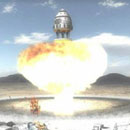
This whole space travel thing has gotten pretty boring ever since we landed on the moon. We can't make it to another planet and none of our ships have lasers. What the hell is the point?
But there were some incredibly awesome technologies that never made it off the drawing board. All because we didn't have the foresight, there wasn't enough funding, and they sounded like they were made up by a kindergartner.

Gerald Bull was a physics genius, and without a doubt the greatest weapons designer that Canada has ever produced, which may very well be impressive for all we know of Canadian weapon designers. Bull's line of work was a field called "super-artillery", which is a military term meaning "huge fucking cannons."
One of his crowning achievements was the G5 Howitzer, which could launch a shell 30 miles. Being the sort of person who gets a Physics PhD and goes into the field of "giant gun design," Bull decided 30 miles was fucking embarrassing.
So he went to work with the American government in the High Altitude Research Project, where he pointed other gigantic guns directly up into the sky and fired objects up to 60 miles high. You know the Stratosphere? Bull shot through that shit, sending projectiles into something called the Mesosphere. But that wasn't enough. His dream was to build a cannon so big it could shoot a satellite into orbit. After all, isn't that how they'd do it in a cartoon?
Above: Gerald Bull
After trying the Americans, who shockingly turned down the opportunity to build a ludicrously huge cannon, he went about building and selling arms to crazed dictators from all over the world, including South Africa, China, and Iraq. He eventually convinced budding young Iraqi leader Saddam Hussein that the only way to make all the cool countries respect him was to have a space program built around his big-ass cannon.

Saddam put him to work building his dream. They made a small scale prototype to work out the kinks, and there were probably several considering the final gun (nicknamed Big Babylon) was to be 500 feet long and 3 feet wide. It would have to be built into a freaking hill, just to stand up.
So Why Don't We Have One?
Before they could import the materials for Big Babylon, Hussein decided to invade Kuwait, and brought down the wrath of the international community.
It turns out part of Iraq's strategy in the Gulf War consisted of shooting at the Israelis. Israel wound up sending the Mossad (they're sort of like the CIA only they're actually good at what they do) after Iraq's weapon suppliers. Shortly thereafter, Bull was found dead in his apartment with 5 bullets in his head.

And thus, another of the world's dreamers died, taking his dreams with him. Just as John Lennon wanted world peace, Gerald Bull simply wanted a gun big enough to fire shit into space.

Even when space travel was still on the drawing board, mankind was full of visions of missions to Mars and space hotels. We saw with sinking disappointment that people could only go up in tiny little capsules with stale air, cramped quarters, and crappy food, and even then only after decades of training.
But there was a pair of crazy bastards named Ted Taylor and Freeman Dyson who headed a project to build a huge, sci-fi atomic spacecraft. And no, we don't mean that it worked on atomic power (though NASA tried to do that, too, with a project called NERVA). We're talking about something way, way more awesome than that.
Freeman Dyson totally doesn't look crazy or anything.
Their idea was a mammoth spaceship weighing up to 7 million tons that ran on nuclear bombs. Yes, nuclear bombs. As in, you take a huge spaceship, and stick a fucking nuke under it, then set it off. These guys would have taken one look at the giant gun guy and laughed in his face.
So the ship gets flung into the atmosphere by the nuclear explosion that just happened under it. Then what? It's going to start slowing down eventually, right? Well, you drop another nuke out of the concave (and heavily armored) bottom of the ship, and detonate it when it gets about 200 feet away. Rinse and repeat until you're in orbit. What could possibly go wrong?
Uhh...
Oddly enough, the lift-off would actually be smoother than any shuttle liftoff because the sheer mass of the enormous vehicle would almost completely eliminate turbulence. Initial tests were conducted with C4 and determined that the project was not only feasible, but actually exceeded expectations.
So Why Don't We Have One?
First, a bunch of party-pooping anti-nuclear types got a hold of it and started on with their "fallout" this and "environmental catastrophe" that. Then when the 1963 Treaty banning upper atmospheric nuclear detonation was signed it basically gave the project the kiss of death.
That's right, it took a Treaty to convince people that a nuclear-bomb-shitting space city was a bad idea.

After Nixon started the 1970s fad of slashing NASA's budget whenever they asked for money, it became something of a government tradition. To try to deal with having craptastic funding, NASA veteran Buzz Aldrin came up with a clever idea to save money going to Mars: Don't use any fuel.
Instead of actually powering the ship, he suggested you use Earth's gravity like a slingshot, shooting it into mars' gravitation field, which then would sling it back at earth. It would theoretically continue with this gravitational slingshottery until the end of time, using almost no fuel, and allowing them to load it up with equipment and personnel in a detachable cargo ship to drop every time it got close to Mars.
Above: Cracked's childlike grasp on this complex concept.
Also, you would get two going in opposite directions, because the way the gravity system works out, the trip there is nice and speedy, but the trip back takes a while. This way one of the ships would spend the short trip going Mars to earth, and the other would be earth to mars. No problem!
So Why Don't We Have One?
The long end of the trip takes about 21 months. At about this point the guys at NASA stopped listening, because who the hell wants to wait two years to be able to send another shuttle?
This also means the departure times are non-negotiable. Still working out the kinks on your little Mars rover? Too bad, the bus is leaving! Better luck next time, assholes!


The book "Footfall" by Niven and Pournelle describe #4 (nuke powered spacecraft) fairly well. It's elegant in a horrific way.
ReplyPeople probably taste like chicken.
ReplyNot that I'd know or anything...
>.>
Finally! Freeman Dyson proves that elves exist!!!
ReplyVALID QUESTION INCOMING...
ReplyFor the slingshot idea, don't Mars and Earth have different orbits? I thought at some points in time they are really far apart and sometimes they are really close, common sense tells me that they would be on opposites sides of the sun sometimes.
That's why it'd take so long at some points.
Nuclear bomb shitting space city made me laugh my ass off.
ReplyAn article about Freeman Dyson with no mention of the Dyson Sphere? Picard would be ashamed!
Reply Hide All See All 5 RepliesOr Miles Dyson?
even mike tyson would be!!!!
The title of the article was "retarded" space travel ideas. A Dyson sphere network is actually a quite plausible idea.
And proof that retarded isn't limited to just space ideas. Thanks for reassuring me of that fact tr3... can you're name be any more stupid?
Or not. The encased star system can't provide enough materiel required to build the sphere.
The only solution is private space programs, regrettably. NASA is too wrapped up in old ideas and keeping a huge beaurocracy employed. Maybe the private groups can gradually take on the other ideas as they can.afford it - I know, I'm nopt thrilled about the timeline either but forget NASA. (Look at their newest design with shuttle carryover elements. Sheesh!)
ReplyThe government actually funding NASA might have helped and government is always going to have more funds than a private interest group, that and I wouldnt trust aspiring Blofelds to not put space lasers or some such cartoonish supervillainy occuring.
Yes. The private angle has worked out real well. Investors are just clamoring to invest in space travel. That's why all manned flights in the past decade have been funded by governments.
f**k it i'd eat space tumor. can't be worse than mcD's
ReplyDamnit, replied to the wrong comment.
I would try the meat in #2.
Replyhi would no hesitation f**k that im french if i can eat frog legs bring the f*****g tumor and salt please ^^
This is why NASA needs to test it's projects on people who aren't astronauts. They're simply to well cared for. They've become snooty with their refusal to eat Soylent Yellow. Now, test out your projects in the projects of Philadelphia or the like and you'll find everyone loves Soylent Yellow.
Soylent Yellow, the one that isn't people.
"This also means the departure times are non-negotiable. Still working out the kinks on your little Mars rover? Too bad, the bus is leaving! Better luck next time, assholes!"
Reply Hide All See All 3 RepliesOf course, launch windows work like that anyway, so it's not a strange, new burden.
Only going to Mars, and even with that they have at least a couple of weeks window.
And where the fuck's the idea of launching multiple ships so that you have regular pickup schedules? Like you know... a bus. >_>
also there is a fuckton of middle ground between the Aldrin transfer loop and "never going to mars".
I saw an idea similar to the nuke ship, only it was a metal disk to shoot at spacecraft.
ReplyAll this will be a lot easier once we've perfected carbon nano tubes.
Reply Hide All See All 3 RepliesWell, we are a good way towards that goal. We (as in people much smarter than us, somewhere out there) have already conceived the technology to produce them in quantity and with relatively stringent quality control. Unfortunately, as of now we are quite limited in how long they can be made (the limit being very, very, very short). However, once it becomes feasible to create carbon nanotubes that are measured in meters as opposed to nanometers, almost every form of technology will be advanced, from computers and spacecraft to cars and washing machines, cable and wiring to televisions and the internet.
Basically, once we have the internet delivered via a combination of carbon nanotubes and fiber-optics, speeds will surpass 1TB/sec, computers will have processors with cores numbering in the hundreds (if not thousands) with each processing at speeds equivalent to at least 10ghz, RAM will become extraordinarily fast (1ghz FSB, anyone?), true optical storage will become reality and even commonplace, and even laptop screens will be able to achieve resolutions of 4k or higher (4x1080p).
In short: carbon nano-tubes are the future, and they will rock the foundation of every aspect of technology.
Insert 'Internet is a series of tubes' joke.
You know. I remember twenty years ago when someone said. "Everything will be a lot easier once the internet becomes more common. Computers will be more powerful and complex than the human brain!".
He was a fool too.
#1 made me laugh. They thought up this complex plan of interstellar travel with no mention of what mach 64k would do to a person? The second that thing took off you would be disintegrated lol. Wouldn't that be one of the first things you would take into account? in fact that is one of the huge obstacles we face for space travel. Its not so much that we cant produce the speed needed to travel to, say mars. Its being able to reach that speed while keeping the astronauts inside alive. I think humans can only take around mach 10 before serious damage happens, and that's nowhere near fast enough to travel to any planet in any conceivable time limit.
Reply Hide All See All 6 RepliesMach 64k is impossible in space as Mach is a function that involves the the speed of sound which is a function of air pressure (so irrelevant in a vacuum). Not to mention, with no gravity the speed of the spacecraft is moot, you would never feel it (I think you are confusing Gs with Mach number). Bear in mind that the space shuttle reentering the Earth's atmosphere is traveling at 18,000 mph and at 400,000ft that's only Mach 25 but the crew still survives that.
I think it's pretty clear (you know, the not being able to stop part, etc) that this mission was conceived as an unmanned probe.
As to the question of humans tolerating speed, humans can in fact tolerate any speed at all. Astronauts in orbit for example go much, much faster than the equivalent of Mach 10. The problem is acceleration, and the time needed for acceleration. For example, the very best fighter pilots with all the technological support we can give them, can endure maybe 9G for several seconds before blacking out (and dying if the G forces are sustained). And a continuous G over 2-3 would be very uncomfortable for pretty much anything. At the other end of the scale, car accident victims have endured over 50G for a brief instant and survived(though not everyone, and 100G is generally considered to be the "instant death" point).
For example, if you accelerated at 1G for just over 1 year, the people on the craft would be completely comfortable throughout it all, feeling basically the equivalent of earth-like gravity, and at the end of that period, they'd being going about 90% the speed of light.
If you accelerate at 1G for a couple weeks towards Mars, turn your spaceship around and decelerate at 1G after passing the halfway point, you could get to Mars in perfect comfort in under a month.
But we are nowhere near the kind of propulsion technology needed to provide a continuous 1G acceleration for that length of time.
Once again, Amphiox, you deserve a Molly. . . I was just going to call this guy a retard.
@amphiox something like a cannon, you mean?
accelerate at 9.8m/s squared and you have earth-normal gravity.
doing that in an Orion drive for about a quarter of the distance to the nearest star gets you to its maximum available speed.
i am not sure if you are overestimating the acceleration required or failing to note that it is only acceleration that generates force on the astronauts (so travelling at mach whatever is no problem, so long as you change speed gradually), but either way you're wrong.
The G force is merely the equivalent force exerted by the earth over the period of one second. When measuring how much force a human being can withstand you have to take that into account. For instance, a human experiencing 50G's in an accident isn't actually experiencing 50G's. That's because the force exerted occurs over a period of time much shorter than a second. It would only be 50G's if that force was consistently applied for the full second.
More importantly. Mach is the speed of sound. A velocity is constant when no force is applied to it and it's the force, or change in velocity, that causes damage to the human being. A space ship can go to 64,000 times the speed of sound and the people inside will be fine. Provided the acceleration isn't much more than 1G. Up to 4G (approximately) can cause long term health problems and above 4G can cause severe short term problems including blacking out and death.
Notably one could get the ship to go even faster than the speed listed but it would require more fuel.
How would a person be able to be blasted out of a gigantic cannon and do anything but turn to a red mist? No matter how protected you are the sheer g-force would liquify you. I get that the cannon could shoot "objects" close to space but a person? This is assuming the phrase "space travel" means a person traveling through space and not just putting anything INTO space. You would think a brilliant physicist would be able to think of a better way then just building a huge f*****g gun to shoot things into space. The whole law of physics would seem to dispute a person being shot into space at a billion miles an hour from a giant cannon and coming back.
ReplyAgain, the space gun was obviously intended not for people, but to launch things like satellites into orbit. Or the building parts of space stations and space ships to be assembled in orbit (by robots or astronauts to get there some other way).
length of barrel; the longer the barrel the more time you have to apply acceleration so the longer you can take so the less the G force on the payload. Bear in mind there was talk of a gun half a *kilometre* long.
what about solar sails?its a ship with a sort of ginormous sail that uses the tiny amount of pressure from the light of the sun to push it forward. since space is empty, nothing will slow it down so it can accelerate indefinetly. you could only turn it very slowly and cant go towards the sun but hey, no gas
Reply Hide All See All 6 RepliesNot in anyone's reasonable imagination would a solar sail be considered "retarded". It's actually an idea that holds a great deal of promise.
It's not true that space is empty. Solar wind, ions blown off the sun, are what pushes a solar sail. Solar wind has an average velocity of 300 km/s at 1 A.U, so a solar sail ship couldn't move any faster than that at that distance. Out in the void between stars you get cosmic wind, which would exert the same pressure on the front of your sail as the back, meaning it wouldn't accelerate a ship. At relativistic speeds however a sail could be used as a powerful drag chute.
epamphleteer, it's not pushed by the solar wind, it's pushed by light (i.e. photons). sorry to be nitpicky but imo that's what makes the idea so cool
It doesn't accelerate indefinitely since the particle density exerts less pressure as you get further away.
Damn spehs elfs.
I consider the solar sail idea retarded. I also consider Amphiox retarded but for completely different reasons.
The solar sail idea works wonderfully in a vacuum and would allow for a constant acceleration, up to the speed of light, no matter where you were. However, space isn't really a vacuum. There's trillions upon trillions upon gazillions of little particles that would act as frictional resistance to the sails. More importantly, there's a wide variety of rocks in space that no one can track. They fly all over the place at high speeds and would tear through the sail.
No, ultimately the problem with solar sails is trying to sail a ship through a hail storm where the hail is flying horizontally. It's just not a good idea.
anyone interested in ridiculously cool ideas crazy nasa people have about going to space should read "footfall" by larry niven and jerry pournell. pretty legit. alot of sweet possible sci-fi ideas.
ReplyOMG!! Someone else in the entire world that has read the book Footfall. Greetings brother! Wouldn't it make the best movie ever?
I LOVE that book; Tuf Voyaging also makes a good "feed the masses" argument for eating "tumors" ...yes lucas73... that would make an awsome movie... keep the thread goin...
Getting into space using explosions is like rocket jumping in Quake. Might kill you (thought in quake this isn't true in Clan Arena).
ReplyI used to do that in Doom. I'd wait for someone to get close to me in battle and then fire away. There's nothing more frightening than a suicide bomber in a video game. They just keep coming back!
- set aside 100 x 100 miles of wasteland.
Reply Hide All See All 12 Replies- start dumping dirt and crap on it to create a pyramid 100 miles high
- carve roads and railway and lift tunnel on or in it
- you'll go to space with the price of bus ticket
That's it, you hear it first from me. When someone actually build that, I have the patent rights.
Good Sir, I do believe we must collaborate on my design for bulletproof armor. I have all the magnets we need to make it work.
.....why does this not seem like a bad idea? I think you're onto something.
Tower of Babylon? Why not just hang a space elevator from a satallite to just the thereshhold of space, which probably is just 1/4 of the proposed space elevator. Then we can get satellites by dropping it to a net from hanging on that elevator, the way the USAF got its camera pics from the old Corana KH-4 satellites.
F[]ingpedant, that is actually an amazing idea. Why hasn't this been done before? Is it the problem of gravity? Cost? What?
lol its a joke dont take it so seriously
Just make a huge elevator that stops at the space station, then a shuttle takes you to a moon base or mars etc. In fact i think i heard that as an actual idea they where working on for future space travel. I could not tell you how to begin making an elevator that big but hey, its better then strapping a nuke to your ass and blasting into oblivion.
Sorry to piss on everyone, but this really can't be done.
The Earth's gravity accelerates all particles toward its center. As you build bigger, the weight of your object increases until its itnternal cohesion is overcome by that downward acceleration.
In other words, build big = build heavy; heavy = strong downward pull; strong downward pull = squish.
This is why Earth's tallest mountain has to sit on top of the Tibetan Plateau and have its bottom bits bound together by other mountains, while Mars (less gravitationally demanding) boasts a single peak twice as high.
also, where the hell do you expect to get all that dirt? Think about it, that's a fuckton of dirt you're talking about
@munkee, Don't worry, I know a guy.
Evilcor's right. Even if it was made of stone it would essentially liquify before reaching a fraction of the required altitude.
By my shoddy calculations you'd need about 680TJ of energy (the atomic bomb dropped over Hiroshima released about 50TJ) to lift enough rock into a pyramid shape that size. Oh, and the money for materials, equipment and manpower plus the energy to transport it all to the site- these factors would far dwarf the (still astronomic) price of just generating enough energy for lifting the materials into position. Also, it would all collapse due to it's own weight and ruin the tectonic plate it's sitting on long before being finished.
TL;DR A space elevator is cheaper and has the distinct advantage of being possible without changing the laws of physics.
King Nimrod would like a word with you. And I think he brought his copyright lawywers.
I can just imagine an alien going about his business when he see's a Daedalus approaching and has the most epic what-the-f**k moment ever. Although at Mach 64K, the Daedalus would be an awesome weapon against giant asteroids or alien mother ships. Like a gigantic railgun. Holy s**t.
ReplyYou cant shoot meteors or asteroids with any kind of solid projectile, it will just break up into smaller pieces and rain down destruction on earth. They have prototypes that could stop meteors from reaching earth but they have to find the meteor years before it is close to us and then send out sort of meteor "eating" robots that slowly disintegrates it by constantly shooting a lazer beam at it while spinning around the object. That way it slowly chips away and turns it to dust. Ether way the closes danger area meteor we found is something like 200 years away so it wont matter to us lol. Of course who knows what something shot at mach 64k would do lol. Its to fast to comprehend.
Wonder why the article didn't mention the primary problem with a nuclear powered lift vehicle: the electromagnetic pulse, which destroys electronics in a wide area by creating massive electrical surges. That's why upper atmospheric tests are banned.
Reply Hide All See All 4 RepliesThe shielding protecting the ship from the blast itself would also be designed to deal with any pulse.
I imagine alot of the ship would be made of metal, togethr acting as a massive faraday cage
@MaxWang mentioning Faraday gets me hot. You win my services.
you don't get a massive EMP from the size of detonation used, in any case, but most plans for launching the Orion drive consist of using a Verne Gun - you sink the spaceship a mile into bedrock and put a big nuke underneath it that can lift it to orbit in one blast.