The 6 Most Overhyped Technologies
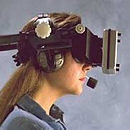
Contrary to what you learned in your economics classes, the market isn't always about supply and demand. Sometimes it's the opposite: supplying some technology nobody wanted, then trying to create the demand for it with hype.
Ultimately it's the technology that suffers, as the public slowly gets more and more pissed off that it isn't as awesome as USA Today or the salesman at Best Buy told them it would be.
These are some of the most egregious examples.
High-Definition TVs

Last year Best Buy reported huge numbers of unexpected returns of high-definition TVs because many who bought the sets thought the picture looked "like someone rubbed cat shit on the screen." How is this possible? That's the entire point of HD TV--its ability to render today's most visually intense shows in crystal-clear detail.

Root Problems:
Consumer confusion, slow adoption.
It turns out the problem doesn't lie with the televisions; it lies with the people who buy them. Or, you could say it lies in the industry's inability to explain to those people what they're buying. It seems obvious to us computer- literate and sexually confident Internet users that if you buy an HDTV you still need an HD source--a special box from your cable company or satellite provider--to get an HD picture. But to your average Joe, who's used to plugging one wire into the back of his TV, this can be a frustrating realization.
"What do you mean I need special cables?"
"What do you mean I need to rent a little box with it?"
"What do you mean I'll have to pay more monthly for the HD plan?"
"What do you mean my DVD player isn't high definition? What's 'Blu-ray?'"
"RAAARRRRGH!"
Then he goes into the other room and kicks his dog. This is the true face of animal abuse in America today: frustrated A/V installations.

from FlatPanelTV.org
According to a recent Nielsen study half of the people who own HD television sets don't use them with a high-definition source. Many of them don't even know.
That's a problem, because if you happen to watch any standard definition channels on your HD TV, you'll find the picture is now distorted on your widescreen set. If we wanted to see what Katie Couric looks like 40 pounds heavier, we'd Photoshop her head onto a fat guy's body, like any normal person.

Sure you can fiddle with the picture settings to sort of resolve this; it'll likely require a couple of hours on the phone with a support center in India, and the resulting picture will still be a grainy mess. This is why Best Buy is getting irate customers dragging in returned sets with shattered holes in the screen the exact size and shape of an angry fist.
Eventually these problems will fade away, once the only type of television on store shelves is HD, and the only type of cable is HD, and the only type of DVD players for sale is HD. Mr. Johnny Average Consumer Idiot* won't have to take a six-week course to figure out what terms like HDMI and 1080p mean, because everything will be figured out for him.
*Not a real person. If this is your real name, we are sorry. For a couple reasons.
eBooks

Sometime in the late 1990s, when seemingly every noun in the English language was getting prefixed with an "e" or an "i" by clever marketing types, some young firebrand decided that the book, an invention that had served mankind faithfully for several decades, wasn't good enough anymore. These visionaries reasoned that people would much rather read everything on a computer screen all the time, because computers were rad ("rad" still being used in its un-ironic sense at the time).
Root Problems:
Bad screens, bad batteries, l337 W@rez Pir@te5.
As it turns out, computer screens are miserable, hateful things to read on. People read on computers because they have to, not because they want to. Modern "electronic-ink" technology had improved the readability of ebooks somewhat, but other technological challenges remain--most notably, battery life. As an example, our favorite book here in the Cracked offices--the novelization of Batman Begins--never needs its batteries recharged. Can an ebook ever make that claim?

Actually, what exactly is the advantage to carrying an ebook? An MP3 player is great because it prevents us from having to carry a backpack with 100 CDs in it. An ebook isn't any more convenient to carry around than a paperback, and you can use the latter to swat a fly if you need to.
Probably the biggest obstacle, though, is piracy. We all know what happened when MP3s arrived on the scene. Internet pirates began treating the music industry in a delicate manner normally reserved for prison rapes. Wherever publishers are offering content for download, there is someone out on Gnutella offering it for free. As it is for music and movies and software, it will be for books.
Given the hurdles, we can't imagine ebooks taking off any time in the near future, even if they are probably inevitable in the long run (when we run out of trees, if nothing else). What seems most likely is that "ebooks" won't be separate devices at all, just a way to read the books on the next generation of all-in-one devices (a cell phone/MP3 player/PDA/taser). Why people in the future will still choose to read novels when they're constantly bombarded with opportunities to download clips of the popular future television show "Fisting With The Stars" is harder to say.
Municipal Wi-Fi

"Muncipal Wi-Fi" is the idea that if Wi-Fi hotspots could be carefully laid out in a city--say, one on every lamppost--then everyone in that city would have free (or cheap) Internet access. This has made the news a few times over the last couple years as various cities have announced they were going to roll it out, in an effort to fulfill an oft-forgotten part of the American Dream.

Root Problems:
Nobody wants to pay for it.
Obviously to get that kind of ubiquitous Wi-Fi signal, someone (specifically, someone else) has to actually set up and maintain all of these Wi-Fi hotspots. That means the local government has to hire a company to do it, which would be great if that company was willing to do it for free (like if it was owned by a kind old billionaire who just likes giving things to people).
Otherwise, the money has to come from somewhere and nobody is quite sure where. Everything from monthly user fees, to tax increases to ad-supported access has been suggested.
Compounding these problems is that it costs way more than was anticipated to get the cities wired up. The ones who'd actually maintain the hotspots, network engineers, generally don't like being outdoors in the first place and so they probably charge extra.

Even Google, which is fully capable of buying and selling our comedy-writing asses several billion times over, was only willing to set up Municipal Wi-Fi in their own idyllic small town. What hope does an unpopular and unattractive city like, say, Chicago, have? In most cities, the people will take to the street with torches and pitchforks when a tax increase is imposed to put a new roof on the school. What will they do when they're asked to fork over money to give everyone in the city free access to YouTube?
Hybrid Vehicles
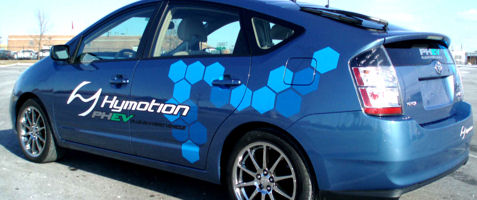
Hybrid vehicles, with their part-electrical, part-gasoline engines are a sort of compromise for people who care about fuel consumption, but aren't going to go all-out for some hippie contraption that has to be plugged in for eight hours before you can drive it. Ask any hybrid owner why they own one, and you'll likely hear a variety of answers like "to save the environment," "to reduce our dependence on foreign oil," and "to drive Dick Cheney back into the sea from whence he came."

Root Problems:
Hysterical, possibly Gore-fueled overestimation of value.
The problem with hybrid cars isn't what they can do, it's what people think they can do. Realistically, a hybrid car will get roughly 20-30 percent better gas mileage than a similarly sized normal car. It turns out they don't perform as well in the real world as in the lab, and the talk of 55 miles to the gallon for hybrids was pretty much bullshit ( the Toyota Prius' gas mileage was knocked back from 55 to 46 MPG by the EPA). Sure, those numbers are still light years ahead of the customized Escalades issued to the Cracked staff ...

...but don't blow away the numbers for regular ol' economy cars that cost $5,000 less.
As far as environmental impact, don't forget the manufacturing process. Just by insisting on buying a new car instead of keeping your old one, you added 27 tons of waste to the environment. It's more so for a hybrid, since their enormously powerful batteries don't grow on trees, perhaps due to an oversight on the part of God. They have to be built and shipped around the planet, creating waste every step of the way.
We're pretty level-headed here at Cracked, and generally agree that mankind should never harm the planet, except possibly in self defense. So, we applaud the goal of improving fuel economy in vehicles. But if you buy a hybrid, don't fool yourself into thinking you're single handedly saving Earth. You're maybe helping a bit, but if the planet's ever going to be saved, it will require a concerted effort from everyone, including consumers, businesses, governments and, most importantly, Batman.
The Internet on your TV
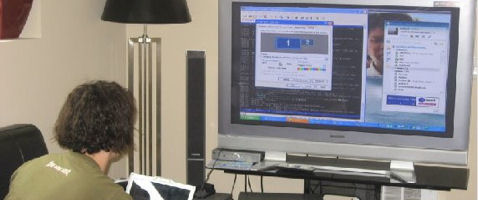
For some strange reason, it's long been a goal for many very smart people to move Internet users away from the computer desk and onto the sofa. You can browse the Internet on the Nintendo Wii and the Sony PS3, plus Microsoft still has its set-top browser out there (they bought up the old WebTV thing years ago) which is enjoyed by literally hundreds of people.
Root Problems:
Remarkably ill-conceived product.
To see why this doesn't work, here's a fun little experiment you can do. Go get a ruler and measure how tall the text is on your monitor when viewing one of your favorite websites. It doesn't have to be this one, and in fact, probably isn't.

Every website in existence is designed to be viewed from about 2 feet away, and uses relatively small fonts as a consequence. So in other words, you'd need something like a 200-inch television to display text that's readable from your couch.
This leads us right to the other problem: Web content isn't designed to be shared. TV shows are broadcast in 30- to 60- minute chunks that a family or group of friends can all sit and watch together. Web browsing is a series of three-minute-long hops from link to link, at the whims of whoever is doing the navigating.
Mom sitting there and watching while Dad navigates through his favorite sports blogs would be torture for both. Mom, because she probably doesn't care about his sports and Dad, because he has to now pretend he uses the Internet to read about sports and not anime porn.
Virtual Reality

In the movie Disclosure, Michael Douglas has to track down evidence that proves Demi Moore at one point found him sexually desirable. In order to access his company's network, he's forced to use a virtual reality getup thanks to several unlikely plot contrivances. This involves donning a 10-pound helmet, slipping on some kind of power glove, and then clambering up on a sort of roller platform. Once that's all done, he gets to pretend to walk down the corridors of a virtual library, where he pretends to open a virtual file cabinet, pretends to grab a virtual file folder, and then pretends to flip through virtual pages looking for the evidence that proves that the woman who was pretending to find him attractive wasn't pretending.
Got all that?
Root Problems:
It's not actually useful for anything.
The problem is that any idiot (even Michael Douglas, probably) could accomplish the above task 10 times faster with a keyboard and mouse. Just because you could do it in virtual reality doesn't mean you should. Given the choice, anyone who uses a computer to do a job is only going to be interested in using the fastest and easiest method, not the one that requires the user to possess both a helmet and the weathered good looks of Michael Douglas.
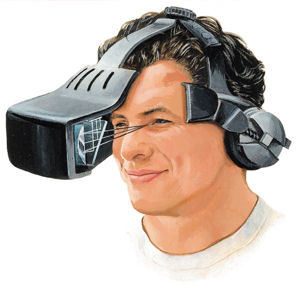
No one in the '90s thought that we'd be sitting here in 2007 and thinking of those VR headsets as a ridiculous fad. Yet, even the most advanced game consoles are still played with the same old control pads on the same old television. The Wii does add a tiny element of virtual reality in that it lets you physically interact with the game, a little. But, just a little.

The whole point of VR is to completely immerse you in the entertainment, but a regular old TV kind of already does that. When you're wrapped up in a good TV show, you're not thinking about your surroundings. You block it out, you're focused on the show. By moving the screen to an inch in front of your eyeball, VR is solving a problem that doesn't really exist.
Sure, some time in the distant future when real "almost reality" simulations exist, we'll wind up using some kind of VR technology, but only if it doesn't require us to stand up and wear a 10-pound helmet. But, it will be well worth the wait, because on that day we will find ourselves neck deep in a first-person sex-with-Michael Douglas simulator, and it will be glorious.
If you like this article, check out Chris's post about a Wii conspiracy theory on the Official Cracked Blog today.
