31 of the Most Intriguing Things About Ancient History

‘Humans have been around for over 100,000 years. How is there only writing going back 6,000 years?’
31 of the Most Intriguing Things About Ancient History

One of the biggest misunderstandings about history as an entire discipline of knowledge is that we know all of it. In fact, even to say we know most of it is still way off. We’ve only got the barest sliver of what came before, such a small slice that it would be insulting if left out at an office pizza party.

There’s an incredible amount of information that was lost to time along with the people it concerned. Huge gaps that historians can’t do much past postulating on, which lends a certain mystery. 

Redditors collected the facts and thoughts that sent their brains reeling when it came to unrecorded history. See if they’ll trigger a minor existential crisis by reading on.
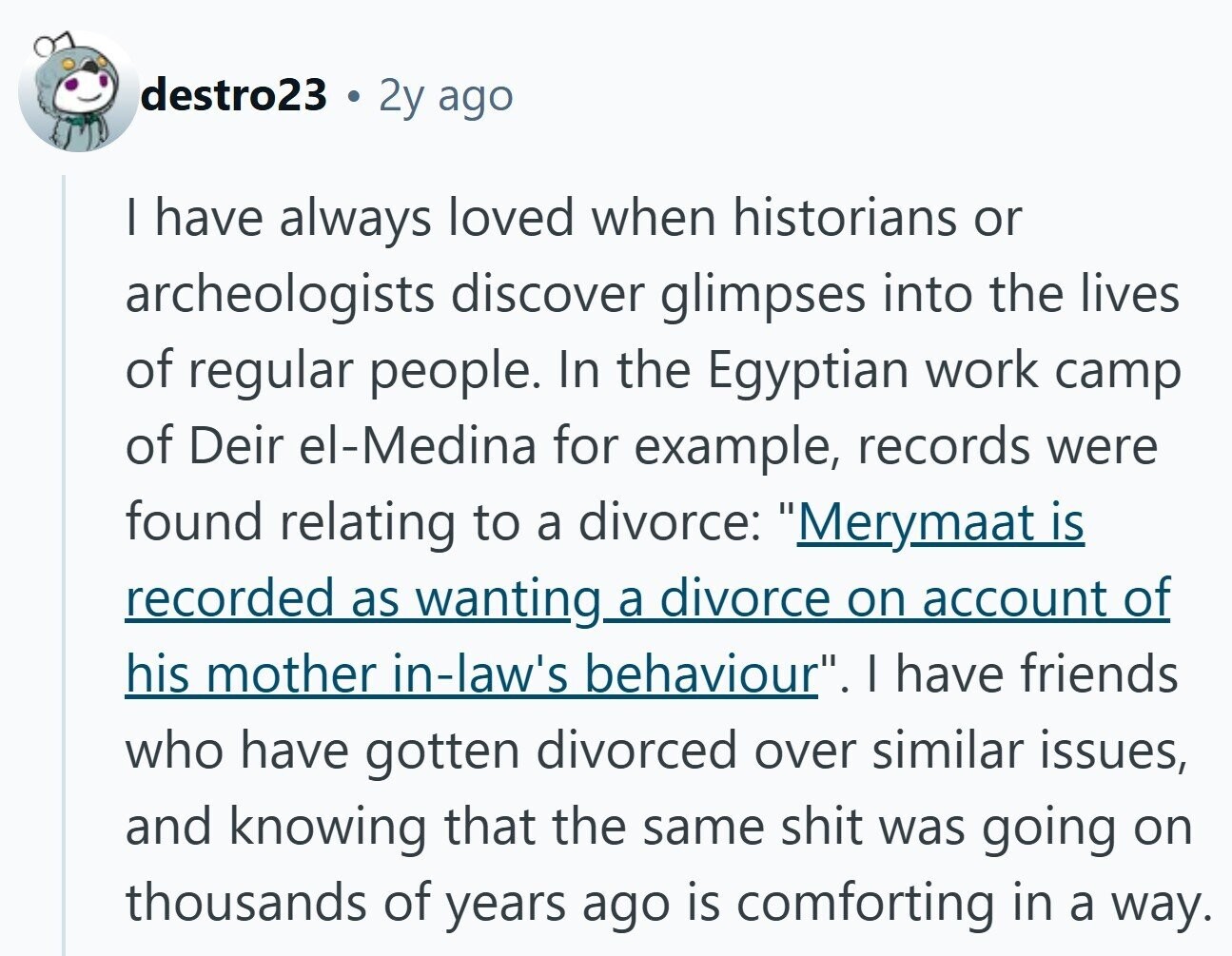
destro23 2y ago I have always loved when historians or archeologists discover glimpses into the lives of regular people. In the Egyptian work camp of Deir el-Medina for example, records were found relating to a divorce: Merymaat is recorded as wanting a divorce on account of his mother in-law's behaviour. I have friends who have gotten divorced over similar issues, and knowing that the same shit was going on thousands of years ago is comforting in a way.
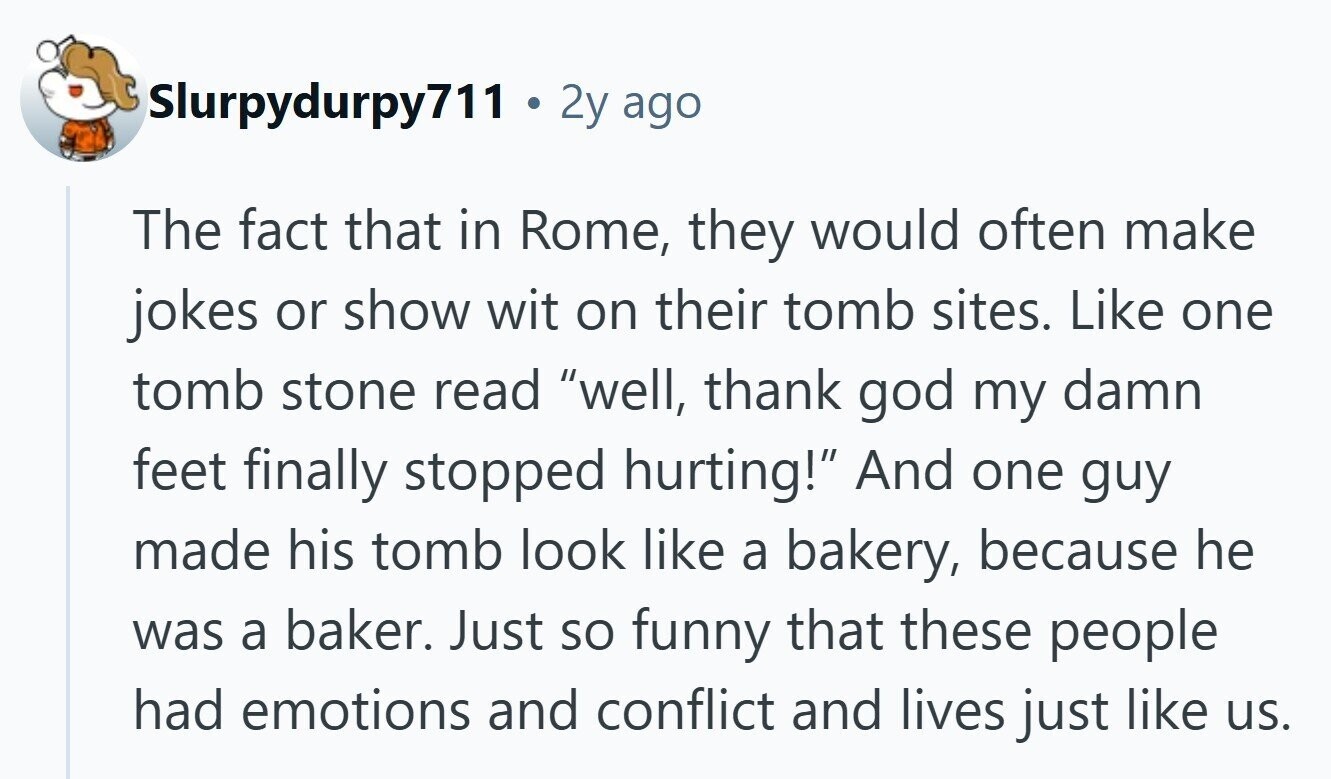
Slurpydurpy711 . 2y ago The fact that in Rome, they would often make jokes or show wit on their tomb sites. Like one tomb stone read well, thank god my damn feet finally stopped hurting! And one guy made his tomb look like a bakery, because he was a baker. Just so funny that these people had emotions and conflict and lives just like us.
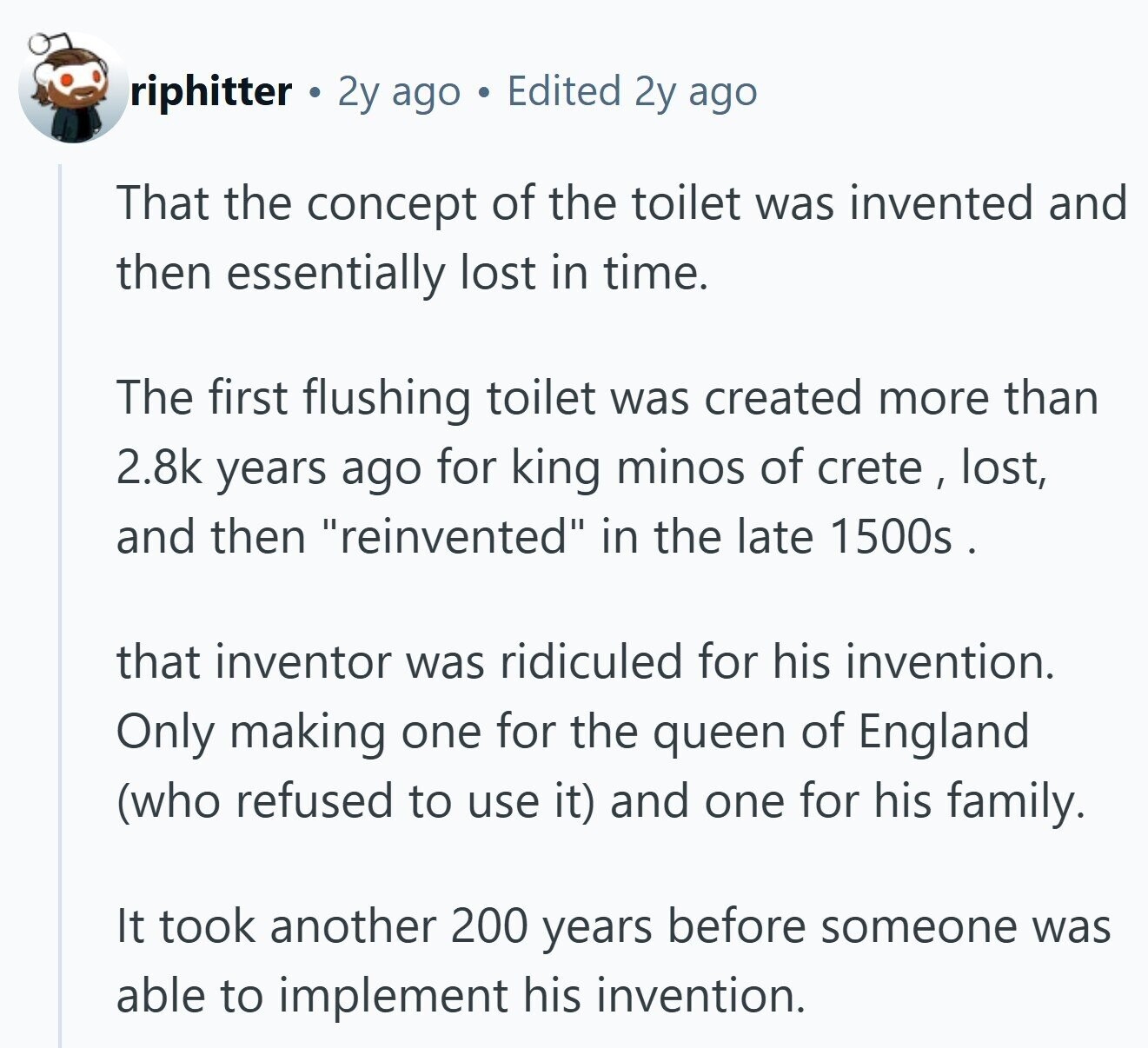
riphitter 2y ago Edited 2y ago That the concept of the toilet was invented and then essentially lost in time. The first flushing toilet was created more than 2.8k years ago for king minos of crete , lost, and then reinvented in the late 1500s . that inventor was ridiculed for his invention. Only making one for the queen of England (who refused to use it) and one for his family. It took another 200 years before someone was able to implement his invention.
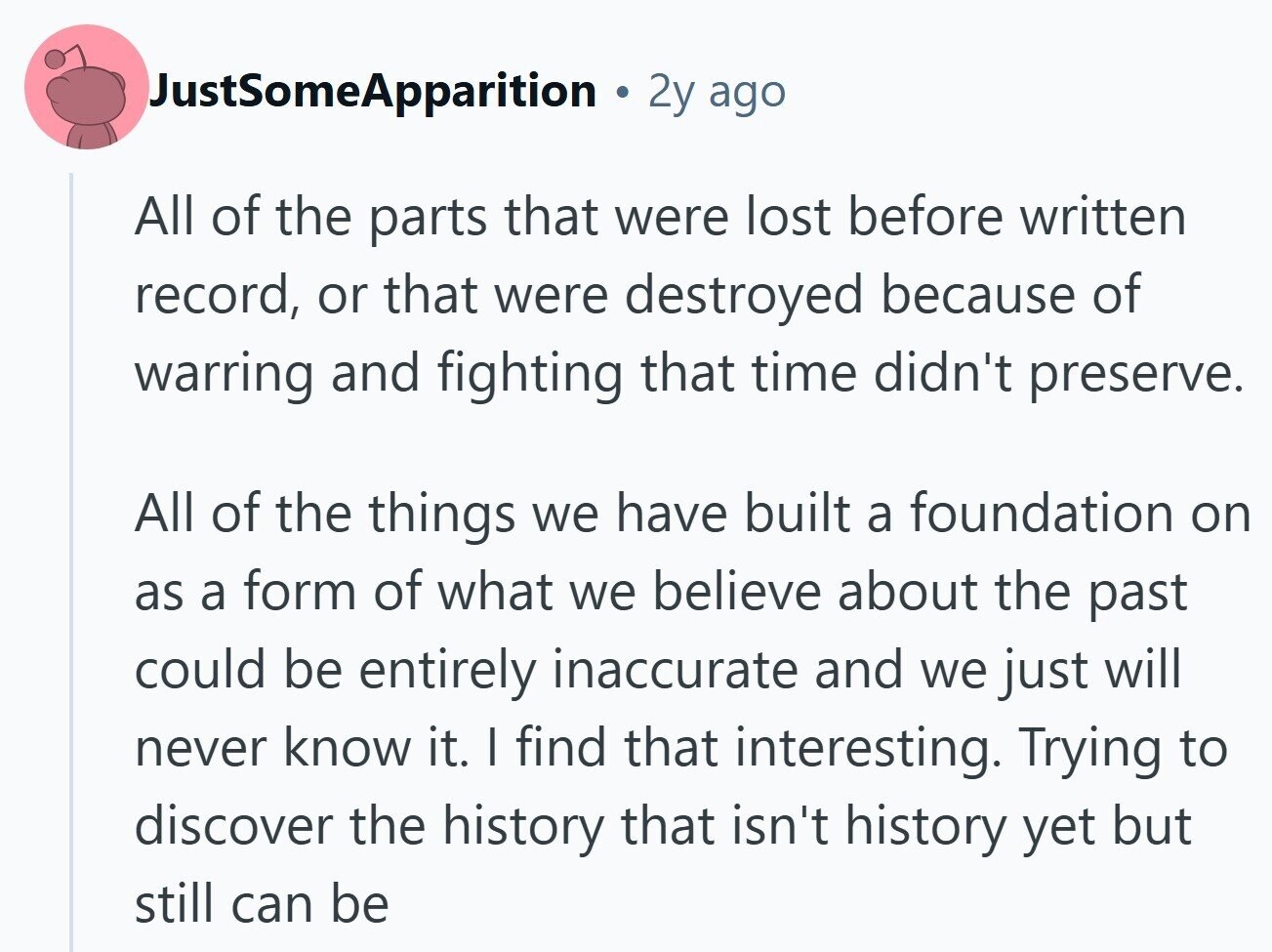
JustSomeApparition 2y ago All of the parts that were lost before written record, or that were destroyed because of warring and fighting that time didn't preserve. All of the things we have built a foundation on as a form of what we believe about the past could be entirely inaccurate and we just will never know it. I find that interesting. Trying to discover the history that isn't history yet but still can be
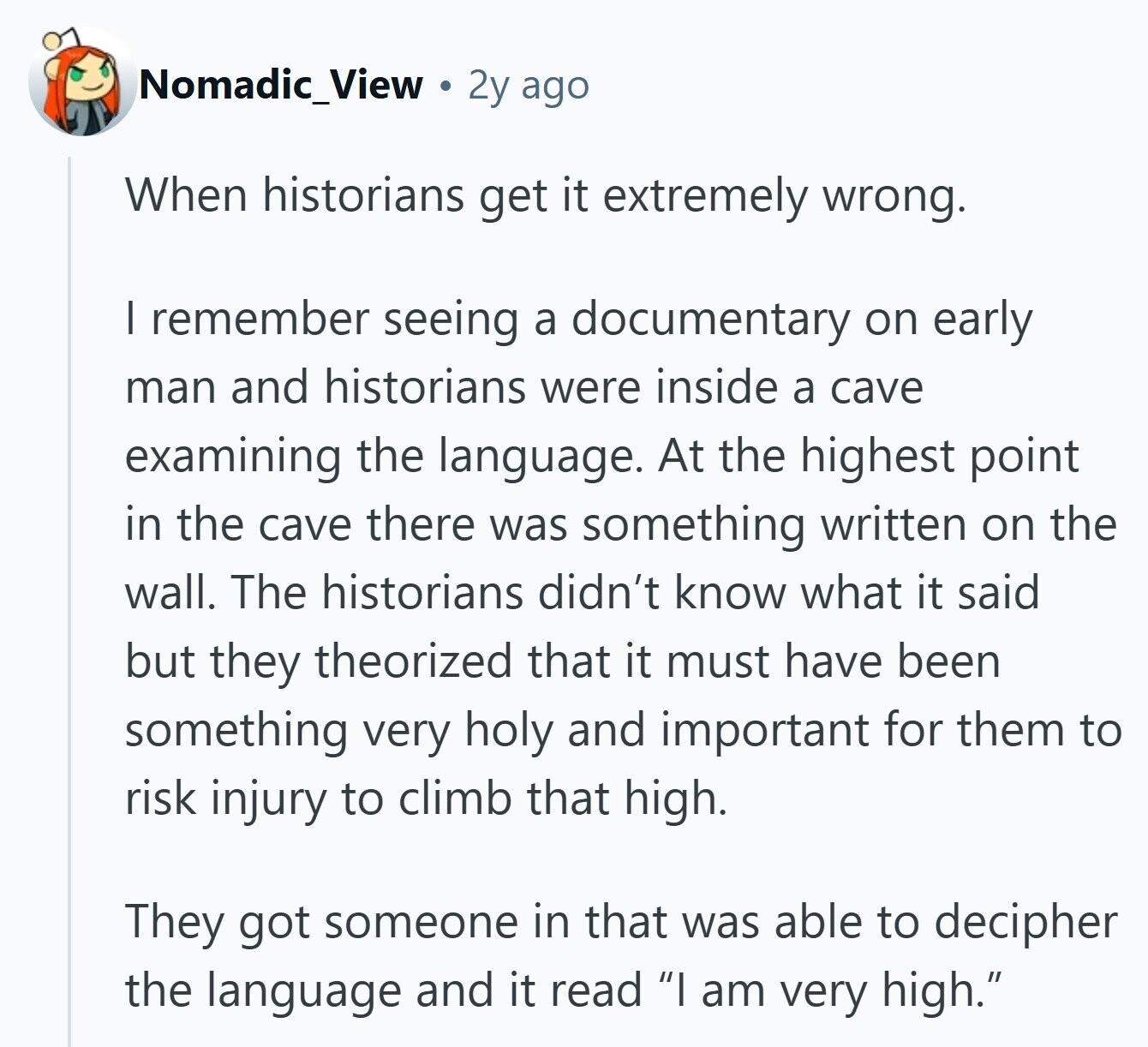
Nomadic_View 2y ago When historians get it extremely wrong. I remember seeing a documentary on early man and historians were inside a cave examining the language. At the highest point in the cave there was something written on the wall. The historians didn't know what it said but they theorized that it must have been something very holy and important for them to risk injury to climb that high. They got someone in that was able to decipher the language and it read I am very high.
Environmental-Car481 2y ago How did we ever get bread? Seriously. It's not like you just stumble upon berries or potatoes or find that cooking a meat makes it taste better. Wheat needs to be ground down. Add in water. And bake. For rising who figured out yeast caused that? So many questions.
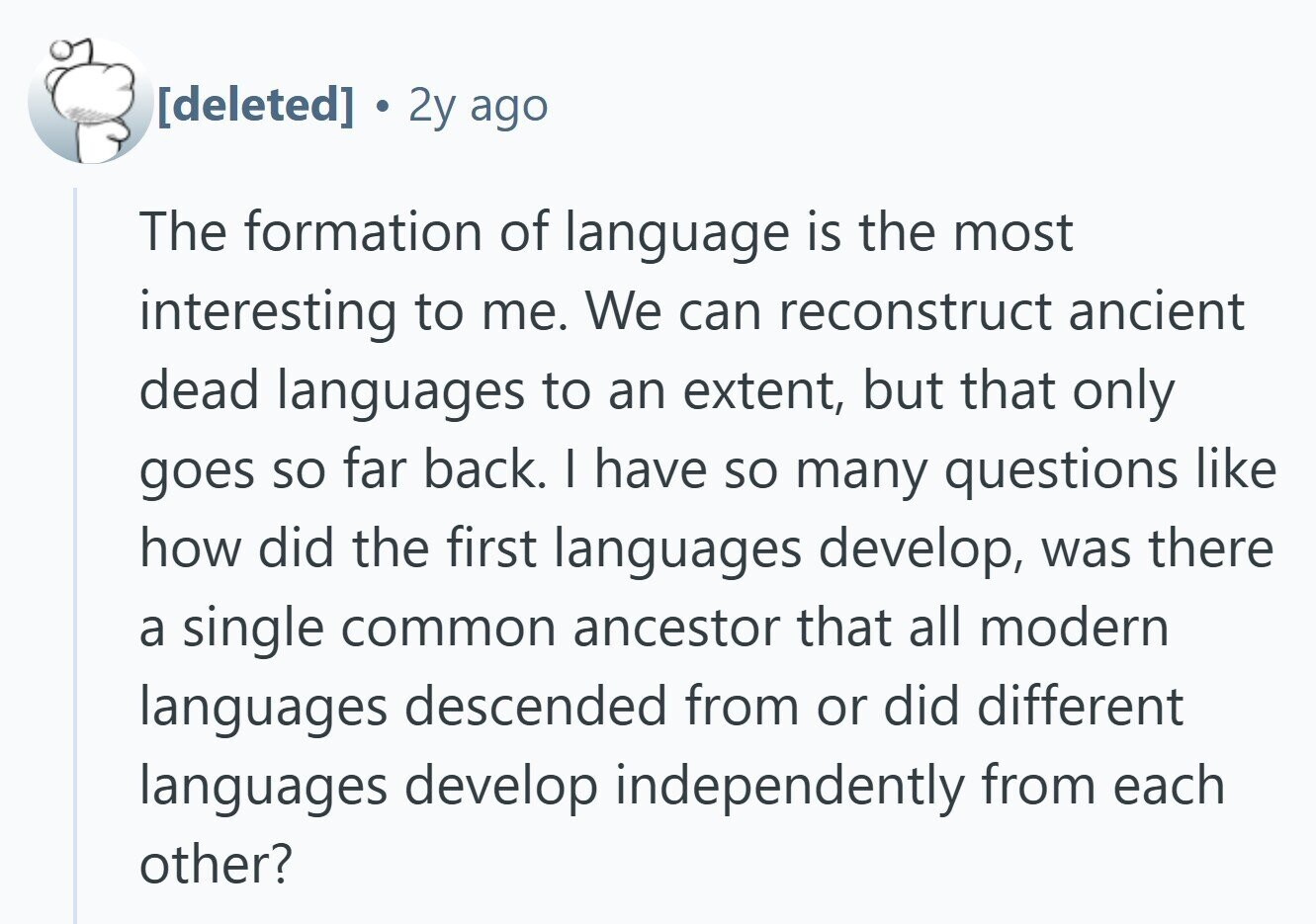
 2y ago The formation of language is the most interesting to me. We can reconstruct ancient dead languages to an extent, but that only goes so far back. I have so many questions like how did the first languages develop, was there a single common ancestor that all modern languages descended from or did different languages develop independently from each other?
Poutinemilkshake2 2y ago I think it's totally nuts how we look back at 50- 100 years ago and think of how different things were while forgetting there were cultures that went on generations and hundreds of years without any changes in anything. Fashion, tools, education, and so on.
DreamingOfHope3489 2y ago Edited 2y ago I bought a book recently called Crying: The Natural and Cultural History of Tears by Tom Lutz that I am looking forward to reading. In the book, Lutz researches the history of crying back to, what is for me, an almost incomprehensible amount of human history, the 14th century В.С., and examines how crying was experienced and depicted in art, philosophy, societal mores, etc. I myself have always been a deeply emotional person, I cry easily, so I am especially intrigued by this part of ancient (I think 14th century B.C. is considered ancient?)
MarduRusher . 2y ago Not exactly an original answer but the Bronze Age collapse. Really hope we figure it out, or at least get closer to doing so, within my lifetime.
rock-dancer 2y ago Trying to consider how people, whether the peasants or ruling class, saw and understood the world. Sometimes we imagine the Greeks like 21st century people with less technology. But the world they lived in was full of mystery and magic. Imagine truly believing that a sacrifice's guts could tell you whether it was a good time for battle and making military decisions that way.
SkotConQueso 2y ago Food discoveries! Like what cave man looked at a proto-cow and said Imma drink from that!? Or looked at coffee berries and said I'm going to shell it, roast it, grind it, brew it, and drink it. or the most wild, to me at least, who figured out we could eat octopus?
NatsuDragnee1 2y ago The fact that humans essentially remain the same under the trappings of the different cultures and time periods. People laughed and joked, fell in love, valued pets, had quarrels, and had customer service complaints back then just as they do now.
maiqthetrue 2y ago Not a specific time but I'm fascinated by civilizations collapsing. Like Sumer or Egypt, or Greece or Rome came to be extremely wealthy, powerful, and technologically advanced, had very complex cultures and art and literature. Then they fall apart, often under their own weight or by things that were easily handled decades before. I'm also rather fascinated by the origins of Christianity, and how and why it developed as it did.
Poutinemilkshake2 . 2y ago Native Americans came pretty close to having their own copper/bronze age. They had access to some of the purest native copper in the world but never figured out how to smelt or cast it. They just hammered it into shape and then for whatever reason they decided to go back to other materials
AntiMatter138 . 2y ago Gobekli Тере (built around ~10000 ВСЕ), it's so huge if you search the illustration of it, also mind blowing that the excavation is estimated to be below 20% so we have a lot to discover for that.
Thatingles 2y ago Humans emerge: 200,000 years ago Humans invent art & culture: at least 50,000 years ago, by which point we had spread across most of the world Civilisation begins? Gobokli Tepi is 12,000 years old and if it isn't civilisation, it's something closely related. So what most intrigues me is - did humans really spend 38,000 years - an unimaginable stretch of time - as just hunter gatherers? Surely there was something going on.
lessmiserables 2y ago How much of it is historians making shit up. OK, I'm being facetious, but there's a lot of ancient history that's based on some pretty sketchy things, and historians have to fill in the gaps the best they know how. We assume that if Civilization X did Y and we can prove it via archeological evidence, neighboring civilizations probably did the same--but we'll never know for sure. As disciplined as historians claim they are, a lot of it is just guesswork based on scant surviving evidence. I don't fault historians, because you have to work with what
forman98 2y ago The history that was lost to time from before the last ice age. The earth exited it's last glacial period about 11,000 years ago. We can easily see signs of sedentary communities as far back as 12,000 BC (14,000 years ago) in the Levant. How many sedentary communities, or full on cities, are lost because they were located on a coast that is now completely underwater? How many people lived on Doggerland, an area that went underwater only 8000 years ago and connected the British isles to mainland Europe? How many people lived in the Black Sea
mixmaster7 . 2y ago There are periods of Ancient Egypt that are ancient compared to other periods of Ancient Egypt.
WingerRules 2y ago Edited 2y ago Few things. 1. I want to try dishes people ate that were regularly available. I had this preconception that the masses ate bland gruel, but actually their food looked pretty_good.. It makes me wonder about ancient foods available in different areas. I can't tell you how happy I was to find that medieval peasants had access to such good food. 2. The amount of work that must have gone into gathering and moving materials. You have to mine out tons of earth to get even a small amount of metal. Castles and roman roads
castiglione_99 2y ago The fact the certain things seem to happen over and over again throughout history. Cold wars, globalization, saber rattling between superpowers, wealth inequality getting worse and leading to revolutions, economic collapses, pandemics. It's all happened before. The biggest eye-opener for me was reading about the Peloponnesian War - the way it started out, if you transposed it to modern times, could've been lifted news about international incidents during the Cold War, or out of a Tom Clancy novel.
_MooFreaky_ . 2y ago How much we just don't know. So much we think we know is based off the tiniest fragments, or from information we have that may be hundreds of years out of date. It's intriguing and fascinating, yet unimaginably frustrating.
SuperDuperDylan 2y ago How much of it was erased :(
cleverenam 2y ago The simplicity of their advancement from poor to rich. People look down on a mud hut but I guarantee a large population of first world people couldnt create a mud hut without tools today. Old school irrigation and plumbing systems, yeah modern plumbing blow old school irrigation away but once again take away the tools, transport 100 modern first world folks to a random spot in the wild and see what they come up with. Recently I learned that we track stars by looking up with a telescope but older civilizations tracked them by looking down into
yaboycharliec . 2y ago That there could be and probably are civilizations at the bottom of the ocean, covered in hundreds of meters of mud, buried in sand in the Sahara, etc. Sucked into the mantle through subduction zones, so on and so forth.
LovesMeSomeRedhead 2y ago We as a race of people have not changed significantly in thousands of years, yet our history only goes back a few thousand. What were our people like 10k years ago? If we were really advanced 30k years ago and had a catastrophe that send us back to the stone age, would we know? Would anything have survived?
 . 2y ago Religion and the myths around them. Like, I would love to see the historical Jesus, or Muhammad, and what they were really like and what they did, and how that slowly transformed into a religion.
Genshed 2y ago How much less we'd know about them if pottery or baked clay tablets disintegrated when buried. Nobody knew about the Epic of Gilgamesh for over two thousand years. If it wasn't for a few remarkable discoveries we still wouldn't.
SCViper 2y ago . Edited 2y ago Humans have been around for over 100,000 years. How is there only writing going back 6000 years?
Bobo4037 2y ago Two things: How did anyone live a long life without antibiotics, x-rays, advanced surgery,etc.. How did our species survive? Everyone must have smelled so awful, it must have been hard to have any kind of sex. Although I guess everyone was used to the smells.

Tags:

Scroll down for the next article
Forgot Password?