Leaving ‘The Great North’: The Creators of the Animated Series Discuss the Show’s Journey and Recent Cancellation
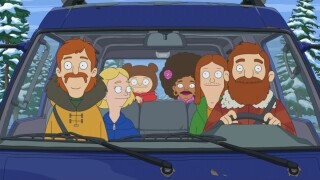
Fox’s Alaskan adventure has come to a close.
The news recently broke that The Great North won’t be returning for a sixth season and that the Season Five finale, which aired on September 14th, would be its final episode.
When The Great North debuted in 2021, it began as something of a sister show to Bob’s Burgers, as its co-creators and showrunners, the Molyneux sisters, came from that series and it featured the same style of animation. It also shared a musicality and gentler brand of comedy with Bob’s Burgers. But the setting for The Great North was so wildly different than a boardwalk burger shop that the series quickly found its own territory to explore.
Don't Miss
At the center of the series was Beef Tobin, an outdoorsman and single father to Wolf, Judy, Ham and Moon, all of whom reside in the fictional small town of Lone Moose, Alaska. There was also a good deal of heart to the series, at the center of which was that Beef’s wife and the mother of the children, Kathleen Tobin, abandoned the family before the show began. This setup gave the series a weightier dynamic and room for character growth, which was most evident in Beef, who eventually learned to let his wife go.
In an era when shows like Bob’s Burgers, Family Guy and The Simpsons run for decades, only five seasons of The Great North may seem like things were cut short, but with 97 episodes, The Great North undoubtedly had a solid run. It also told a complete story about its main characters with both humor and heart, which is precisely why I reached out to Wendy Molyneux and Lizzie Molyneux-Logelin to offer a bit of a retrospective on the show.
Before getting into the ending of the show, I wanted to talk about the beginning of The Great North. What were you trying to say with the series when it began?
Wendy Molyneux: We wanted it to be a show that explored being quirky. Our setting was out there, and we tried to make it so that each character was kind of out there in their own way and all mushed together into this family that was funny, but also found ways to get along in spite of how different they all were — particularly Beef and Judy, because Judy longed for the glamour of the mall and Beef loved the vastness of the outdoors. That was the germ of it. Then, as it built out, we really fell in love with the town, too, and wanted to establish this sense of place for Lone Moose. The more we learned about Alaska and Alaskan small towns, the more we wanted our show to express that vibe as well.
Lizzie Molyneux-Logelin: There's the tradition of a show about a town that's a little smaller, but that still has the diversity of the bigger world and a little bit of heart and optimism about what it means to be a person in this time. It’s a little cheesy, but I do think there was a bit of that running in the background — that it’s good to be weird, and it’s fun to live in a place where everyone is weird in their own way.
Wendy: Also, we just set out to make a comedy that uses animation a little closer to the way that Bob's Burgers does, where it’s a little closer to reality, but there’s plenty of room for fantasy, music, etc. — but not as many crazy cutaways and wild stuff you might get on some animated shows. And I think we did what we set out to do for five years.
Where did the setting of Alaska come from?
Lizzie: We knew we wanted to do a smaller town. We obviously stayed away from the East Coast, as Bob's Burgers is in that zone. And there have been so many animated shows that are set in a small town in Middle America. So we were trying to think outside the box; I had recently been to Alaska, and it was top of mind.
The natural environment up there is so impressive and overwhelming. I remember being at a grocery store and just looking off in the distance, and there’s the most enormous, beautiful mountains you’ve ever seen in your life. It felt like a really nice place to showcase visually and a great area to help us generate stories because there’s so much going on with the wildlife. So many people end up heading to Alaska because they love being outdoors or they’re drawn to certain aspects of it. So, it felt like that could be a fun place to explore.
Wendy: Because of the setting, we set ourselves a goal to really be outdoors more in our show, which I don’t think is a consideration for most shows. It was really a story generator for us. It kept it fresh because we were coming off of Bob’s and we wanted to be somewhere where our brains could run free in terms of thinking of new things. We needed to be somewhere different.
With Kathleen having left the family before the show began, the series has this theme of abandonment that recurs occasionally and leads to some of its most heartfelt moments. How did you land on that dynamic?
Wendy: We’ve been trying to get our mom to leave us our whole lives, for her to run off, and this was our way to do it in a show.
Lizzie: Initially, we knew we really liked this idea of a father and daughter. We loved working with Jenny Slate, and we felt like her voice is so fantastic for a teenage girl character. Then, we knew we wanted to work with Nick Offerman. It felt like that pairing, where she has such a big personality and he’s a little more reserved, would be really fun. That naturally led to the question of “Why is their bond so strong? What happened to her mom?” So, we were like, “It’s very funny if she just took off and left the family to fend for themselves.” It naturally came out of building the family and building their connection. We wanted it to play as a comedic choice, but then there’s also the real aspects that we carried through of what it would truly mean for this family.
Wendy: Also, there’s the trope of the deadbeat dad or the dad who leaves the family. It’s much less common in shows and movies to have a mom who peaces out. It felt like a fun starting place to explore different types of storylines, even if Kathleen, as we always intended her to, remained a myth within the family. We never actually meet Kathleen, so we could make up whatever we wanted about her, including that she destroyed an owl sanctuary and rode a police horse through the Toys ‘R’ Us.
Was that a rule for you guys — that you never wanted to show her? Or do you think you would have gotten there with a longer run?
Wendy: There was never going to be a reunification. That was the story of the family, and now that we’ve gotten to write a show for five years beginning to end, I think the story was also about the progress of a family that had been abandoned.
It started with them a bit obsessed with her. In the first episode, Beef can’t admit that she did what she did. He has to pretend she’s dead. But by the end, she’s not so much a factor for Beef anymore. He’s moved on, he’s had girlfriends, he’s become the town mattress and he’s gotten over her to a certain extent, and the family is really whole as a unit by the end. We would’ve loved for this show to go on for 25 years, but it didn’t, so at least we got the chance to tell this arc.
Is that what you always thought would be the arc, or did you find it along the way?
Lizzie: We really found it along the way. Going into the first season, it’s this emotional cloud looming over them. It’s obviously the subject in the pilot, and then you have to baby step it out. It’s like, “When does it feel right to let Beef go out on a date?” From there, you want it to build naturally and, obviously, create the most room for comedy that you can. It all evolved naturally and got to the place that it did with everyone pitching stories. He definitely had the most growth overall as a character, and Nick, obviously, can do that.
Wendy: It’s a dance because you’re living in the eternal present and your kids are never supposed to age — maybe a couple of our characters have gotten one year older during the course of the run, but that’s it. For Judy, it was just exploring different aspects of being a teenager. Ham had a whole relationship begin, transpire and end, and that was interesting and fun. Of course, we would’ve liked to explore single Ham a little more, but R.I.P. Ham. Everyone’s dead now, I keep saying.
Then Moon, he got his first kiss and had a little bit of growth in that direction. I think the introduction of Aunt Dirt in Season Four really helped us expand Moon in a way because Moon and Aunt Dirt were similar and liked to be together, and we had this unlikely pairing of a 10-year-old boy and an 80-something-year-old woman that was super fun.
Because Aunt Dirt was gay and Ham was gay, that was also a fun way to explore those topics in a primetime Fox cartoon in a realistic and fun way. It was more the interplay between them and circumstances in their lives that helped us explore different aspects of them, rather than them aging or changing super significantly over the course of the series.
When did you get the feeling that The Great North wouldn’t be coming back?
Wendy: It was a few episodes into Season Five. It was very business-related because there was the Fox 20th partnership, and we just weren’t necessarily making the big bucks for anybody. It is what it is. There was never any feeling of “We don’t like this show, or we better get rid of this show.”
Lizzie: And because the animation process takes so long, you know by a certain point if we’re doing the next season. It was never completely certain, but all the clues were there and we did get that heads up enough to make some choices that we wanted to make, which was good.
Did you know for sure that this was it, or was it just probably the end?
Lizzie: We didn’t know for sure, so our thinking was, “Let’s have the episode in place that will feel good if this is it.” But it could have continued, so we didn’t have everybody drown or Beef go nuts and kill the family.
How did the story for the finale come about?
Lizzie: The idea of doing an It’s a Wonderful Life about someone in the family is something that had been floating around. It had been on our boards for other seasons, and we played around with it. Then, thinking about the potential end of the show, we knew we wanted to tell a Beef story and give him some sort of perspective on everything that had happened over the seasons we created.
Wendy: I think too, not to get too overarching or out there, the theme of this episode is that Beef doesn’t have to do this huge thing — that your life is for you and for the little experiences you have. And right now, we’re in a moment where people feel like, “Oh God, I have to do this big thing. I need to be known. I need to take this huge swing or be this public person.” So it’s about this idea that you can be a good person for just doing small, decent things.
