‘I Love Lucy’s ‘Vitameatavegemin’ Routine Was a Lot Naughtier in Vaudeville
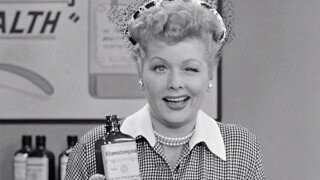
Lucille Ball might have been a creative visionary, but she was no stranger to the yoink. We’ve told you before that one of the most iconic scenes of I Love Lucy, in which Lucy fails miserably to keep up with her work as a chocolate factory in the episode “Job Switching,” was inspired by a 1936 Charlie Chaplin film, and it wasn’t the last time she took inspiration from ‘30s slapstick comedy. In fact, probably the only other episode of I Love Lucy that anyone born this century can recall was borrowed — if toned down significantly — from vaudeville.
In the Season One episode “Lucy Does a TV Commercial,” Lucy has once again schemed to get herself on TV, this time as a spokesmodel for a health tonic called Vitameatavegamin. The gag gets a big laugh right out of the gate when Lucy can’t hide her disgust upon tasting the product during rehearsals, but the joke escalates to dizzying heights when it’s revealed that Vitameatavegamin contains a staggering 23 percent alcohol. With every extra take, an unwitting Lucy slurs, stumbles and sloshes her way to disaster.
Don't Miss
It’s a bit as closely associated with Ball as her hair, but it originated with a different Red. In the ‘30s, when legendary comedian Red Skelton was still just your average vaudevillian, he was amused by FCC regulations that forbid depictions of drinking beer and wine or advertising hard liquor at all. Wouldn’t it be funny if the opposite were true? Not only could such a demonized product as, say, gin sponsor a radio program, but the pitchman had to drink it? Skelton knew that a lot of spokespeople never tried the products they sold, so what if it was someone who didn’t drink and had no idea what gin would taste like? The result was the skit known as “Guzzler’s Gin.”
The similarities to “Lucy Does a TV Commercial” are obvious, right down to the pitchman coming up with creative solutions to his increasing difficulty pouring the bottle and eventually just drinking straight from it, but it differs in important ways, most notably the fact that Skelton’s spokesman is well aware of what he’s drinking. Keep in mind, this was just post-Prohibition, so it was as risque as How High in the 2000s. As Skelton noted, however, Ball’s family-friendly version became much more famous than his, proving that there’s some merit in selling out — namely, the selling part.
