The 7 Sneakiest Ways Corporations Manipulated Human Behavior
In a perfect world, there would be no substitute for a quality product offered at a bargain price. But this is not a perfect world, and a lot of times the only thing between mediocrity and market dominance is the kind of devious plan that would make a supervillain proud.
Like ...
Tricking Doctors into Saying Bacon Is a Healthy Breakfast Food

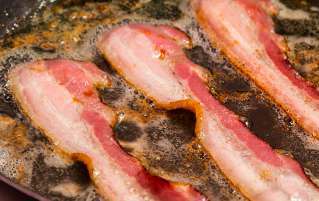
Here's something you've probably never wondered: Why are some foods considered "breakfast" foods (pancakes, bacon, eggs) and others not? Why is it weird to eat pancakes for dinner and pizza for breakfast? Well, if what we know about bacon is any indication, it's purely a matter of marketing.
You only have to go back several decades to find a time when bacon for breakfast was about as alien as having a steak for dessert. The entire reason we even consider bacon part of a traditional breakfast is due to the work of one man and a lagging company's desperate attempts to sell their product.

We will not stand idly by while we tarnish bacon's good name!
The Deviously Simple Plan:
Edward Bernays, aka the godfather of spin and the forefather of modern PR, was given a simple task: sell bacon like a motherfucker. Bacon seller Beech-Nut Packing realized that sales of their products were slipping and they hired Bernays to fix that. Seeing as this was the same Bernays who convinced women that smoking was totally the best way to stick it to men back in the '30s, they figured he was up to the task.

Bacon's much easier to sell than lung cancer, though only slightly less deadly.
His target would be a specific meal: breakfast. Now, at the time, breakfast wasn't considered a big, heavy meal -- it was a cup of coffee and some toast for most people. Bernays needed to convince America that breakfast was Bacon Time.
Being the nephew of the legendary Sigmund "You're always thinking about wangs" Freud, Bernays knew that to a customer, the words of famous spokespeople were nothing compared to the words of a trusted professional. So Bernays approached a doctor with a simple question: Was a hearty breakfast better for a person than a smaller, shittier one?

"So basically you're asking me if size matters?"
Once he had the obvious answer, he then asked whether bacon and eggs could be considered a hearty breakfast. Again the doctor agreed. That was all he needed; Bernays repeated this process with 5,000 doctors, using this roundabout method to get them to actually say that strips of fried pig fat was a healthy way to start your day. Newspapers across the country treated this bullshit publicity stunt as a scientific study and ran story after story about how if you weren't starting the day with a big plate full of bacon and eggs, you were signing your own death warrant. Beech-Nut's sales soared.
We can't really do the story as much justice as the man himself, because you can totally tell that all the way through the story, he still can't quite believe that people fell for his bullshit:
McDonald's Removes the Guilt from Ordering More Food

If you went back in time to the 1960s, you'd be shocked at how small fast food was back then. And we don't mean Baconators had less bacon, we mean burgers are now 500 freaking percent bigger than they were when McDonald's first came around. It was just good economic sense: The meals were cheap, so you only got a little food. If you wanted more, you just had to order more. There was way more profit in selling two orders of fries than there was in selling one larger size.

"If you'll turn to page 509 of our report, you will see that two is almost certainly greater than one."
But when McDonald's head Ray Kroc noticed that some of the local store sales were starting to plateau in the 1970s, he hired a guy named David Wallerstein to figure out why.
Wallerstein started his research by going to several McDonald's locations around Chicago to watch people eat, presumably through a newspaper with eye holes cut into it. Wallerstein noticed a peculiar trend: People would sit picking at the bottom of their fry bags while others fruitlessly tried to suck nonexistent soda out of their insultingly small cups, but they never went back to buy more.

"Another small salad? Check out Fatty McLardass over here!"
This is when Wallerstein realized that there was a social stigma in being seen ordering extra portions of anything. People who loved fries didn't just ask for a double order, because they thought other people would judge them for their gluttony.
The Deviously Simple Plan:
Wallerstein's solution was simplicity itself: Normalize the idea of ordering bigger food. Put it right on the menu, promote it and just charge more up front. Tell the cashiers to offer the larger sizes to customers, sending the subconscious message that "It's totally OK to eat twice as much food as is recommended for a person your size, and in fact we would prefer if you did." Wallerstein pitched his idea to Kroc, who promptly shot it down.

"What do you think we are, a nation of gluttons?"
But Kroc eventually came around, and McDonald's would fully embrace the idea of "supersizing" meals in the 1990s. An entirely new model for selling fast food was born, booming almost as dramatically as the worldwide obesity epidemic that mysteriously occurred around the same time.
Cake Mixes Make You Add an Egg for No Reason Whatsoever

Betty Crocker is one of those elite household brand names everyone recognizes, even if none of its billion or so customers know who Betty Crocker is or if there was ever a real woman with that name. The brand got to where it is thanks to a line of instant cake mixes, which turned the hours-long pain-in-the-ass process of making a cake from scratch into a simple matter of adding water and then cramming it into the oven.

Men had to nearly double their dirty laundry output just to make sure their wives were busy.
But the initial sales were terrible. To housewives, it almost seemed too easy. How could a cake worth eating come from a "just add water" mix?
So, the people at Betty Crocker knew what they had to do: make the process harder.
The Deviously Simple Plan:
For help, the company turned to Ernest Dichter, a pioneer of advertising and one of the first to use focus groups and psychoanalysis to aid with product development and advertising. After countless hours of probing the minds of customers with surveys, questionnaires and a terrifying gaze framed by his heavy '50s era glasses, he had his answer: make the customer add an egg while baking.

"Are we sold on the egg? I kinda liked Jim's idea of stuffing a live rattlesnake into every fifth box."
It was completely unnecessary -- the first mixes had powdered egg built in. But this pointless and symbolic extra step worked like a charm -- sales skyrocketed, to the point that today you probably have never eaten a cake that didn't come from an instant mix. It turned out people who bake things still want to feel like they're doing something.

"This is degrading, patronizing and insulting to women, and I won't -- oh goddammit they're buying it."
So why have them add the egg, instead of some other ingredient? Some claim the egg held a special significance as a symbol of womanhood and fertility. But it really seems more likely that cracking a fresh egg just makes you feel more like you're actually baking something homemade, instead of feeding your party guests a powder-based dehydrated space food. In an age when everything was becoming instant and automated, people just wanted to feel like they were still needed.
Cadbury Assumes You Won't Remember How Big Their Eggs Are from One Easter to the Next

For those of you unfamiliar with Christianity, it may be difficult to explain why they celebrate the brutal torture and resurrection of their deity by eating a shit ton of chocolate. It would be even more difficult to explain why the candy is shaped like bunny rabbits and chicken eggs, and in fact you'll find that if you ask an expert, it's almost impossible to get a straight answer.

One theory is that rabbits were believed to reproduce asexually, thus giving virgin birth.
Regardless, one of the most popular treats around Easter is the Cadbury Creme Egg, a seasonal candy that is just a chocolate shell shaped like a chicken's egg, with a sugary white-and-yellow filling inside. You know, so you feel like you're eating a raw egg. So what were the people at Cadbury to do when sugar prices started eating into their profits, with consumers unwilling to pay more?
The Deviously Simple Plan:
Shrink the eggs, and tell consumers that they're simply misremembering how big they were before.

"Smaller? You're crazy! Next you're going to tell me it's not all right to sleep with your wife!"
Because the eggs are a seasonal item, that means that for nine months of the year, no one has any access to them. In 2006, when the company shrank the size of the eggs, they posted a message on their website saying that the eggs hadn't gotten smaller, your hands and mouth had just gotten bigger (or as they phrased it, "You've just grown up").
Strangely, it was actor B.J. Novak (Ryan from The Office, also seen in Inglourious Basterds) who decided to go on TV to prove that Cadbury was giving everyone less for their money:

"I have a lot of downtime on set."
Cadbury was forced to change their website messaging to the slightly more honest though incredibly vague statement that they offer a "broad variety of sizes and flavors of products." See, they only made them smaller to appease all of those people who insisted on getting less product for their money.
Alka-Seltzer Doubles Their Dosage With a Theme Song

Alka-Seltzer is one of those weird products that seem to have no competitors. It comes with two tablets you drop into a glass of water, they dissolve, you drink it, you feel better. You may only know Alka-Seltzer as a slayer of hangovers, but if you are old enough to remember the 1970s and 1980s, you remember their TV ads absolutely bombarding prime time television. You can guess someone's age by whether or not they can complete the phrase "Plop, plop, fizz, fizz." (The correct answer: "Oh what a relief it is.")

Only the best ads provoke the sinking feeling that someone might be screwing with you.
Two tablets, that's all it takes. "Plop, plop," just like the jingle says. Except you actually only need one tablet. The second "plop" isn't doing anything but dissolving your money.
The Deviously Simple Plan:
Up until the 1960s, the instructions only said to use one tablet, and that's all they showed people doing in the ads. But the company hit a rut. Sales were steady, but not great. They needed a way to market the product to younger customers, and to get them to buy more.

"How do we give kids more heartburn? Don tells me you have something called 'Taco Bell'?"
This is when inspiration struck: tell people to use two tablets, even if they didn't need to. It's not like taking two of them would kill you or anything. The problem was that nothing in the company's current advertising said anything about taking two Alka-Seltzers, and it's not like they could just arbitrarily tell people to double the dosage and never explain why, right? Oh wait, that's pretty much exactly what they did. They just had a cartoon mascot sing it. Who's going to argue with a jingle?
Thus was born the "plop, plop, fizz, fizz" campaign, aka one of the greatest and most terrifying ad campaigns of all time:
Just like that, all of the decades where they insisted that one tablet was enough were erased from memory, with utterly no explanation. Sales didn't exactly double, but people started doing exactly what the company wanted. Using two Alka-Seltzer tablets became the norm, with so-called "single fizzers" being stigmatized and beaten in the street.
Chivas Regal: If We Jack Up the Price, They'll Assume It's Good

Despite having a pretty-good-tasting whiskey, and selling it at a bargain, Chivas Regal's sales kind of sucked. Simple market math says in that situation you need to cut prices, or improve the product, or pour millions into advertising. Ideally via The Flintstones.

"Gee, Barn, I just feel like unfiltered Camels better deliver the slow release I crave from this torturous life."
But there is something unique about the liquor market that makes it different from selling other beverages. Perception is everything. But how do you change people's perception of your product?
The Deviously Simple Plan:
Leave the product exactly the same, and massively raise the price. And we're talking about charging far more than any of the major competitors.

"Johnnie Walker? Oh I'm sorry, I thought you wanted scotch, not oak-matured goat piss."
Suddenly, people started buying it.
Yeah, it turns out that most people don't know anything about alcohol, or what makes for good-tasting scotch. You can't blame them -- besides looking at proof, there is no objective way to measure the quality of alcohol. So, in situations where there really isn't anything tangible to consider, people look at the price. People automatically assume that if the company charges more for a product, it must be worth more. And get this: They continue thinking that even after they drink it.

If you don't spend a lot of money, how will anyone know how much to hate you?
Scientists actually tested this: At the California Institute of Technology, they did an experiment where they stuck people inside an MRI and gave them a couple glasses of wine. Although the glasses were both from the same bottle, the people were told that one glass contained regular table wine, and the other contained an incredibly expensive vintage. As the subjects drank from each glass, the part of the brain that controls taste behaved the same, but the brain's pleasure center went off like crazy on the "more expensive" glass.
And if you're thinking that you'd never fall for a cheap trick like what Chivas Regal tried to pull, well, guess what: That's why it works.

Introducing our new website, for only $3.99 an article ...
The Invention of the "Coffee Break"

Some of you reading this drink more coffee than water. But no matter how much it seems like a staple of our workday, the popularity of the drink comes and goes like any other product (you might have noticed there wasn't a Starbucks on every corner when you were a kid).

"A coffee shop? But I've got a perfectly good wife at home!"
So, during the 1950s, coffee was going out of style. For whatever reason, people started thinking of it as something low class, only consumed for the side effects. To turn the tide, the coffee-growing nations of South America and the major coffee companies in the United States banded together to form the Pan-American Coffee Bureau. They poured a ridiculous $2 million a year into making Americans love coffee again. To do this, they recruited sociologist John B. Watson, now working in advertising after a previous career in scaring the shit out of babies, to lead their campaign.
The Deviously Simple Plan:
Watson noticed that during World War II, some factories started giving their employees a couple of minutes off every shift, during which time some of these workers would drink a quick cup of coffee to wake themselves up. Figuring that using the novel idea of "work less" to sell coffee was worth a shot, he ran a massive series of advertisements to get people on board with the new "coffee break" idea he had thought up. His ads featured happy people sitting around and conspicuously not working, all while drinking huge mugs of coffee.

Do you see, beer advertisers? This is called "subtlety."
It makes no sense whatsoever. At most jobs, you can drink coffee while you work. And there are a million things you could be drinking or eating on a work break. It didn't matter -- you don't question tradition, even if it's a tradition somebody just made up last week. Getting people to refer to their morning break as a "coffee break" was enough to cement the idea that if you consumed anything else but coffee on that break, then you were screwing it up somehow.
By the end of the first year, 80 percent of businesses were giving their employees a short break, and they didn't call it a "cola break" or a "candy bar break" or a "sit quietly and stare at the kitten calendar in your cubicle" break. No, it was a goddamned "coffee break," thanks to one of the most ingenious marketing moves in history.

Had to be coffee. Couldn't be the "Skyrim break" or the "blowjob break." Fuck this guy.
Karl has a Twitter, Facebook and a blog. He also says hi. Jack Hall is busy chasing ducks right now, but can be hired to write funny for you by emailing coastyjack@gmail.com.
For more ways you're getting screwed out of your money, check out 5 Ways Stores Use Science to Trick You Into Buying Crap and Dickonomics: How 5 Everyday Businesses Trick You.
If you're pressed for time and just looking for a quick fix, then check out The 2 Best In-Car Freakouts In TV History.
And stop by LinkSTORM to see how we're screwing you out of time -- like that movie with that hot sexy actor who has time on his forearm. The Matrix or something.
And don't forget to follow us on Facebook and Twitter to get sexy, sexy jokes sent straight to your news feed.
Do you have an idea in mind that would make a great article? Then sign up for our writers workshop! Do you possess expert skills in image creation and manipulation? Mediocre? Even rudimentary? Are you frightened by MS Paint and simply have a funny idea? You can create an infographic and you could be on the front page of Cracked.com tomorrow!
