6 Bizarre Ways Architecture Is Designed to Ward Off Ghosts
When designing a building, you have to account for things like terrain, materials, weather, handicapped accessibility and, of course, ghosts.
You can design a building more awesome than the Guggenheim and nobody will want to go in it if there's evil spirits just running through it willy-nilly. With that in mind, here's how people in different parts of the world build guaranteed demon-free housing.
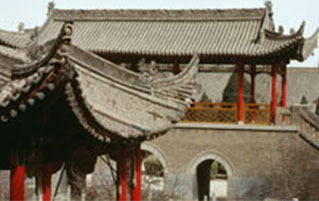
Chinese Curved Roofs

Quick, what do you think of when I say, "Chinese architecture"? The first thing you probably think of is that the doorways don't need to be as high, and then the second thing is probably those weird curvy roofs like you always see on pagodas.

Why do they build them that way? Because of ghosts. Did you know that spirits can only travel in straight lines? Well, according to Chinese tradition, anyway. Sure, they might be evil spirits, but they're Chinese evil spirits, dammit, and they are going to do things by the book. None of this individualistic zigzagging and newfangled "turning." No sirree, we're just going in traditional straight lines like we've been doing for thousands of years, thank you very much.

They're also afraid of fireworks. Goddamn, do we have the stupidest evil spirits ever.
That's the explanation given for many curvy roads and paths in China, and the fact that it's easier to curve the roads to follow the contours of hilly terrain is probably just a coincidence.

This is an actual military road in China. I'm sure it's completely ghost free.
And that's why Chinese roofs are curved, supposedly. I'm not sure what happens when the straight-line spirits hit the curvy roof but I like to think they slide along the curve and fly right off the end, and also that they go, "Wheeeeeeeeeee!" while doing it.

"Haint Blue" Paint

If you've ever been shopping for house paint, you know there are a lot of ridiculous names out there for blue, leaving you confused whether you want "Utah sky," "blue lapis" or "windmill wings." Haint blue is sort of the opposite. It's one name for a whole bunch of shades of blue -- the exact shade doesn't matter as long as it repels ghosts, or "haints."

Does not repel poor maintenance.
As everybody knows, ghosts can't cross water, at least according to the Gullah people of the American South. The Gullah, descendants of African slaves, did not have money to mix standard paints at the Home Depot so they made their own paint -- mixing lime, milk and pigments in pits to make a blue paint that looked like water, which, when applied to a house, would obviously convince ghosts that the house was covered with rivers or something. They would paint porch ceilings as well as door and window frames. You know, all the typical ghost entry points.

Another story purporting to explain the porch ceilings specifically says that they're actually painted to look like sky, causing the spirits to think they're the way up to heaven. So they walk right on up to your porch, intending to give you a good haunting, moaning and complaining about how they're trapped between this world and the next, and then look up and go, "Oh, hey, heaven!" and make a quick 90-degree turn upward before they reach your door.

Like so.
I guess they're too dumb to figure out what happened, or else that would be a recipe for some really mad haints coming back to your house in a bit.
And another theory is that some people were just embarrassed about looking so superstitious so they painted the porch ceilings where people couldn't see them from the street. The important thing, after all, was that the ghosts would see it when they got there.
If you don't have your own backyard paint-mixing pit, you can buy actual Benjamin Moore-based haint blue shades today, if you trust mass-produced corporate formulas when it comes to protecting your home from ghosts.
Japan's Kimon Corner

I don't know whether Japan's spirits are like the Chinese ones and thus can't navigate corners or whatever, but I can tell you they all come from the same direction -- the northeast, or "kimon." Kimon means "demon gate," and is where the bad spirits come from. As you can guess, that would be a bad place to put a door.

The view would be terrible.
It would be a good place, obviously, to put something like a guard tower. Hiji Castle, for example, has a kimon tower on the northeast side, to guard against evil spirits. They even cut off the kimon (northeast) corner of the kimon (northeast) tower to be extra safe, somehow.

I guess that's kind of smart, actually. Structurally, a corner is a weak point. Flattening it off means it can stand up to more damage from demons before it begins to break down. I have no idea what kind of calculations you'd do on a structure to measure how much spiritual damage it can withstand, but you know what? I'm not an ancient Japanese architect. I'm not going to tell them how to do their job.
Say you're an average Japanese person. You live in an apartment. You can't build a fucking tower. How are you going to ward off spirits to protect your home, your family/robot companion and your spouse/pillow with a picture of an anime girl on it? Well, I guess your landlord is responsible for making the building kimon-safe on the outside, and the only way the spirits will get into your apartment is through your plumbing, so that's why it's a pretty big deal to not build a bathroom in the kimon corner of your apartment. I guess this is something quite a few Japanese people still actually care about.

Because nobody wants ghosts in their apartment to begin with, but if anything could make that worse, it's probably a ghost crawling into your apartment covered with an entire apartment building's worth of sewage.
Thirteenth Floor (And Floors that End in Four in China)

"Wait a minute," you might say. "The number 13 is not a ghost." You are clearly someone who has never had to wake up to the number 13 rattling its chains in the next room or causing your child to say "REDRUM" over and over again. Anyway, unlucky numbers are specific concepts that people believe will do horrible things to them in a magical way, so close enough. If you're insistent on ghost purity, read ahead to the next entry.
Most people have heard about some Western buildings not having a 13th floor due to superstition about the number 13. The practice has been dying out, but some newer buildings still do it, like One Canada Square, the tallest building in Britain (until the Shard London Bridge is completed).

Doesn't really have much else going for it, does it?
One Canada Place gets around the problem by having no "usable space" on the 13th floor, and no button for it on the elevator. Other buildings just rename the 13th floor as "14," exposing the unsuspecting residents of the new "14th floor" to all kinds of magical catastrophes, unless the number 13 spirit is as stupid as a Chinese ghost and just wanders away disappointed after not finding its designated floor.
Speaking of China again, Chinese buildings are even better. The unlucky number in China is four, as well as any number that ends in four. Why? Because the word for "four" sounds like the word for "die". Yes, that's a superstition based on a pun. I think that accounts for about half the superstitions in China. Like the word for "orange" sounds like the word for "gold," so you eat oranges on the New Year so you can be rich. Anyway, so no fourth floors.

And on many buildings, no 14th floors either. And no 24th, 34th, etc. But wait! There's more.
China is part of the global economy now. That means they're picking up Western habits, like smoking, pollution, getting fat and a ridiculous avoidance of the number 13. So you can find buildings that are missing not only the fourth floor and 14th floor, but also the 13th floor.

I think the -1 floor here might have been an attempt to offset the missing floor four, but throwing out floors 13 and 14 kind of makes that whole exercise pointless, you'd think.
So yeah, it seems pretty silly, until you look at one study saying that Chinese and Japanese (who share the superstition) populations actually show a spike in heart attacks on the fourth of each month, apparently literally scaring themselves to death. The study has been disputed, but you can't say the number four isn't serious business in Asia.
Filipino Building Beliefs

The Philippines is an extremely superstitious country, which may sound a bit ballsy coming from someone whose people think evil spirits can slide off of roofs. There are many, many Filipino superstitions. But when it comes to building your house in a ghost-aware way, probably the biggest thing is basements.
In some cultures in the Philippines, basements and sunken rooms are seen as hiding places for evil spirits. The only way you can get away with a sunken room is if you have an exit in the house that is lower than that room.
I guess this works as a sort of evil spirit drainage. Sure, why not.

A guide to proper ghost drainage.
Though not directly ghost-related, a more popular superstition is "oro, plata, mata" (gold, silver, death). This is seriously almost exactly like "eenie meenie miney moe." When you're building steps in your house, you count them with, "oro, plata, mata," and repeat, so step four is oro again, and step five is plata, and so on. If you finish with "oro," you're good, "plata," you're OK, "mata," OH MY GOD YOU'RE GOING TO DIE IT'S THE DEATH STEP. So not a lot of three or six-step flights of stairs. This same phrase is applied to anything you can count off in the house, like flagstones in a path or planks in a ramp.
Ghosts take their "eenie meenie miney mo" SERIOUSLY.
Thai Spirit Houses

While a lot of cultures build their houses around spirits, Thais actually build houses for spirits. Thai spirit houses are built on the assumption that there are spirits living everywhere, including any land where you want to build a new building. Like anyone would be, they'll be upset that you're kicking them out of their house to build your dream home.
At some point in time, one brilliant Thai had the idea that you could build another house for them, next to yours. Then the spirits could live in the tiny spirit house and not bother you in your giant fancy people house that you built on their land. We had a similar plan in the United States at one point, only we did it to people, and we called the shitty houses "reservations."

Too soon?
Well, while Native Americans were pretty upset about it (being intelligent human beings), Thai spirits were apparently too stupid to realize they were getting the short shrift, so spirit houses work. Not only are the spirits appeased, but they also help protect you and help you win the lottery, especially if you give them enough offerings. Acceptable offerings include fruit, rice and strawberry Fanta.

Yes, seriously, the strawberry Fanta is a real thing.
However, some spirits seem to have a stronger sense of self-esteem. During the construction of the Grand Hyatt Erewan, the workers put up a spirit house like they always did, but apparently the spirits weren't very happy with it, because there were a lot of accidents and problems with the hotel construction. They consulted a monk and finally replaced the spirit house with a much fancier one and everything went swimmingly, now that the spirits had a proper crib.

Still not as nice as the hotel, I bet.
To add insult to injury, when a building is sold or demolished, the humans toss the spirit house in the garbage or leave it under a tree to rot. And still there's been no spirit rebellion. Man, they have to catch on eventually, right?
Check out weeks past, when Christina showed us 5 Examples of Americans Thinking Foreign People Are Magic or 7 Things From America That Are Insanely Popular Overseas.
