The 5 Most Hated Creatures on the Planet (Don't Deserve It)
We've always had a weird double standard toward non-humans. We'll build elaborate habitats for hamsters and dress them in tiny costumes, but will poison a rat without a second thought.
In the midst of those arbitrary rules it's easy to lose track of the fact that some of the most hated pests are also the ones that least deserve it. Well, we're here to ask you to reconsider...
Cockroaches

The thing about cockroaches isn't just that they're incredibly gross and/or disease-ridden, but that they insist on living right in our kitchen. Most people would rather see a freaking ticking time bomb in their cabinet than a nest of these bastards.
But the reason why roaches survive so well around your boxes of twinkies is that for centuries they were like our tiny, industrious little roommates. Cockroaches specifically adapted to share the nests of larger mammals, getting access to a continuous stream of food scraps, mold, mildew and even the delicious eggs of more dangerous insects such as fleas, bedbugs or lice. In return, us larger vertebrates are supposed to enjoy the free janitorial service and snack on the ones that don't run fast enough.

For most of the animal kingdom, it's still a pretty sweet deal. But a few centuries back, we humans decided we could keep ourselves clean without an army of hungry bugs, and our former custodians became just another form of "filth" to our high and mighty standards.
And just how filthy are the little freeloaders? Well, that depends.
If you happen to live directly over an open sewer or keep decomposing corpses under your floorboards, it's entirely possible that your cockroaches might be tracking the occasional pathogen on their sticky little feet, but their habit of incessant, cat-like grooming tends to rid them of contaminants long before they might scuttle over your ham sandwich.

In fact, testing shows that germs don't even stick to them that easily in the first place, so they're really only as dirty as whatever they're standing on at the time.
So, we know that roaches just aren't very dangerous... but we would still be better off without them, right? Sure, if you don't mind the wafting diseases that'll build up when we lose a major player in the process of decomposition. Cockroaches are also the primary predators of bollworm and armyworm, two of the most destructive pests of cotton, soybean, corn, cabbage and tomato crops in the United States and Africa.
Really, it's just a PR problem at this point. Maybe Pixar just needs to make a movie starring one of these guys.

Wasps

"I cannot persuade myself that a beneficent and omnipotent God would have designedly created the Ichneumonidae with the express intention of their feeding within the living bodies of caterpillars."
-Charles Goddamn Darwin
A huge wasp flying into an office full of people has about the same effect as a crazed gunman. "Aaaahhh! Wasp! Here he comes! Ruuuunnn!! Find out what he wants, and give it to him! "

"You want my daughter? You can have my fucking daughter!"
When wasps aren't pumping us full of excruciating venom, they're condemning other insects to some of the slowest, most grotesque deaths in the natural world. A parasite that devours its host from the inside out is known scientifically as a parasitoid, and the vast majority of parasitoids in nature just happen to be wasps. They are even believed to have assimilated a fucking virus to make their sting even nastier.
Cockroaches, caterpillars and even spiders fall victim to their insidiousness, becoming the walking dead; chemically enslaved incubators to ravenous wasp larvae.
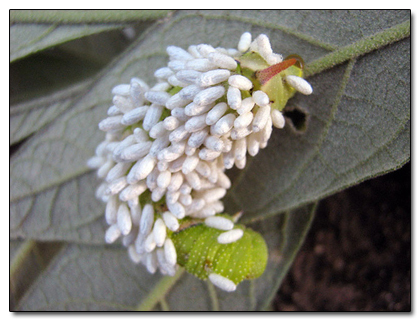
Parasitic wasp cocoons attached to a caterpillar. Go ahead, try and count them. From Alex Popovkin on Flickr.
The thing is, this sort of devilry is precisely why the world would be worse off without these little sadists. Predatory arthropods such as spiders, dragonflies and ladybugs all have a hand in maintaining nature's delicate balance, but none are so geared towards grand-scale pest control as parasitoid wasps, who have not only evolved to track down and slaughter specific plant-destroying insects, but the rest of the natural world has evolved to help them.
For example, let's take a look at ordinary, everyday corn. When stalks of this staple crop find themselves infested by caterpillars of the species Spodoptera exigua, the plants release a chemical concoction that attracts the species of wasp designed to fuck up that particular caterpillar. If it's dealing with some other type of caterpillar, like Mythimna separata, corn sends out a modified signal designed just for a different wasp that will kill it.
Yes, fucking corn has evolved a means of saying "please inject brain-eating embryos into the worms that devour my precious tissues. No, not you, these are the other worms. Yeah, send those guys. Thx."

Scientists aren't sure just how many different wasps one plant can keep in its chemical rolodex, but many are believed to have a unique emergency broadcast for every local pest that may munch on its foliage.
And it's not just the vegetable kingdom that benefits; some wasps hang around large mammals to pick off biting horseflies and even the dreaded bot-flies.
Just as your immune system continually adapts to new strains of the common cold, wasps function as an ecosystem's own "antibodies" against all manner of infectious, invasive vermin. It really is one of the fundamental laws of all living things: You must tolerate douchebags if they're keeping out the bigger douchebags.
Rats

The most widespread of all mammals that don't walk on two legs or drive cars (at least not yet), rodentia of the Rattus genus are most famous in Western culture as sewer-dwelling, corpse-nibbling cornucopias of contagion who gnaw their way into our homes and use our cereal boxes as toilets.

To be fair, a part of this monstrous reputation is firmly rooted in reality. Besides costing us billions of dollars a year in property damage, rats are one of the most widespread ecological pests in the world, feasting on defenseless native wildlife wherever they've been introduced and even driving other species to the brink of extinction.
On the other hand, the same can be said of a much larger, even more destructive species that happens to be reading this very article as we speak, and while your average person finds rats at least a little creepy, it's probably not because they eat endangered kiwi eggs. Filth, plague and pestilence are what rats are known best for in popular culture, and any extermination company will tell you that rat germs are an immediate, serious and costly threat to you and your entire family.

Oh, but not that costly. They have a very reasonable payment plan. Nothing's too good for your family, you know.
But if rats are really such a biohazard, one must wonder why we don't hear about it more often. If you're living in a city, chances are good you have thousands of the precocious imps breeding right under your feet at this very moment.
The truth is that while you certainly shouldn't pull one out of a storm drain and put it in your mouth, there isn't any scientific basis to assume that rats are exceptionally disease-prone animals. This stereotype primarily stems from the infamous Black Death, an outbreak of bubonic plague speculated to have killed over 75,000,000 people during the mid-1300s. But it was actually transmitted by the fleas of warm-blooded mammals in general. Rats appeared responsible for the plague only because they were so common.

This was also during an era when our most scientific explanation for disease was some sort of divine punishment or witchcraft, and mankind had neither the facilities nor interest in washing their damn hands. Now obviously bubonic plague isn't a problem these days, and you'll be hard pressed to find a rat-spread disease that is. According ot the Center for Disease Control, rats don't even spread rabies.
That's right, despite their absolutely staggering numbers, rats are one of the animals you're least likely to get sick from.
Mosquitoes

The 3,500 members of the family Culicidae are famous for prowling the night in search of fresh, warm blood, leaving obnoxiously itchy welts in their wake and contributing to the spread of diseases like dirty hypodermics with wings.
By accidentally transferring germs from one victim to the next, mosquitoes contribute to millions more deaths each year than every other animal in nature combined. Beginning their lives as wriggling, aquatic larvae, they breed exponentially in even the smallest and filthiest bodies of water, surviving off bacteria alone until ready to take wing. Could there possibly be a bright side to these bloodthirsty assholes?

Hey, if you ever see a mosquito on us, don't take its picture. Please just tell us.
Well, the thing is, these blood drinkers are one of the most abundant sources of nourishment for a staggering number species in nearly every corner of the globe, and it's specifically because they're blood drinkers.
While adults are consumed by all manner of birds, bats, frogs, spiders and predatory insects, mosquito larvae are the most important food source for the bulk of developing freshwater fish, which in turn feed increasingly larger predators such as ourselves. As links in the food chain go, mosquitoes may rank among the world's most necessary insects.
Now, you're probably thinking that every animal is food to something anyway, and if the asshole mosquitoes were gone, maybe one of the less obnoxious, bite-y ones would step in to fill the void. But the fact that some mosquitoes feed on the protein-packed blood of vertebrates is actually what makes them such prolific breeders in the first place, and all that rich blood inside them is what makes them such a perfect meal.
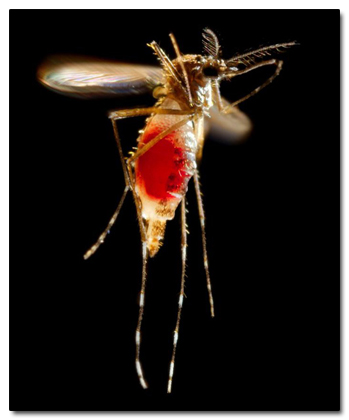
So thanks to mosquitoes, millions of animals are feeding vicariously on our fluids each and every night, making mosquitoes a sort of nutrient redistribution system. It's hardly their fault that deadly microorganisms are bumming rides in their saliva.
We're not asking anybody to like the bastards, but if you've ever wondered what Mother Nature keeps them around for... it's not just because she's being a bitch.
E. Coli Bacteria

Let's face it, if somebody tells you your food is "covered in bacteria," you're going to throw that shit out. And if somebody told you your body was full of E. coli bacteria, you'd get to a doctor before the uncontrollable shitting starts.
Now it's true that countless bacteria are waiting at any moment to invade and conquer our own bodies. Diarrhea, leprosy, anthrax, salmonella, syphilis, gangrene, pneumonia and strep are just a fraction of the diseases caused when certain bacteria multiply within our vulnerable tissue, and we spend billions of dollars a year on a never-ending war to purge them from our bodies, our food and our countertops.

But it's a war we don't actually want to win.
Consider this: The average human body is comprised of around ten trillion cells of its own. That's a lot. You know what else is a lot? A hundred trillion--roughly the number of bacteria living harmlessly in your intestinal tract as we speak.
A few are parasitic and others are irrelevant freeloaders, but the vast majority are living in symbiosis; a partnership where both life forms benefit from the presence of the other. Once the stomach breaks food down into a fine mush, everything we consume is in turn feasted upon by our tiny intestinal residents whose subsequent by-products (germ crap) comprise a significant portion of the nutrients our bodies absorb.

This is what comes to mind when we hear "symbiosis," because we haven't mentally developed beyond the age of eight.
Many starches, sugars, proteins and fiber are even impossible for our own enzymes to digest, but easily converted into the bacterial dookie you didn't know you craved. These "gut flora" collectively perform as much metabolic function as an entire organ, and while the average person hosts hundreds to thousands of different species, the most dominant is none other than Escherichia coli. They prefer to go by "E."
Yes, E. coli, the same bacteria who force us to recall perfectly good vegetables and apply heat to perfectly bloody meat, have already been a resident of your digestive tract since infancy.
One or more strains of E.coli began to colonize your body within days of your birth, and not only set to work pooping in your innards but immediately programmed your immune system to recognize them as friends. This is part of why so many other, rarer strains will make you sick; the first ones to arrive convince your body to keep out their competitors.

E Coli is like your asshole's bouncer, keeping ugly bastards like this guy out.
This is the reason why you can use all the antibacterial hand sanitizer you want, but nothing good can happen if you start shoving it up your ass. Well, it's one reason anyway.
Jonathan Wojcik has a lot more to say about bugs, parasites and even weirder creatures on his own website, Bogleech.com.
To see how else animals are improving our lives, check out 6 Disgusting Ways Animals Can Improve Your Health. But don't go getting all buddy-buddy with them before reading The 6 Most Adorable Animals (To Ever Go On a Bloody Rampage).
And stop by this month's Top Picks because Cracked isn't the only good thing for you on the Internet.
