6 Sci-Fi Movie Conventions (That Need to Die)
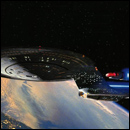
With the rebirth of the Star Trek franchise, sci-fi is a cash cow again. And while studios all over Hollywood are busy building model space ships and robots, we'd like them to pause for a moment and, you know, give the scripts a look.
After all, there's a few arbitrary sci-fi rules that seem to turn up in all of these movies and, quite frankly, it's time to move on.The Ship is an OSHA Nightmare

Two starships meet for battle and open fire. A photon plasma space torpedo slams into the hull. Inside, on the bridge, we watch as the whole room shakes, throwing the cast around like rag dolls. A second impact causes sparks to fly from the control panels, possibly even killing an extra.
The battered crew can only wonder why, on a ship that has technology in place to keep them from getting splattered against the rear wall when it jumps to light speed (or stops suddenly), every impact shakes their world like a kid rattling a Christmas present.
Why They Need To Stop:
We know why they do it. It's a way to add an element of danger for the main characters. That tends to get diluted if they're sitting comfortably on the bridge while the battle goes on in their view screen.
But no matter how far into the future you set your film, if the cable guy can keep our TV from exploding when lightning strikes the house, why does this futuristic spaceship have a panel blow every time anything remotely interesting happens on the ship?

And more to the point, why is the crew in an exposed spot at all? Sure, there are those ships (like most in Star Wars) that have windows, but, why do they need them? That's what view screens are for. Nobody is trying to navigate that bastard by squinting at the next planet through a dirty windshield. Look at the protruding command towers on the Star Wars Star Destroyers--at least once we see a fighter smash into their window, causing the whole damned ship to crash.
And if the bridge doesn't have windows (as it doesn't in Star Trek), then why in the hell does it need to be in some exposed spot where any random object can destroy it? Why not bury it in the middle of the ship, with layers of metal between the guys at the wheel and all of the exploding warp phaser missiles outside?
Don't tell us we're over-thinking this, damnit! That's what sci-fi is for, to make us feel smarter than people watching other movies.
The Futuristic Conversation Rule of Three

Two characters will be carrying on a normal conversation. One character will try to make a point by listing historical references. First, the character lists two references from the real world to set up a pattern, then tacks on a completely fictional reference that's either alien or hasn't happened yet. Like this exchange from The Wrath of Khan:
"You'll be remembered among the great scientists: Newton, Einstein, Sulak."

Sulak?
See, the first two establish the caliber of scientists we're talking about. Sure, you've never heard of the third one (Trekkies notwithstanding), but if he's on the same list as Newton and Einstein, he has to have cured cancer or something, right? It helps keep the story rooted in the real world as we know it.

"Let's play a game like Chess, or Monopoly, or Bleep Glorp. Or Jenga."
Why They Should Stop:
There's something corny about the way they always start the list off with something that happened close to the time when the show was made, rather than starting close to when the characters are supposed to live. It would be like starting off your genocidal references with the Jerusalem massacre of 1099 rather than the Holocaust.
Also, how often is it that you list more than one past reference in a single sentence? "This kid is great, he'll be the next Michael Jordan, Kobe Bryant, LeBron James!"
We do have to give credit to Firefly, which largely avoided this. The series takes place in the wake of a massive (failed) war for independence, of which two main characters are veterans, so most historical references are from that war, with the exception being a (very) educated doctor referencing Ancient Egypt.
The All-in-One Instant Plot Fixing Tool

The heroes are running out of time and they must do something NOW in order to save the day. All of a sudden, a space version of a Swiss Army Knife appears (e.g. Tricorder, main deflector dish, R2D2) that happens to be able to do just what is needed to save the day... quite tidily, in fact.
Even if it can't do exactly what the heroes need, it can usually be easily modified to do that exact thing, even if the thing it needs to do is completely made up. A common variation on this is the sensor that senses everything and then senses the side effects of everything else, even things the designers didn't know existed.
The writers of Dr. Who flaunt this idea with the "sonic screwdriver," creating a running joke that it can do anything the plot needs it to do.
Why They Should Stop:
Whether it's epic poetry or sci-fi, the whole fun of a dramatic adventure is watching how the characters use their courage, wits and creativity to get out of these jams. That all gets farted out the window when you realize that the little droid they've had with them the whole time has the magical power to make any machine in the galaxy do exactly what they wanted.

It also creates logical holes all over the place. For instance, once you've shown a character using his phaser to tunnel through a mountain, you immediately think back to every time a character has ever been trapped in a room, and wonder why he didn't do the same. And why would even the most secure doors in the Star Wars universe have locks that can be "picked" by random repair droids?
It's the kind of lazy "get out of plot trouble free" card that we wouldn't tolerate for a second in a story set in the here and now (MagGuyver explained how he hotwired a car with bubble gum, damnit!).
As for the sonic screwdriver on Dr. Who, in the original run on BBC, the producers forced the writers to break the sonic screwdriver to make the show more interesting. The writers had become so accustomed to using it as a crutch that they only agreed to do so because they thought they were going to be able to write another one back in (by the way, it wasn't until the new relaunch of the series that it was actually used to drive screws).

For a corollary to this, also see the "Tim Taylor" rule: if a part of the ship isn't getting the job done, just divert more power to it! More electricity makes every device work better than it was designed to! Just try it with your TV! Of course, if it doesn't work, you could always just reverse the polarity.
One Planet, One Culture... Except Earth

Our intrepid space explorers make contact with a new planet named Generisis III (cool planets always have numbers) and make contact with the sentient species, the Latexx Foreheadians. Assuming peaceful contact is made, the heroes will be spending a lot of time learning about the Foreheadian culture, language, religion, and all other aspects of Foreheadian life.
But wait a minute. Earth has hundreds of languages, cultures and religions. There's not even a single culture which has "dominance," and the most common trade language (English) is barely spoken by half the planet. So why in sci-fi do we still have races who are "warlike" or "profiteers" that live on a "desert planet" or an "ice planet." Apparently all civilizations eventually just consolidate everything to avoid confusion?

Babylon 5 did an entire episode on showcasing how each race has only ONE religion (to their credit, they say "dominant"), then the following scene is tacked onto the end, drawing full attention to the fact that Earth, unlike the rest of the galaxy, has religions and cultures shotgunned all over the landscape.
Why They Should Stop:
This is a lazy leftover from other genres of writing. Planets in science fiction tend to serve the same purpose that kingdoms, nations or towns do in other fiction. Writers keep it that way because it's easier to write about a new planet if you treat it as if it only consists of five square miles and 50 people.
Even Star Trek, which is supposed to be all about enlightened understanding of these new cultures, still flies their ship from one two-dimensional, monolithic planet to another. If they find some planet with multiple races, it's always to teach some basic lesson about racism, and always for the purposes of that one specific episode.

Once again the genre that's supposed to be expanding our horizons, manages to make the universe seem like a very simple, boring place.
Space is an Ocean... a 2D Ocean

Captain's log, stardate who cares: After laying a new course to Madeupia IV, we hit an ion storm, damaging the port side bulkhead. Waiting on the other side were a band of pirates whose ships circled around us and began firing. After a fierce battle we found ourselves adrift. Unless we contact a rescue ship soon, the sailors may get space scurvy.
From the first moment we started writing about spaceships, space has been treated as perfectly analogous to an ocean. Everyone uses nautical terms. Ships that lose power stop moving and are "adrift." And even stranger, the ships move in two dimensions.

In this clip, watch Jango Fett release "depth charges" that first float out behind him, then unleash a flat, Frisbee-shaped disc of destruction that Obi-Wan barely evades. After all, where else would he go? It's only outer freaking space.
Why They Should Stop:
As with the above, this is another leftover from genres that pre-date sci-fi, basically borrowing conventions from pirate movies (the writers would call it an "homage," we suppose). But the comparison only goes so far. There's not a whole lot of good nautical words to describe things that are "above" and "below" you without implying a universal "up" or "down," which space obviously doesn't have. So it goes from charming homage to something that doesn't make any damned sense within that universe.
Even in Star Trek II, when Spock points out that Khan's thinking is "two dimensional," the enterprise still has to "surface" to fire at Khan's ship instead of just shooting from underneath it.

Are they worried we'll get confused if spaceships fought using all of the cool techniques free 3D movement would afford them? Give it a try, guys. When blockades are literally a "ring" around something and nobody in the movie thinks to just move "up" and around the ring, it's hard to keep thinking of the heroes as the best and brightest.
Which brings us to...
Infantry? Really?

Exciting music swells as we see our heroes gearing up for a battle. Spaceships then plummet from orbit, dropping platoons of laser armed infantry onto the battlefield. What ensues next is an epic battle, with a storm of laser fire between ranks of foot soldiers. Some battles may involve futuristic tanks or planes, others seem like a high-tech version of Braveheart.
As you can see, these highly advanced armies still move in block formations of infantry, using tactics that were considered primitive by Robert E. Lee.
Why It Needs to Stop:
Sci-fi film makers love to make their battle scenes in the style of classic war films (George Lucas modeled his X-Wing vs. Tie Fighter battles around old World War I dogfighting movies). But isn't sci-fi supposed to give us something different?

This isn't nitpicking here; it stretches credulity when the typical audience member can think of better ways to fight battles than what's going on up on the screen. Who can watch the good guys in Starship Troopers standing 10 feet away from the bugs, shooting at them ineffectually with rifles and not think of how the current U.S. Air Force would have just bombed the bugs out of existence in one afternoon?
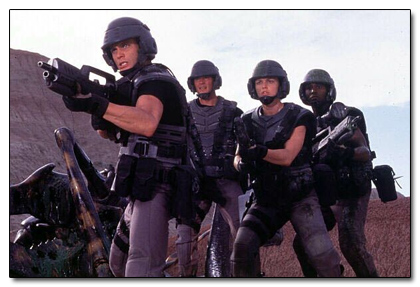
It becomes clear that the U.S. Army, or even the French Army, could beat this highly advanced sci-fi team over their lunch break.
Yes, we realize that even today's plane vs. plane dogfights take place with the aircraft miles apart, and doing it realistically on film wouldn't be all that much fun to watch. But that's the point; your sci-fi battle shouldn't be recycling either classic war movies or modern war footage. You should be giving us something new.
Isn't that what it's all supposed to be about? It's sci-fi, guys. Stop recycling The Longest Day and give us something that will blow our minds.
Before the entirety of geekdom gets its panties in a wad, here's a peace offering: 5 Deadly Sci-Fi Gadgets You Can Build At Home. Or find out about how the military is tapping its inner nerd, in 5 Famous Sci-Fi Weapons That They're Actually Building.
And stop by Cracked.com's Top Picks to seem some quality Arcturian poontang.
