The 9 Most Racist Disney Characters
These old Disney movies are a little bit like your aging Uncle Frank. Honestly, he means well when he points out that Will Smith is "well-spoken." It's just that he, like the assemblage of clips below, dates from a time when people were unfairly characterized by their ethnic background (the acceptable methods are, of course, religion, geography, sexual preference and income).
The Merchant from Aladdin

The opening musical sequence from the hugely popular 1992 animated film had to be edited due to protest from Arab-American groups for saying about the Middle East what most of us were merely thinking.
Lesson Learned:
The Middle East is a barren wasteland where the justice system runs on a clear and simple limb-removal policy.
Best (Worst?) Moment:
"Where they cut off your ear if they don't like your face" is the offending line, which was changed on the DVD to the much less provocative "Where it's flat and immense and the heat is intense." Whatever. Our question: In a city full of Arabic men and women, where the hell does a midwestern-accented, white piece of cornbread like Aladdin come from? Here he is next to the more, um, ethnic looking villain, Jafar.

Sebastian from The Little Mermaid

In this 1989 film, a Jamaican-sounding crab teaches Ariel that life is better "Under the Sea," because underwater you don't have to get a job.
Lesson Learned:
Up on the shore they work all day
Out in the sun they slave away
While we devotin'
Full time to floatin'
Under the sea!
Are we reading too much into it? Do you see anything wrong with how they've drawn "the duke of soul" at 1:57?

Still too subtle? How about at 2:01 when the "blackfish" appears?

Best (Worst?) Moment:
As far as Disney movies go, you've got two choices: unforgivably offensive and just slightly racially insensitive. Sebastian definitely falls into the latter category. So while making Sebastian a charming, party-loving stereotype is a baby step forward for Disney, it's still a stumble backwards for civil rights.
The Crows from Dumbo

In this 1941 classic, Dumbo the flying elephant runs into a band of jive-talking black crows who sing, "I'd be done see'n about everything/when I see an elephant fly!"
Lesson Learned:
Come on, blackbirds acting in a manner stereotypically assigned to African-Americans isn't that offensive. At least they didn't just get some white guy to do his best "black voice." Oh, really? They did? And, they called the lead character "Jim Crow?" Um, hey, look over there! It's a convincing, logical end to this argument!
Best (Worst?) Moment:
So many too choose from. The crows are very specifically depicted as poor and uneducated. They're constantly smoking; they wear pimptastic hats; and they're experts on all things "fly," so it's really a team effort contributing to the general minstrel-show feel to the whole number. You could pretty much pause this video at any second and use it as evidence in your hate-crime lawsuit against Disney.
For its time, though, the portrayal of the crows was almost progressive. The crows band together and help Dumbo learn to fly, so they're counted among the heroes of the film. Remember, this was just a couple of years after somebody introduced a bill to outlaw lynching and congress voted it down. So, you know, you take what you can get.
King Louie from The Jungle Book

Having outgrown the crude portrayal of African-Americans as black crows, in 1967 Disney decides to portray them as monkeys instead.
Lesson Learned:
All animals in the jungle speak in proper British accents. Except, of course, for the jive-talking, gibberish-spouting monkeys. Did we mention they desperately want to become "real people?"
Best (Worst?) Moment:
Fine, so an ape singing, "I wanna be like you" might be a little subtle, in a "we own multiple copies of Catcher in the Rye" conspiracy theory kind of way. Still, considering the author of the The Jungle Book also thought up "the white man's burden", we don't think it's too much of a stretch.
The Siamese Twin Gang from Chip n' Dale Rescue Rangers

Overt racism against African-Americans was obviously intolerable by the time this Chip n' Dale series began in 1989. Overt racism against Asians, luckily, was still on the table.
Lesson Learned:
Even as criminals, Asian-Americans immigrants, represented here by a gang of cats, have become integral parts of American culture. Kidding! They own a laundromat, run an illegal, basement gambling operation and speak in horribly mangled "Engrish." It's like a designer of World War II propaganda posters accidentally quantum leaped into the body of a late '80s cartoon writer.
The video becomes cringe-worthy about six minutes in:
Best (Worst?) Moment:
The Siamese Cats sell their karate expert Juice Lee, a Japanese fighting fish, for a suitcase full of dead fish. If you can't find something offensive in that sentence, congratulations. You're a cyborg.
Sunflower the Centaur from Fantasia

Of all the items on this list, this is the one Disney has tried the hardest to make us forget.
Lesson Learned:
Even in Fantasia's beautiful, magical landscape, African centaurs are hoof-polishing handmaidens for prettier, Aryan centaurs. Also, 1940 was a great year to be a centaur fetishist and/or Don Imus.
Best (Worst?) Moment:
It was insulting enough for Disney to include the smiling servant stereotype to begin with, but, to make matters worse, they started categorically denying Sunflower's existence with the Fantasia re-release in 1960. How does that possibly make things better? "No, you misunderstand. In our perfect, Fantasia world, Africans aren't servants. They don't fucking exist."
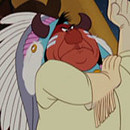
The Indians from Peter Pan

In this charming musical number, the "Red Man" explains his people's history and culture.
Lesson Learned:
Why do Native Americans ask you "how?" According to the song, it's because the Native American always thirsts for knowledge. OK, that's not so bad, we guess. What gives the Native Americans their distinctive coloring? The song says a long time ago, a Native American blushed red when he kissed a girl, and, as science dictates, it's been part of their race's genetic make up since. You see, there had to be some kind of event to change their skin from the normal, human color of "white."
Best (Worst?) Moment:
It's a tie between Tiger Lilly's traditional Native American hussy dance, and the number of times Native American's misogynistic tendencies are played for laughs (hint: It's more than three!)
Uncle Remus from Song of the South

The tales of Br'er Rabbit are relayed by kindly old Uncle Remus, a black man happily working on a plantation in the post-Civil War South. Disney has never released this one on home video, for some reason.
Lesson Learned:
The late 1800s were a great time to be African-American and possibly on acid.
Best (Worst?) Moment:
Less eerie than any imaginary singing birds is what's not in the film. It's as if someone made a children's musical about Jews in post-World War II Germany that had a number titled "Hey! Nothing Bad Has Happened to Us, Ever." Also failing to reach the screen: When the movie had its world premiere in 1946 in Atlanta, James Baskett, the actor who played Remus, was not allowed to attend. Zip-a-dee-doo-dah!
Thursday from Mickey Mouse and the Boy Thursday (Book)


Lesson Learned:
"What's the deal with Africans? If they're not trying to eat it or throw a spear at it, they're worshiping it as a some sort of tribal deity, am I right?"

Best (Worst?) Moment:
Where to begin? The book compiles almost every offensive preconception of Africa lurking in the American subconscious.

Some choice quotes:
"Well, well." Mickey laughed ... "So I'm supposed to be your governess and nursemaid, and you can't even talk!""Let me see. A genuine African native," Mickey murmured. "Perhaps I should start showing him off."
Perhaps the most depressing part is that this was somebody's idea of tolerance, back in the ideallic '40s:
"Poor little guy! He just makes mistakes. He doesn't know any better. I'll just have to be patient and teach him the right way to do things," said Mickey.
If you liked this article, you may also enjoy Ben Joseph's 10 Most Ridiculous Overseas Rip-Offs of American Films. Or, check out Mike Swaim's rundown of some very naked propaganda.
