|
|
|
|
6 Natural Disasters That Were Caused by Human Stupidity
5 Self-Destructive Ways People Accidentally Cured Themselves
The 6 Creepiest Places on Earth
17 More Images You Won't Believe Aren't Photoshopped
I was not at all expecting a philosophical article, but it seems it is destined that I was to read this and it has given me much to think about.
While indeed the concept of morality is a laughable one, without free will we probably would not have gotten this far. Despite the fact that our brains are technically a mushy mass of neurons and tissue, it creates something much more than that, the thing that differentiates us from other beings, a consciousness; and that is the closest we have to free will. If it were not for free will, would I be sitting here reading this? I'm reading this because I thought it would be "better" than performing another activity. And while that is simply an opinion that exists solely within my head, it is because of it that I am here right now. There were 15 links, but I CHOSE to click on this one because my brain told me to. I could have clicked on any other, but after thoroughly analyzing the options, I decided this one was the most worthwhile. I made a choice. And don't give me bullshit about the particles in my brain and stimulus. I could have chosen any of those links. Our brains aren't just made the way they are right now. Every second of life molds our thinking processes in different ways. Everything that has ever happened to me has influenced my decisions made from that moment. And all of those events were in turn affected by other people, who were affected by other events, and so on. Even if is this is what you truly believe, then please don't publish articles like these. Free Will is all we have left to live for. If indeed we have no free will and no morality, then we should try to simply live life happily, as there doesn't even seem to be a purpose anymore. If ignorance is bliss, then why do you have to reveal the truth in such a shocking way? Most people can't take that. You live however you want to live, but try not to f**k up other people's lives, free will or no free will. And if you haven't read Kurt Vonnegut, then that's what you will be doing next week. It's been destined since the Big Bang.
This article was entertaining and thought-provoking.
However, as many people have already pointed out, the field of quantum mechanics actually provides substantial evidence AGAINST a deterministic view of the universe. Basically, scientists realized that things on the smallest quantum levels act in completely random and unpredictable ways.
Ergo, it is incorrect to say that everything was determined from the moment the Universe was created. Instead, the exact opposite is true. Everything is actually completely random, and NOTHING can be precisely determined.
Of course, you can always "determine" that the earth will exist tomorrow, and chances are that you'll be right. But, according to Quantum mechanics, there is a very very very slight chance that the Earth might disappear tomorrow. This probability is so close to zero that it is laughable, but the probability exists.
But if you take this down to a smaller level and observe the smallest subatomic particles, you'll find that they tend to zip in and out of existence spontaneously, leaving scientists befuddled. The fact that matter can actually spontaneously cease to exist is troubling, to the say the least.
In conclusion, I think that the real horror of the Universe isn't that everything is completely determined. The real horror is that nothing is determined, and everything is subject to probabilities.
Nevertheless, I agree with the idea that free will is an illusion (we are, after all, a collection of molecules with some sort of an illusion of self-awareness). I also agree with the idea that "better" and "good" are ultimately meaningless. Even though I may think that being alive is "better" than being dead, I have nothing to back up that statement other than the fact that I really, really like to live.
bigdaddy93, I'm sorry to be the one to say this, but the reactions of a person who doesn't believe in what you think doesn't really qualify as proof. This is what Wong does, he poses realistic existential questions, entwined with comedy to get his audience both thinking and entertained, so though there are obvious bits that aren't real, there are also numerous questions to consider after reading. What you supposed, would be like me going into a catholic church and saying "Your god's not even real", I may or may not be correct, but that doesn't mean those people aren't going to hate me for it.
I'm 95% certain this is satire. 95%. If it is satire, as a scathing indictment of reductionism and fatalistic thinking, it's a bit of a non-starter. I say this because you seem to have convinced most of the people who read it of the veracity of that mindset. On the offside chance you're being serious, go tell a cancer patient that the ongoing battle with cancer is meaningless, because "well" and "not-well" have an equal ultimate value. When she hands you back your face, we'll talk further.
Sunny, you're missing my point. I never said that a good knife is a good thing. In fact, I explicitly denied it in certain cases.
"Good" isn't like "red". If something's a red car then it's also a red vehicle and a red thing. This is called a "predicative" term. "Good" is like "complete" or "half". The truth conditions of its use depend on what kind you attach it to. So, for instance, something can be a "complete" chapter without being a "complete" novel or a "complete" thing. This is called an "attributive" term.
Most people don't learn the logic of attribution, so words like "good" and "complete" throw them. However, arguing that I can't say that a good knife is a good knife without saying it is a good thing is like arguing that I can't say that a complete chapter isn't a complete chapter without saying it is a complete novel or a complete thing. Attribution just doesn't work that way.
Neither does the word "good". When people try to use "good" as a predicate like "red", it becomes a mess. But that mess doesn't show that the word is meaningless, just that people don't understand attribution.
And hey, your 2nd to last paragraph reminds me a lot of Jean Paul Sartre's discourse on existentialism.
Personally, I think it's "better" to teach everyone some of the topics you covered here, because there are enough smart, non-tyrannical people in the world who, adopting this perception of the world, can make greater progess towards absolute truth.
But that's just my opinion, not any better than those of the state of Texas, which has forced Bibles into schools this year.
"Why do you think "good" is dependent on emotion and free will? Water is good for trees. There's no emotion of free will there. A good knife is sharp. This isn't just a part of my desires for the knife. A serial killer can have a good knife, while the good knife is still a bad thing. "Good" is an attributive term, defined in terms of characteristics relative to the powers of a kind. "
What are you even saying? He's basically asking, why is a dull knife better than a sharp knife? Because it can cut better? What makes that a good thing? Why should things be cut and, if it's because it aids tasks such as eating watermelon, then why is cracking a watermelon open on the ground and shoving your face in it any worse? If you say because it feels uncomfortable then you were born with that sensation, free of your will.
Same with the plant analogy. What makes a dead plant better than a live plant? The beneficial emissions into our environment? Why is that 'good'?
Another example that brings credence in this article is something cited by another post of David's, Conservapedia. In the post he writes that if the media is in any way biased against conservatives then it's because there aren't that many conservative journalists. Well, why? Clearly a series of experiences shaped their beliefs, and those beliefs shaped what they deemed to be fulfilling jobs.
There seems to be a lot of confusion in this article. To name a few:
1) You use the word "just" a lot, where is isn't justified (hehe pun). Even a bowl isn't "just" clay. It's also a bowl. What makes something a bowl is a capacity to hold liquid, a capacity that clay doesn't have unless put into a particular shape. So, a bowl isn't just clay; it's clay in a particular shape (or set of shapes). This is usually called "emergence" and is far to complicated to just assume reductionism and throw around the word "just"
2) Have you heard of "compatibilism" in ethics? It's the view that indeterminism isn't required for moral responsibility and it's a widely held position in ethics. In fact, it's probably the majority view among professional philosophers studying ethics. Hume was a compatibilist, as one example.
3) Why do you think "good" is dependent on emotion and free will? Water is good for trees. There's no emotion of free will there. A good knife is sharp. This isn't just a part of my desires for the knife. A serial killer can have a good knife, while the good knife is still a bad thing. "Good" is an attributive term, defined in terms of characteristics relative to the powers of a kind.
4) I simply don't get the whole, "It just is", thing. Any explanation is going to have to stop somewhere, even scientific ones. The standard view of atheist philosophers of science is that the fundamental laws of nature, whatever they might be, are just what are called "brute facts", which is as close to "it just is" as a concept can be. Something is going to have to be either self-explanatory or unexplained; an infinite regress would be vicious.
Anyway, that's all just off the top of my head. The idea that we have "discovered" the meaninglessness of all existence is just silly. The philosophical concepts involved in such a claim are still in a process of being worked out and are highly contentious. You might want to reconsider the freedom-emotivism-morality and determinism-knowledge-indifference conceptual knots you've tied up your thought into.
I've embraced the horror, took it to the movies and had sex with it in a cheap motel.
Or shouldn't I have?
I would say you are my new god. But then again, why want a god because it doesn't make any difference in the long run. OR DOES IT?
Who'll ever know, timeline differences don't exist in a linear world.
I want to make sweet dirty love to your brain.
"The existing scientific concepts cover always only a very limited part of reality, and the other part that has not yet been understood is infinite."
—Werner Heisenberg
Those who think that quantum mechanics leads to determinism have not even the slightest understanding of quantum mechanics. If anything, quantum mechanics destroyed the determinism implicit in old school Newtonian physics by demonstrating just how little we truly understand our world. It is not mere coincidence that the founding figures of quantum mechanics were drawn to religion and mysticism, Oppenheimer being the classic example.
I would write more, but have not the time; I shall return to this page later on.
It is funny how materialism makes questions that have the same answer regardless of your metaphysical bent seem more threatening. Socrates asked Euthyphro where morality came from well over 2000 years ago and there wasn't a causal answer within the theistic viewpoint. Also, when a person is free (not restrained by physical force) to do what he/she wants, regardless of whether matter is the whole show, he/she will always do what he/she wants. That is the essence of freedom, you may do what you want, but your wants have come from outside of you.
Materialism did not cause these dellimas, it just helped us to see them.
Morality requires faith and a willinness to see the chain of causality end on a moral law. Science also requires a faith in a determistic and consistent universe (there is no causal reason that whatever laws of physics that are fundimental cause things to act in the way they do, experience just tells us that they do).
The sense of it all is just that it is.
I just re-read this, and was surprised to find out how much of my personal philosophy and way of thinking comes from it. I doubt I'd be nearly as cynical as I am now if I hadn't read it. And then I got thinking about how I don't understand what conciousness is, and if emotion is an illusion how can there even be someone for it to fool, and I would like to find out, but liking doesn't really exist, and at this point my brain dissolves because everything is hypocritical and sitting on my arse being confused doesn't seem like the best course of action but "best" doesn't exist and it's what's probably going to end up happening
I have just forgotten how to think
aah
"You harped on this "better" concept for entirely too long for me to let it go unchallenged, written in 2007 or no.
It doesn't matter that "better" is relative. The concept of "better", formed by the "mind" aka the "brain", as predetermined by the Big Bang (or to be accurate, whatever happened first... ever), is what drives an individual's "want", and the "want" makes our choices for us. And don't downplay any attempts to "change" things. Because in order for the universe to be what it was predetermined to be, the things that were predetermined have to happen. We have no problem with things being set in stone because, wouldn't you know it, the things we were predetermined to do were the things we were going to do anyway. No one ever says "I didn't want to put on this particular pair of socks today! Curse you, big bang!" "
But don't you realise the implications of this? You and Hitler are no different, because there no system of morality is superior to another's. If you put a gun to Hitler's head and shot him, you would have no justification beyond "Because!" No legal system can truly find a man guilty, because their interpretation of right and wrong is not any "better" than the accused man's.
Even if absolute morality is irrational, I'd prefer that society continue to practice it. I think everything would collapse without it.
You harped on this "better" concept for entirely too long for me to let it go unchallenged, written in 2007 or no.
It doesn't matter that "better" is relative. The concept of "better", formed by the "mind" aka the "brain", as predetermined by the Big Bang (or to be accurate, whatever happened first... ever), is what drives an individual's "want", and the "want" makes our choices for us. And don't downplay any attempts to "change" things. Because in order for the universe to be what it was predetermined to be, the things that were predetermined have to happen. We have no problem with things being set in stone because, wouldn't you know it, the things we were predetermined to do were the things we were going to do anyway. No one ever says "I didn't want to put on this particular pair of socks today! Curse you, big bang!"
There. Horror dissipated.
I love the overall concept, though. Or at least my brain thinks it does.
You do realize my head literally exploded, don't you?
Seriously, it's disgusting.
There are enough comments here to discuss to get me thoroughly fired from work for unproductive use of time, so I'm going to comment only on Humility's previous post.
You cannot prove that any event, be it movement or lack thereof in regards to any matter or antimatter, is indeed random. One can only prove randomness by absolutely knowing the outcome of a series of events and observing varied behavior. Since one cannot know the future of all events of the matter in the universe, it cannot be said that those events are not in fact predetermined. Likewise, it cannot be said that they are predetermined. They merely are what they are.
The only observations that can be said to be accurate are those made from outside of a system, like a scientist watching the movements of a mouse in a maze. He is outside the mouse's universe, and thusly can make complete observations and statements with complete (or as complete as possible) truth.
Since a "higher power" that should exist outside the bounds of our universe, be it described in three dimensions or ten dimensions, cannot be observed from within the closed system itself, one can never make an accurate statement regarding the qualities of said power.
One can also not say that there is not another layer outside of the "higher power's" universe (or whatever such system it exists within) that dictates the actions and "will" of the power. In that regard, no comments describing the existence or qualities of such a being (or non-being) can be considered to be truthful.
Perhaps an infinite being existing outside the scope of our understanding can do such things as extending will unto all creations, but it cannot be proven (or disproven). One (of reasonable intelligence) could only say that their opinion or basis for belief is based solely on their own opinion, which I would hope is based on their understanding of probability.
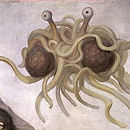
With regards to probability, there is probably not a giant flying spaghetti monster. There is probably much that is wrong, but it cannot be proven or disproven. Just play the odds.
Except for one small problem, with higher dimensions, black matter and energies like that which don't follow a predestined course because they are in fact random, nothing is destined.
Any higher power existing above our dimension with such an infinite mind, would truly have free will and thus should be able to extend that free will to any of his creation.
7 Secrets Only Two Living People Know (For Some Reason)
6 Creepy Urban Legends That Happen to be True (Part 3!)
Curse of the Duck Hunt Dog
6 Types Of Youtube Videos There Are Waaay Too Many Of
HOLY SHITFUCK CARROT TOP IS BLINKING IN THAT PICTURE