Connie Booth Makes Shocking Admission About John Cleese and ‘Fawlty Towers’
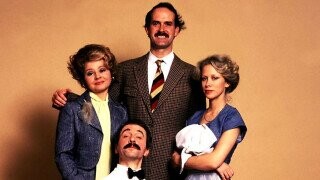
Even though it ended 46 years ago, John Cleese is still very much in the Fawlty Towers business. There’s his recent stage adaptation, an upcoming behind-the-scenes book and, of course, the planned reboot starring Cleese, his daughter Camilla and zero cast members from the original series who aren’t named “John Cleese.”
But Fawlty Towers isn’t solely the product of the ex-Monty Python member’s imagination — and not just because he based Basil Fawlty on a real-life erratic hotel manager/war hero.
Don't Miss
All 12 episodes of the classic ‘70s British comedy were scripted by Cleese and his then-wife Connie Booth, who also played Polly, the housekeeper and struggling artist.
Booth and Cleese split up between the first and second season of the show, and she eventually quit acting in 1995 in order to pursue a career in psychotherapy. These days, Booth rarely gives interviews about her work with Cleese, and was once quoted as saying, “I used to watch a lot of comedy until I got divorced. Then I went off it.”
But with the show celebrating its 50th anniversary later this year, Booth made a rare statement to the U.K.’s Radio Times. Somewhat shockingly, she claimed that she never should have been credited as the co-writer of Fawlty Towers in the first place. “In the year and a half it took to write Fawlty Towers, John and I never imagined the impact the show would have,” Booth stated. “On its 50th anniversary, I’d like to take the opportunity to get something straight. John wrote the dialogue.”
“Before that dialogue was written, he and I developed the plots,” she clarified. “Each episode took about a month to contrive. Out of the ridiculous complications of farce, his brilliant lines emerged. When the issue of billing arose, I thought ‘Written by John Cleese, storyline by us both’ would’ve been fine for me. John said they didn’t do that in TV comedy and insisted on co-authorship.”
Booth went on to say that “yielding to John’s generous offer turned out to be a kind of poisoned chalice. For half a century, I’ve been receiving praise for lines which John wrote. When people quote back words from the script, instead of flattered I felt counterfeit. I’ve had to say, ‘No, John wrote that.’”
“Because I’m American, this disclosure about the pitch-perfect dialogue may be self-evident,” Booth joked, concluding that “at this celebration of our work, one of the things I wanted to celebrate was the truth.”
While fans may be surprised to learn that Cleese wrote the entirety of the show’s dialogue, and kept the extent of his authorship a secret for all these years, that isn’t to say that Booth’s contribution wasn’t absolutely essential to the show’s creative success.
In addition to the fact that Cleese and Booth spent weeks hammering out the show’s intricate, farcical plot lines, her unique perspective was invaluable to the creation of Fawlty Towers.
Cleese has admitted that Booth was ”better on character” than he was, recalling how he once “suggested a line for Sybil, and Connie said, ‘A woman wouldn’t say that.’ And I thought, ‘I didn’t know that.’” And she was pivotal to the creation of Basil Fawlty. As we’ve mentioned before, Booth was the one who injected Basil’s personality with many of Cleese’s more unflattering traits, possibly as a result of their collapsing marriage.
According to Cleese’s At Last the 1948 Show co-star Tim Brooke-Taylor, Booth “managed to combine John’s failings into the character (of Basil)” because she “knew John better than anybody else.” And Booth herself once confessed that she and Cleese “were able to get out a lot of our frustrations with each other through those characters,” revealing that the writing process was “kind of like therapy.”
So while Booth isn’t responsible for coming up with lines like “Don’t mention the war,” she clearly is responsible for fleshing out the maniac who said it.
