5 Insane Ways Words Can Control Your Mind

On some level we already know that language shapes the way we think. We're automatically more afraid to fight a guy named Jack Savage than somebody named Peewee Nipplepuss, even if we've never seen either of them before. It's totally illogical, but you probably run into an example of that every day, and don't notice it.
While we tend to think words are just sounds we make to express ideas, science is finding that language is more like a fun house mirror, warping what we see in mind-blowing ways. For instance ...
Speaking English Makes Us More Likely to Blame People

Let's say your roommate Steve is jumping on your bed. Maybe you have a Tempur-Pedic mattress and he wants to see if he can make a glass of wine fall over, like in the commercials. The frame breaks and the bed collapses. Your other roommate yells from the hall, "What the hell happened?"
How will you answer? Will you say, "That dipshit Steve broke the bed?" That's true, but he wasn't trying to break it. Or would you just say, "The bed was broken?"

Keep in mind, Steve pulls this shit all the time.
The answer largely depends on what language you speak. And the language won't just determine how you phrase it, but who you actually blame for the accident. An English speaker is more likely to name Steve as the responsible party -- even if he wasn't jumping on the bed like a jackass but just sat on it. A speaker in Japan or Spain would be more likely to just say, "It broke."
Stanford scientists did experiments on this, by having speakers of various languages watch videos featuring, in various situations, people breaking eggs or popping balloons, sometimes on purpose, sometimes on accident. The subjects didn't know why they were watching.

"Maybe it's a kid-friendly version of Jackass?"
Later, the scientists quizzed the subjects on the people in the videos. In videos where the guy intentionally broke the egg, all of the subjects, regardless of language, were equally good at remembering details of the guy. After all, he's the one who broke the egg. The video was about him, the egg breaker.
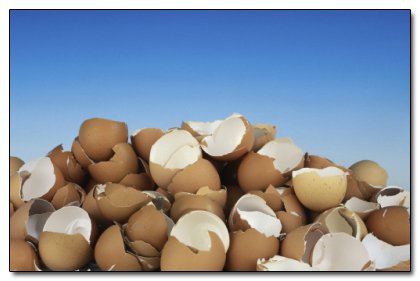
Will nothing stop his madness?
But when asked about the people who accidentally broke something, the Spanish and Japanese subjects -- the groups more likely to use "the bed broke" earlier -- couldn't remember them. Since it was an accident, the guy wasn't important. The egg broke.
But us English speakers? We could remember him just fine. To us, the distinction between intentional and accidental was much less important. Somebody had to be blamed.
You'd think that this has less to do with the language and more to do with the culture -- that maybe they're just less prone to throw around blame in Japan. So they did another experiment, this time with just the English speakers. They had them watch the infamous Janet Jackson boob flash during the Super Bowl a few years ago.
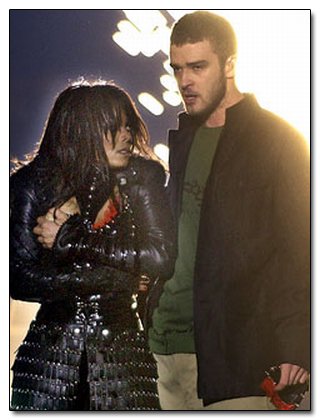
"Seriously? This pissed off millions of people?"
The group was then handed a report on the incident and told to come up with a punishment. Half of the group got a report with a very subtle difference in wording: at the end instead of reading "the costume ripped," it read Justin Timberlake "ripped the costume." The people who got the second report levied fines 50 percent higher than the others. Even though they had all watched the same video about the same incident. Just changing the phrasing to imply blame changed the way they thought about it.
Science is just beginning to grasp how this changes a culture, but you can have fun thinking about it. For instance, during this election season, think about how much of the debate centered around figuring out who is to blame for each problem. Whose fault is it that the health care system is screwed up? Washington? The insurance companies? The lawyers? We must know! It has to be somebody, dammit. It can't just be, you know, some kind of complex, chaotic system subject to a billion variables no one understands. To phrase something that way, even if it's an accident or a natural disaster, feels weird to us. The story needs a villain.
It Makes You Worse At Following Driving Directions Than Aboriginal Tribesman

Say we want to come to your house, to crash on your sofa for a couple of months because, you know, Steve broke our bed. When you give us directions you'll say something like, "Turn left at the adult book store and go down two blocks ..." That's the way you think through the directions in your head, after all -- turn left here, turn right there.

U-turn at the hobo.
But let's say that somehow you never had the word "left" in your language. Well, you'd still have the idea of turning left, right? You'd just have a different term for it. It's not like you'd actually have a tougher time finding your house just because you lacked a certain word.
Actually ... yes you would.

Figuring this out required a unique set of test subjects, but researchers found them in a bunch of deaf kids in Nicaragua who invented their own sign language. This language, in its early stages, had no terms for "left" or "right." But the people who used the language were otherwise normal -- their other senses worked exactly the same as yours. You'd think that while they had a tougher time explaining where things were in a room, they'd be the same as you or me at finding things. They're not.
They took the sign language speakers, blindfolded them, spun them around and had them try to relocate an object they had just watched being hidden in the room. For you and most people you know, it's a super easy test -- the object is on the floor to the left of the window. For other sign language speakers, it's not much harder. But these guys sucked at it.
Hard.
Lacking the terms for directions like, "to the left of the window" didn't just make it harder for them to tell you where the object was -- it made it harder for them to tell themselves where it was, when trying to remind themselves inside their head. Their ability to figure out where things were was dictated by their language. They'd eventually find it, but it was a much slower and more difficult process for them. They lacked the internal language to orient themselves properly.
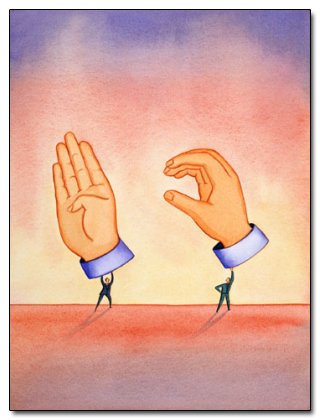
What's the sign for, "can't-read-a-damn-map"?
It gets weirder. If we were to ask you to come pick us up so we could crash at your place, because our El Camino was in the shop, and we gave you the directions as, "turn north at the Citgo station, go six blocks, then turn west at the Hooters, then south down the alley ..." would you tell us to go fuck ourselves? Hell, without a compass some of you can't even point which way is north from your own living room, let alone in a strange city.

"What the fuck did that airport security guard mean by 'east'?"
But you could go kidnap an Aboriginal tribesman from Australia and he'd immediately know which way is which. He'd know at any given second which direction he's facing. He has to know, because in the Aboriginal Guugu Yimithirr they also don't have words that mean "left" or "right" or "in front of" or "behind." They give all directions in terms of north/south/east/west. Seriously. If you're trying to hang a flat-screen TV on their wall they won't say, "Move it two inches to the left." They'll say, "Move it two inches east."
Now you'd think that, in practical terms, this would be pretty freaking annoying. But it turns out sticking to the compass gives them an almost supernatural sense of direction, and it's because they have to -- their language doesn't work otherwise. Because they speak in terms of geocentric directions, they also think in those terms. They could probably get around most cities better than you, even if they've never been inside of a car.
It Makes People Who Speak Russian See More Colors Than You

Everyone's perception of colors should be the same. We have the same retinal structure due to evolution and the same wavelengths of light shooting at us.

Illustrated here, probably.
Yet somewhere, right now, there is a young couple at Home Depot looking at little cards with paint colors on them. The woman holds up four cards to her husband and says, "Do you like the eggshell, ivory, cream or bone?" at which point he looks at the cards, all of which are white, and says, "You're messing with me, right?"

"And what's all this 'taupe' bullshit?"
She's not. Experiments have found that whether or not you can register a color depends on whether or not you have a name for it in your language. You can see the color, it just doesn't register in your mind.
One study compared some young children from England with kids from a tribe in Nambia. In the English language, young kids usually learn 11 basic colors (black, white, gray, red, green, blue, yellow, pink, orange, purple and brown) but in Himba it's only five. For instance, they lump red, orange and pink together and call it "serandu."

We don't know what they call that hairstyle, but we call it "awesome."
If you showed the Himba toddler a pink card and then later showed him a red one and ask if they're the same card, the kid would often mistakenly say yes -- because they're both "serandu." Same as if you showed you "Eggshell" and an hour later showed you "Bone" and asked if it was the same card from before. Now, again, they can see the colors; if you hold up a pink card and a red card next to each other, the English kid and Himba kid both would say they're different. But not when they see them one at a time.
But if you teach him the new names for the colors, that one is "pink" and the other is "red," from then on he can identify them when seen by themselves, without the other one for comparison. Same as the girl or interior decorator who can immediately identify "eggshell" as distinct from "ivory" the moment she sees it on a wall, while her boyfriend couldn't do it with a gun to his head. The ability to recognize the color comes with having a name for it.

Also, with giving a shit.
Likewise, Turkish and Russian both split what we call "blue" into two different colors, for the darker and lighter shades. Therefore they consistently do a better job than English speakers when given the same "is this blue card the same as the last blue card" test. Even weirder, when testing the Russians they found that by giving them a verbal distraction (making them try to memorize a string of numbers while doing the color test) the advantage disappeared. It was the language part of their brain that was helping them "see" the color.
It Skews Your Perception of Time

Picture, in your head, a timeline of your life. Your birth at one end, your death at the other, today somewhere in the middle.

The night you burnt that clown's body, buried safely behind you.
We're going to take a wild guess and say that you imagined that line running horizontally, your birth on your left, your death on your right. Most English speakers imagine time that way, and then when we talk about events we picture ourselves moving along it like we were walking down a path. We talk about how we've put that terrible relationship "behind us," about that miserable physics exam we have "coming up" and how in few years "down the road" no one will care that we failed that exam just because a hasty drawing of a swinging dick does not, as it turns out, qualify as an answer to all 20 multiple choice gravitational rotation problems.

It might be enough to get you through freshman philosophy though.
Mandarin speakers, on the other hand, imagine time in a vertical sense. They'll sometimes talk about whether an event was "up" (already happened) or "down" (coming up in the future). The difference appears to relate back to how their text runs -- English reads from left to right, but Chinese text used to read vertically from top to bottom (and still does in some parts of the world). So it became second nature in the language to picture events unfolding in the same direction as in a story they were reading.
Now here's where it gets weird: They did an experiment at Stanford where they'd try to trip up this process by taking Mandarin speakers and having them arrange objects horizontally in a certain order, then asked them a series of time-based questions ("Does April come before or after March?").

The act of getting them thinking horizontally with the object puzzle made it harder for them to answer the time-based questions. Take an English speaker and make them do a puzzle where they have to stack objects vertically, and they'll then find it harder to answer the same questions having to do with chronology. In other words: Make them think in the wrong physical direction, and they find it harder to think about time.
Perhaps weirder than that, Indonesian people often don't use terms to explain the passage of time at all. That is, in English if you're reporting a crime, you're either going to say, "Mel Gibson shot my dad," "Mel Gibson is shooting my dad" or "Mel Gibson is about to shoot my dad." There's no way to relay that information without giving away where in the shooting process we currently are chronologically. But in Indonesia they have a way to just convey that without any tense at all, and they often do it.

They also often do this, whatever it is.
In experiments they were told to describe three photos of a guy approaching a soccer ball, kicking it and then watching it sail away. The Indonesians would often use exactly the same terms to describe all three, something like "man ball kick." Quiz them later on what was different about the three photos and they often can't tell you. Because their language doesn't require them to state the time sequence, they tend to not notice it. The language drives their thinking.
How does this affect everyday life in Indonesia? Science is just beginning to understand (one researcher joked that Indonesians always seem to be running late).
"Late again, Sue? How Indonesian of you."
It Warps How We View Objects
Quick psychological test: If this ladybug could talk, what would her voice sound like? Would she be sultry and sexy? Motherly and nurturing? Bitchy? What's she thinking about -- her eggs? Getting food for her larvae?

Whoa, what's this?

Holy shit! She totally has a dick! It's almost like there are ... male ladybugs.
Of course, on some level you knew this (the angry dude ladybug was a running joke in A Bug's Life, after all) but the point is there are a few things in life you instinctively think of as being male or female, even when it makes no sense. Some of you are always surprised when you find out a poodle is male, for instance. Sailors think of their ships as female.

Despite the obvious wang-like shape.
Some languages do this with everything, however. Spanish and German assigns gender to every word. In Spanish, la cocina (kitchen) is female. You can tell because of the "a" sound at the end. Burrito is male. The "o" marks it as such (when they're talking about people, they always mark the sex -- in English you can say "my neighbor stopped by" but in Spanish you need to say "vecino" or "vecina," depending on whether the neighbor had a dong).
Just as the ladybug arbitrarily wound up with a name that makes you assign feminine qualities to it, inanimate objects in these languages suffer the same fate. And it is arbitrary -- in Spanish, their word for bridge is masculine. In German, it's feminine. Just like with the ladybug, on some level you know it makes no sense for them to all be women, and Germans know their bridges don't have vaginas. But experiments show they instinctively assign feminine qualities to them -- show a German speaker a picture of a bridge and they're more likely to describe it as "elegant" or "slender." The Spanish lean more toward "strong" or possibly "hung."

"What a slutty bridge."
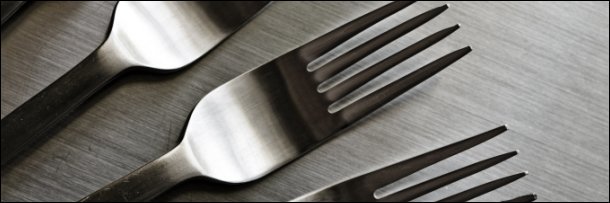
In a different experiment, they sat a fork on a table and told the subject to imagine it could talk, the same as we did with the ladybug earlier. Like if they decided to do a really boring Pixar movie starring forks. French speakers (who refer to the object by the very feminine and delicate "fourchette") immediately assigned it a woman's voice. Spanish speakers (for whom this utensil is the very manly "EL TENEDOR!") cast it as a man, probably voiced by Chris Rock.
The same fork. Once their language started referring to the object as "he" or "she", they couldn't help but think of it that way.
Wait ... does this somehow explain the rubber testicles people put on their pickup trucks?

Ah, probably not.
Do you have an idea in mind that would make a great article? Then sign up for our writers workshop! Do you possess expert skills in image creation and manipulation? Mediocre? Even rudimentary? Are you frightened by MS Paint and simply have a funny idea? You can create an infograpic and you could be on the front page of Cracked.com tomorrow!
If you're looking for ways to compensate for your pathetic English-speaking brain, check out 5 Ways To Hack Your Brain Into Awesomeness.
And don't forget to follow us on Facebook and Twitter to get sexy, sexy jokes sent straight to your news feed.
