5 World Changing Decisions Made For Ridiculous Reasons
Rome wasn't built by accident, and Hitler didn't decide to invade Poland on the flip of a coin. Society is shaped by powerful men with a vision, for better or worse.
Well, mostly. As it turns out, some of the most important changes in pop culture and world history have turned on some guy shrugging and saying, "screw it."
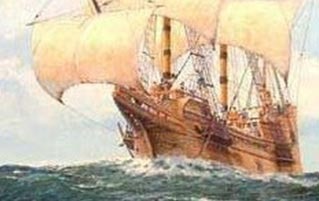
The Mayflower Lands at Plymouth Rock for a Beer Run

Everyone knows the Pilgrims settled in Plymouth because they were searching for a place that would let them practice religious freedom (and that wasn't the Netherlands). What's stupid or arbitrary about that?
The Arbitrary Reason:
Actually, it was about beer. The pilgrims weren't even supposed to go to Massachusetts, they were set to settle in what is now the state of New York, at the mouth of the Hudson River. That was the plan all along, and that's where they would have landed - if they hadn't run out of beer.

The more standard story is that the bad weather made navigation almost impossible and people were getting sick, so they had to stop somewhere. They began searching for a suitable place to settle. However, it was the fact that they were running out of provisions--especially beer--that finally made them realize they couldn't be picky. And as anyone who's lived in New England can tell you, the only way you can voluntarily choose to settle there is if you're not picky about climate, or really anything else.

our victuals being much spent, especially our beer" -The First Goddamn Americans (1622)
Since beer was boiled, it was cleaner than what passed for regular water at the time and therefore safer to drink (especially during long trips). So, if the beer in the Mayflower hadn't been running low at the time they were passing near Plymouth, they almost definitely would have continued their trip further down south, as close to the Hudson River as they could make it.

Of course, once they had settled on land and found perfectly drinkable water there, they didn't really need beer... which didn't stop them from fighting over the beer that remained, and sending the first ship back to England with an order for plenty more.
The World-Changing Consequences:
Plymouth Colony became the oldest permanent English settlement in America, and their search for ideological freedom remained an important theme all through the history of the United States.

The Pilgrims are responsible for much of American folklore, starting with Thanksgiving. Speaking of which, if the Pilgrims had run out of beer anywhere besides Plymouth, there's a good chance they would have been screwed. The Native Americans they happened to befriend (Pilgrim for "stealing their corn") at Plymouth had a guy who spoke English, and were friendly enough to teach them how to survive in that area. Without that stroke of good luck, the Colony doesn't survive that first winter.
In other words, if the murmurs of "keg's tapped" and "this party's lame" had started a few miles down the coast, none of us would be here right now.
Woody Allen Reinvents Cinema By Accident

The film Annie Hall didn't just transform Woody Allen's career: It transformed the world of cinema by reinventing the romantic comedy genre and using a widely imitated style of non-linear narrative (we're looking at you, Tarantino). It also transformed Star Wars fans into raging maniacs by getting the Best Picture Oscar instead of Episode IV.

With Annie Hall, Woody Allen made a conscious decision to leave behind the wacky genre spoofs he was known for and become a respected filmmaker...
The Arbitrary Reasons:
Well, actually, Annie Hall was supposed to be a wacky genre spoof, too. In fact, it was even shot that way. The story was conceived as a murder mystery that happened to have a romantic subplot, but upon viewing the four hours of footage, the editor thought it sucked.
That's right, it was the editor, not Woody Allen, who decided to change the whole thing. The guy convinced Allen to scrap the entire murder mystery plot and focus on the romantic aspect instead. Suddenly Diane Keaton's character went from a quirky supporting player (similar to her role in Woody's previous films) to the most important part of the film.

But hold on a second, you can't just cut the main plot out of a film, can you? Wouldn't that leave the story a little disjointed? Sure it did, which accounts for the influential non-linear narrative we were talking about earlier. The script already involved extensive flashback sequences, so all they had to do was jumble the order of the scenes set in the present and call it "experimental."
It worked surprisingly well, mainly thanks to the stream of consciousness narration Allen and the editor added to the final cut.
The World-Changing Consequences:
First of all, there's the whole "creating a new film genre" thing. Romantic comedies had been practically non-existent in Hollywood since the early 60s. Like musicals, they were deemed too silly for modern audiences. Annie Hall accidentally made them cool again. There was enough neurosis left over from the murder mystery spoof, and since Allen didn't know he was making a romantic comedy, the guy didn't get the girl in the end, which was the guaranteed outcome in romantic comedies up to that point. The basic formula of Annie Hall was ripped off by When Harry Met Sally, and then When Harry Met Sally was ripped off by every single romantic comedy made since then.

Then there's the non-linear thing. No mainstream film was so blatantly disjointed as Annie Hall, and the fact that it did so well proved that wide audiences could go for a thing like that. Modern films like Memento, Eternal Sunshine of the Spotless Mind, (500) Days of Summer and Everything Tarantino Has Ever Done only exist because Woody Allen shot a film that was too terrible to edit.

A Change of Underwear Changes Music

In 1959, Rock 'n' Roll pioneer Buddy Holly boarded a plane with popular musicians Ritchie Valens and JP "The Big Bopper" Richardson. If you've heard the song "American Pie" you know what happened next: the plane climbs high into the night, Satan begins laughing with delight, nobody takes this to be a red flag because the 50s were a more innocent time, the plane crashes, music dies.
The Arbitrary Reasons:
The events leading up to the accident that killed three of the earliest pioneers in rock stardom are full of coincidences, misfortunes and last minute changes; but everything can be traced back to Buddy Holly's hard-on for clean underwear.

After the organizers added a last minute date on February 2 (which meant a lot more traveling and a lot more freezing their asses off--maybe literally), Holly began feeling frustrated. He'd been wearing the same outfit since the beginning of the tour and had run out of clean underpants. And as many rock musicians would go on to prove, it is impossible to play a decent Rock 'n' Roll show if you don't have clean undies.

The local laundromat happened to be closed that day, so Holly suggested he and his band charter a plane to get to the next city early and wash everyone's clothes there. Deciding it wasn't happy with murdering just one headliner, fate intervened and Buddy's bassist kindly ceded his seat to Big Bopper Richardson, who had the flu. Meanwhile, Ritchie Valens realized he'd never seen the inside of a small plane and asked Buddy's guitarist to give up his seat too. The guitarist agreed to flip a coin for it and Valens won.

When Buddy found out his bassist Waylon Jennings wasn't going to be on the plane, he said to him: "Well, I hope your ol' bus freezes up." Jennings ominously replied: "Well, I hope your ol' plane crashes." A clap of thunder was heard in the background.
The World-Changing Consequences:
Due to a combination of adverse weather conditions, inadequate forecast reports and the pilot's inexperience with certain flying instruments, the plane crashed a few minutes after taking off, abruptly ending three promising careers in rock music and one in charter plane aviation. Buddy Holly had been recording for only 16 months and Ritchie Valens for 10, while Richardson had made the jump from DJ to performer around six months prior and already had two hits.
Buddy Holly in particular was considered an innovative genius whose ambition was only growing. Many argue that his death prevented him from taking rock music places that it wouldn't go for years. For instance, much of modern Rock 'n' Roll music is derived from his (at the time) experimental use of the recording studio.
Of course there are those who believe he would have been forgotten within two years if he hadn't died. After all, who knows what artists would be remembered as visionaries today if they had died after their biggest hit?

But that hypothetical scenario might have changed the face of modern music even more. Buddy Holly's death had a deep impact on the entire generation of musicians that replaced him: Bob Dylan saw Holly perform two days before the accident and would always claim to be personally affected by his death, The Rolling Stones were big fans and The Beatles named themselves after his band The Crickets and recorded several of his songs.
Whether you believe Holly was a genius or just another rock star overrated because he died young, the music world would look completely different today had Holly brought an extra change of underwear on tour.
The Motion Picture Was Invented on a Bet

Before Thomas Edison or the Brothers Lumiere, the first guy to ever shoot consecutive images and show them in motion was Eadward Muybridge, who called his invention by the slightly less catchy name of zoopraxiscope.
The development of the zoopraxiscope took Muybridge almost 10 years and was delayed by a complicated personal situation (namely his wife being boned by another dude), but his love of science was stronger than any obstacle and he continued trying until he achieved his objective.

The Arbitrary Reasons:
Did we say his love of science? We meant his love of money. Muybridge and his world changing invention were just pawns in a larger, more complex mission to settle what is without question the stupidest bet of all time.
He was employed by Leland Stanford, the former governor of California, who was apparently a very bored man. He was also very rich; a dangerous combination. Leland was a bit of a horse enthusiast and, in 1872, he took part in a high-stakes bet that sought to solve the age-old mystery: Do all the legs of a horse stop touching the ground at some point during a gallop? A firm believer that horses could for one brief instant fly, Leland offered Muybridge $25,000 to prove this to be true. He didn't care how he did it. He just wanted a picture of a floating horse, damn it.

The existence of the bet has been disputed by film historians, but they all agree that Leland did indeed pay a large amount of money to Muybridge to photograph a horse with its hooves in the air. In fact, the whole endeavor seems even more ridiculous and pointless if there was no bet involved.
Leland was so obsessed with finding the answer that, when his inventor Muybridge murdered his wife's lover, he even paid for his legal defense, ensuring that he was acquitted and could get back to the horse photographing.
The World-Changing Consequences:
Muybridge's work turned out to be instrumental to the creation of cinema. He developed a new method of fast photography for the sole purpose of catching a horse mid-gallop, and later set automatic cameras all over the side of a racetrack to capture every stage of the horse's movement. Later, he created the zoopraxiscope so he could project these images in sequence, thereby producing the first ever motion picture.

Around the same time, famed inventor and Cracked arch-enemy Thomas Alva Edison had created the phonograph. When Edison witnessed the zoopraxiscope in action, Muybridge approached him to discuss the possibility of joining their two inventions to make movies with picture and sound (about 40 years before this was actually achieved). Edison said, "No thanks," and then proceeded to copy Muybridge's invention and market it as the much more popular kinetograph.

Nagasaki Gets the Atomic Bomb Over a Honeymoon

You know the atomic bombings at Hiroshima and Nagasaki ended World War II, but have you ever wondered why those particular cities had to get the A-Bomb treatment? It couldn't have been an easy decision, the lives of hundreds of thousands of civilians hung in the balance.

So a lot of careful consideration must have gone into choosing which cities to bomb... right?
The Arbitrary Reasons:
Well, it's true that they had a detailed report that included a list of five possible targets... which was topped by Kyoto (where the Emperor lived) and on which Nagasaki wasn't even mentioned (go on, Ctrl+F that shit). So why, then, did the U.S. choose not to bomb Kyoto, the greatest strategic target according to the report? Well, because the Secretary of War had spent his honeymoon there.

Secretary of War Henry L. Stimson had admired the city and its culture ever since he visited it with his wife decades earlier. Perhaps if they'd spent more time "honeymooning" in their room rather than sightseeing, he would've been like, "Kyoto? Oh, right... I remember that... , " before grinning wickedly, thrusting his hips forward for the next 20 minutes and then giving the order to bomb it to hell.

Instead, Kyoto was vetoed by Stimson, and the new primary targets became Hiroshima and... Kokura.
Yep, Nagasaki kept getting snubbed, and it would've been saved if the weather in Kokura hadn't been cloudy that day. Due to the clouds the pilot couldn't get a clear view of his target (a factory), so he moved on to Nagasaki and dropped the bomb there.

The World-Changing Consequences:
Did we mention the Emperor lived in Kyoto? You know, the guy who surrendered and ended World War II? It's hard to imagine the military would have surrendered without him seeing as they were so willing to continue fighting that they even tried to overthrow Hirohito when he announced that he planned to surrender. So in other words, all it would have taken to extend the bloodiest war in recent history indefinitely, likely costing millions more casualties on both sides: Stimson and his wife deciding to honeymoon somewhere closer to home, or just having a little better sexual chemistry.
Maxwell Yezpitelok lives in Chile, and when he's not being harassed by earthquakes he likes to waste his time writing back to scammers or making stupid comics.Do you have an idea in mind that would make a great article? Then sign up for our writers workshop! Know way too much about a random topic? Create a topic page and you could be on the front page of Cracked.com tomorrow!
For more randomness that influenced the world, check out 6 Global Corporations Started by Their Founder's Shitty Luck and 7 Random Animals That Decided The Course of History.
Be sure to swing by our friends at Ask Men and see the results to the 2010 Great Male Survey.
And stop by Linkstorm and feel the awesome power of the Internet. The awesome, disturbing power.
And don't forget to follow us on Facebook and Twitter to get sexy, sexy jokes sent straight to your news feed.
