6 Writers Who Accidentally Crapped Out Masterpieces
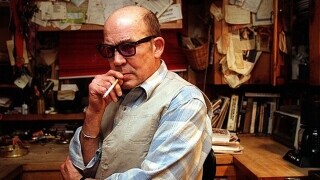
So what does it feel like to write something that will inspire audiences for generations? Apparently it feels like another day at the office, as it turns out some of the greatest works of all time weren't intended to be classics... and often were just dashed off for the hell of it.
Fear and Loathing in Las Vegas

It changed a generation. It was supposed to be a report on a motorcycle race.
The Impact:
When Hunter S. Thompson's Fear and Loathing in Las Vegas stumbled into the American literary scene in 1972 it was almost immediately embraced as a new classic, and has been screaming incoherently at the other classics and eating all the shrimp at their parties ever since.
It is the tale of two barely fictionalized versions of Thompson and prominent civil rights attorney Oscar Zeta Acosta (you can see him here in a yellow fishnet t-shirt) who leave a swath of destruction and crumpled plastic baggies across the desert. It's a manic and increasingly frustrated search for the American Dream in a world where Richard Nixon is President; JFK, MLK and Jimi Hendrix are dead and this is considered an appropriate way to dress:

Really? 'Slack Power' is a better slogan than 'Once You Go Slack'? Really?
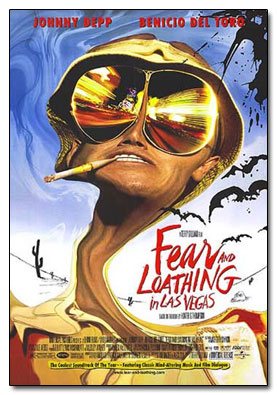
Some of you may be more familiar with Terry Gilliam's film version of the novel, the poster of which is immediately recognizable to anyone who has ever spent more than five minutes inside a college bookstore.
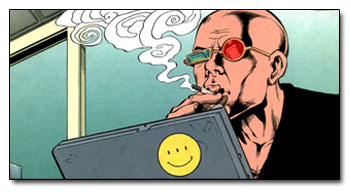
While there, you'll also find comics starring the character based heavily on Thompson, Spider Jerusalem.
But it All Got Started When...
Appropriately enough, the entirety of Fear and Loathing in Las Vegas came to be because Thompson was on assignment from Rolling Stone to report on some retarded dirt bike race in the middle of the crappy desert.
Thompson spent so much of his time summing up the post-hippie zeitgeist that folks tend to forget that he got his start as a sports writer, and remained one up until his death (his suicide note was famously titled Football Season is Over.")
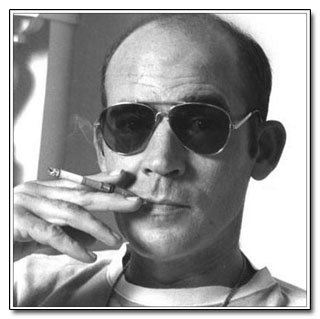
Over for YOU, anyway!
Thompson, never one for deadlines, responsibilities or coherence, started sending his bosses pages ripped out of his personal journal. Go ahead, try that at your job, see how it goes. Especially if your journal includes paragraphs like this:
"The sporting editors had also given me $300 in cash, most of which was already spent on extremely dangerous drugs. The trunk of the car looked like a mobile police narcotics lab. We had two bags of grass, 75 pellets of mescaline, five sheets of high-powered blotter acid, a saltshaker half-full of cocaine, and a whole galaxy of multi-colored uppers, downers, screamers, laughers . . . and also a quart of tequila, a quart of rum, a case of Budweiser, a pint of raw ether and two dozen amyls."
But, if you're Hunter S. Thompson, your editor sends it off for immediate publication and you become the voice of your generation.
The lesson? Contrary to what your parents told you, drugs and motorcycle racing go together beautifully.
Alice in Wonderland

One of the most beloved tales of all time was something a guy made up off the top of his head to please his 10-year-old girlfriend.
The Impact:
Lewis Carroll's Alice in Wonderland is a classic kid's story about a little girl that finds herself transported into a magical alternate universe that reflects and lampoons our own; including humorous explorations into the subjects of mathematics, statistics, logic and linguistics. Sort of like a Victorian xkcd, but with worse art.
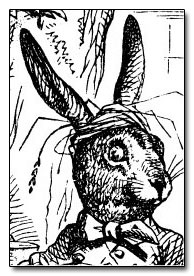
GET THAT FUCKING THING AWAY FROM ME
It's been translated into 125 languages and has been adapted to film dozens of times since the inception of book-adapting technology. There are several silent versions, a Disney version, an anime version, a musical version, an upcoming CGI version and of course a version with some hardcore fucking. It's also responsible for most of the songs written in the 60s, the better parts of The Matrix, a pretty scary-looking video game and even a graphic novel by literary genius Alan Moore, which of course features plenty of hardcore fucking.
It even has an extremely appropriately named medical condition named after it.
But it All Got Started When...
Author Lewis Carroll suffered from a condition that modern biographers have diagnosed as "being a fucking dork." He was home schooled until adolescence, tall and awkward, spoke with a stutter, never married and counted mathematics and logic among his hobbies. But probably his biggest flaw was that he liked to take naked pictures of little girls.

We wonder if the guy doing this portrait ever said "Try not to look so fucking creepy" at any point.
OK, now to be fair, Victorian England was a place and time where pictures of nude children were actually considered pretty cool (apparently, it wasn't terribly uncommon for parents to send out photos of their kids' wieners with the holiday newsletter), and many Carroll scholars believe that his attraction to little girls was purely aesthetic, and free of any sort of eroticism. We will refrain from making any sort of judgment on the matter, but considering Carroll specifically requested that the parents not be present during his naked photo sessions you can imagine how this excuse would hold up when Dateline comes knocking down your door.

"Why don't you just have a seat over there... "
The point is that Carroll wrote Alice in Wonderland at the behest of one of his favorite ladies, 10-year-old Alice Liddell, who was bored out of her mind on some sort of riverboat trip she was taking with her two sisters and Carroll (who was friends with her dad). She asked him to tell her a story, and he did, making it up verbally, on the fly. It was only at her request that he later wrote it down on paper.
This is entirely unlike luring children into your van with promises of candy in the sense that it was somehow socially acceptable and that Carroll actually made good on his promise (sorry to stereotype, but most of the pedophiles we're friends with are extremely unreliable). Oh and Carroll's bait ended up being one of the most beloved works of children's literature of all time. Go figure.
A Clockwork Orange

A classic novel that inspired a classic film. A novel that was written in three weeks, for quick cash.
The Impact:
Although fairly tame by today's standards, when it was it was published in 1962, A Clockwork Orange would have made the hairs on your grandma's back stand up. The novel features a sadistic, drug-addled, amoral young Beethoven fan who roams the streets of London with his gang, robbing, beating, raping and killing anyone unlucky enough to cross his path. He's the hero of the story.

The book was poorly received by critics and public alike, but this general distaste erupted into a category five shit-storm of public outrage when the Kubrick film of the same name was released in 1971 (somehow, beating a woman to death with a giant sculptural penis doesn't pack the same punch on paper as it does on celluloid). The film was blamed for a rash of copycat crimes, eventually leading to the prohibition of its public display in Great Britain, a ban that was only lifted just over 10 years ago.
Despite the public backlash, the film and book have been heaped with awards and both achieved cult status. They're also hugely popular amongst angsty teenagers who identify with Alex's cruel, nihilistic outlook on life, as evidenced by the wide variety of Clockwork Orange avatars that can found on any number of forums throughout the Internet.
But it all Got Started When...
So who was the tortured, violent, kitten-stomping soul that could find enough darkness within himself to release a horror like A Clockwork Orange upon the unsuspecting populace?
This guy:

That's Anthony Burgess, poet, playwright, critic, author, classical musician, linguist and the only man to win the Pan-European Comb-Over Tournament three years running. He may look like a stodgy old academic, but that's only because he was. His considerable literary output includes a few linguistic studies, a biography of D.H. Lawrence, a couple of children's books, a screenplay about the life of Jesus Christ, a translation of Oedipus Rex and a couple of books that attempt to recreate classical music pieces in prose form (lol whut?).
A Clockwork Orange wasn't written to shock the old folks or subvert the young, but rather as an investigation into the nature of evil and free will, inspired by his own wife's assault by a group of AWOL American G.I.s (USA! USA! USA!). The book is heavily influenced by his own Catholic upbringing, which he maintained philosophical, if not dogmatic ties to. Christian protest groups and 16-year-old Internet atheists have, of course, rejected and embraced the book, respectively.

But Burgess himself considered it one of his weakest works, writing that it was, "... knocked off for money in three weeks, it became known as the raw material for a film which seemed to glorify sex and violence. The film made it easy for readers of the book to misunderstand what it was about, and the misunderstanding will pursue me till I die."
Sure enough, a good chunk of the man's life was spent sighing heavily whenever A Clockwork Orange was brought up during interviews. And it was no doubt brought up during every single fucking one.
Most of the Stuff Kafka Wrote

Great works, from a man who was so ashamed of them he demanded they be destroyed rather than shown to the public.
The Impact:
Franz Kafka's work is known for its highly original, surrealistic and disturbing themes and subject matter, covering topics ranging from the meaninglessness of existence to totalitarian regimes--all of which perfectly captured the malaise of a Europe that had been ravaged by the first World War and was staring down the barrel of a second. American high school students probably know him as that scientist that turned himself into a cockroach."
The complex symbolism and themes in his writing have been analyzed to death, to the point that biographers and literary types have taken to compiling and analyzing the memos and reports that he'd filed during his day job as an insurance officer. These include such literary classics as Fixed-Rate Insurance Premiums for Small Farms Using Machinery, the tragic modern morality play of On the Examination of Firms by Trade Inspectors and the hauntingly beautiful Accident Prevention in Quarries.
In this episode, Jim wakes up to find he's transformed into an insect.
But it all Got Started When...
So what were Kafka's plans for the work that would eventually influence Nabokov, Fellini, J.D. Salinger, GarcÃÂa Márquez, Bukowski and David Lynch? Apparently, Kafka thought that these masterpieces would make a very nice pile of ash in his best friend's fireplace.
As it turns out, Kafka was a dude with a generally poor self-image (surprising, seeing as physically-speaking, he's easily the most doable author on this list).

He had little to no faith in his writing ability, considering very little of it to be worthy of publication, and asked for it to be destroyed upon his death.
Luckily for pretentious literary types everywhere, his best friend and executor of his estate Max Brod promised to carry out Kafka's wishes, and then immediately turned around and published then hell out of everything he had been specifically told not even to read himself. Thus providing future generations with a wealth of frustratingly incomplete, half-written and unedited text that would serve as Kafka's legacy (one of the posthumously published novels, The Tower, infamously ends mid-sentence).
So, you know all of those images and videos you've got buried on your hard drive, that you really don't want the world to see? Don't ask a friend to do it, delete that shit yourself.
Frankenstein
The weather is bad, so what's a bored teenager to do? How about stay inside and invent a new literary genre?
The Impact:
Mary Shelley's Frankenstein is the classic tragedy of Victor Frankenstein, a humble scientist whose only sin was his insatiable desire to create an abomination unto the Lord our God. It was met with immediate popular success upon its publication and, like all good novels, was immediately adapted for the stage, since reading is gay and movies hadn't been invented yet.

This was in spite of its mostly negative critical reception, much of which was focused on the fact that the author actually had the unbelievable gall to be a woman. As one reviewer put it:
The writer of it is, we understand, a female; this is an aggravation of that which is the prevailing fault of the novel; 420 SMOKE WEED EVERYDAY OF MY LIFE!!!! (_)_)::::::::::D~ ~ ~ ~ but if our authoress can forget the gentleness of her sex, it is no reason why we should; and we shall therefore dismiss the novel without further comment.
(Source: Wikipedia)
The book's influence could have ended there, but film was invented soon afterward and directors scrambled to pour cash into Frankenstein-themed special-effects extravaganzas, bastardizations of Shelley's work that reached their pinnacle in 1931, when Universal Pictures released Frankenstein, ensuring that Shelley's well-spoken, tortured creature would be forever remembered as a bumbling green retard through countless film adaptations thereafter.

Oh, and did we mention that it's essentially the first science fiction novel, ever? All in all, pretty damn influential...
...for a woman.
But it all got started when...
The summer of 1816 was an extremely crappy one, due to a series of extremely wicked volcanic eruptions in Indonesia setting off a worldwide temperature drop. At the time, a 19-year-old Mary Shelley (who was at that point just plain old Mary Wollstonecraft Godwin) and her boyfriend, poet Percy Bysshe Shelley were visiting Don Juan author Lord Byron at his estate in Switzerland.
Forced inside by the shitty weather, the discussion eventually turned from the pitfalls of being rich, famous and talented (not unlike the conversation around the Cracked office water cooler) to the subject of Erasmus Darwin's experiments with electrically reanimated frog chunks (also not unlike the conversation around the Cracked office water cooler).

"See the hot new secretary? I wonder what she'd look like with frog legs."
Byron, most likely trying end the conversation early so they could move on to the three-way bone session, suggested a scary story contest. Just like that, she came up with Frankenstein and his monster. Two of the most iconic characters in literature, dreamed up by a cabin fever-stricken 19-year-old trying to kill time.
By the way, Lord Byron's entry in the "contest" was a fragment of a vampire story where, for the first time, the vampire was portrayed as a well-dressed aristocrat who preyed on high society. You know, the way they've been portrayed in 90 percent of the vampire novels and movies written since.
The Complete Works of Shakespeare

The Impact:
There's not much else to be said about a dude whose plays are still constantly read, performed and studied 400 years after his death, especially when you consider that we have empirically better forms of entertainment available to us, such as movies where guys get shot in the face, video games where you can shoot guys in the face and songs about times that guys got shot in the face.

The trifecta!
Figuratively speaking, his works define the English language. And by "figuratively," we of course mean "literally." The motherfucker made up half of the dictionary off the top of his damn head. If you've ever said that something was a "sorry sight," or that "what's done is done," not only are you an unimaginative hack, but you owe Shakespeare $10.
"That's mine, too."
And as far as inventing half the English language goes, you've got to bear in mind that although Shakespeare was able to solicit some pretty sweet patronages from the nobility (once again, phat cash), the majority of his audience consisted of the filthy, unwashed peasants that packed the pit in front of the stage (theater-goers in Elizabethan England were in the unique position of being able to both see a Shakespeare performance and stand next to a donkey for three hours).
Far be it from us to suggest that Shakespeare had any sort of contempt for his toothless, donkey-riding fans, but perhaps his ability to invent so many new words had less to do with his prose refusing to be bound by the constraints of the English language, and more to do with the fact that his illiterate audience wouldn't be able to tell a real word from a "Shakespeare original" if their donkey's life depended on it. It's very possible he was just fucking with them.

If you're surprised Shakespeare appealed to such unwashed masses, keep in mind that while he was a pretty popular guy for his time, few critics considered him to be the superhuman writing machine he's seen as today. The plays that Shakespeare wrote were considered low-brow and somewhat poorly made by the day's standards, owing to their utter lack of regard for the strict, bullshit rules of drama everybody was supposed to follow at the time.
But it All Got Started When...
The reason Shakespeare didn't care about the rules is because he wasn't trying to write plays that would outlive him by 400 years. In fact, the guy never even bothered having his stuff published, out of fear that other acting troupes would snap up copies and draw away his audiences.
Shakespeare didn't want immortality, all he wanted was to make a living doing what he loved, with maybe just a little bit left over to bling out his name with a pimp-ass coat of arms. In fact, it would seem as if Shakespeare was...only in it for the money.

And the bitches.
