5 Psychological Experiments That Prove Humanity is Doomed

Psychologists know you have to be careful when you go poking around the human mind because you're never sure what you'll find there. A number of psychological experiments over the years have yielded terrifying conclusions about the subjects.
Oh, we're not talking about the occasional psychopath who turns up. No, we're talking about you. The experiments speak for themselves:
The Asch Conformity Experiment (1953)

The Setup:
Solomon Asch wanted to run a series of studies that would document the power of conformity, for the purpose of depressing everyone who would ever read the results.
Subjects were told that they would be taking part in a vision test, along with a handful of people. The participants were then shown pictures, and individually asked to answer very simple and obvious questions. The catch was that everybody else in the room other than the subject was in on it, and they were were told to give obviously wrong answers. So would the subject go against the crowd, even when the crowd was clearly wrong?
The Result:
Questions the subjects were asked were like the puzzle shown here:

All they had to do was say which line on the right matched the one on the left. As you can see, Asch wasn't exactly asking these people to design the next space station. Really, the only way you could get the line questions honestly wrong is if you took two doses of LSD that morning and rubbed them directly on your eyeballs (which would have made for an even more awesome experiment, but we're getting off the point).
Yet, sadly, 32 percent of subjects would answer incorrectly if they saw that three others in the classroom gave the same wrong answer. Even when the line was plainly off by a few inches, it didn't matter. One in three would follow the group right off the proverbial cliff.
What This Says About You:
Imagine how much that 32 percent figure inflates when the answers are less black and white. We all tend to laugh with the group even when we didn't get the joke, or doubt our opinion we realize ours is unpopular among our group. So much for those lectures you got in elementary school about peer pressure and "being brave enough to be yourself."
"Well, it's a good thing I'm a rebellious non-conformist," many of you are saying. Of course, for virtually all of you, the next step is to find out what the other non-conformists are doing ...

... and make sure you conform to it perfectly.

"Wait, you're right! Surely we must rebel against this mindless herd mentality! Let's all take to the streets!"

The Good Samaritan Experiment (1973)

The Setup:
The Biblical story of the Good Samaritan, if you hadn't heard, is about a passing Samaritan helping an injured man in need, while other, self-righteous types walk right on by. Psychologists John Darley and C. Daniel Batson wanted to test if religion has any effect on helpful behavior.
Their subjects were a group of seminary students. Half of the students were given the story of the Good Samaritan and asked to perform a sermon about it in another building. The other half were told to give a sermon about job opportunities in a seminary.
As an extra twist, subjects were given different times that they had to deliver the sermon so that some would be in a hurry and others not.
Then, on the way to the building, subjects would pass a person slumped in an alleyway, who looked to be in need of help. We like to think Darley and Batson beat the crap out of some random dude to make it more realistic, but sources say otherwise.

C. Daniel Batson probably did not beat a homeless dude
The Result:
The people who had been studying the Good Samaritan story did not stop any more often than the ones preparing for a speech on job opportunities. The factor that really seemed to make a difference was how much of a hurry the students were in.
In fact, if pressed for time, only 10 percent would stop to give any aid, even when they were on their way to give a sermon about how awesome it is for people to stop and give aid. Though to be fair, if you were late for a class, did your professor ever accept, "I had to stop and help a wounded traveler" as an excuse? Probably not unless you could produce the guy's blood-stained shirt as evidence.
What This Says About You:
As much as we like to make fun of, say, anti-gay congressmen who get caught gaying it up in a men's bathroom and pointing out Al Gore's resource-hogging mansion ...

... the truth is us common folk are just as likely to be hypocrites as the politicians. After all, it's much easier to talk to a room full of people about helping strangers than, say, actually touching a smelly and bleeding homeless man. So even pointing out their hypocrisy becomes a form of hypocrisy.
And in case you thought these results were just restricted to hypocritical seminary students, turn on the news. Remember a few years ago when cameras captured at least a dozen cars refusing to stop for an injured woman laying in the road?

Just like the students, they all had to be somewhere. The drivers were presumably proud enough of themselves just for swerving to miss her, rather than squishing her like roadkill.
Which brings us to ...
Bystander Apathy Experiment (1968)

The Setup:
When a woman was murdered in 1964, newspapers printed that 38 people had heard and seen the attack, but did nothing. John Darley and Bibb Latane wanted to know if the fact that these people were in a large group played any role in the reluctance to come to aid.
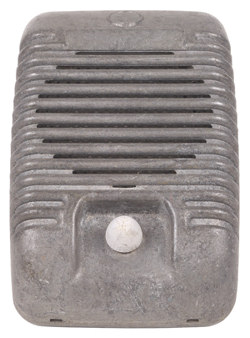
The two psychologists invited volunteers to take part in a discussion. They claimed that because the discussion would be extremely personal (probably asking about the size of their genitals or something) individuals would be separated in different rooms and talk to each other using an intercom.
During the conversation, one of the members would fake an epileptic seizure, which could be heard on the speakers. We're not completely sure how they conveyed over the intercom that what was happening was a seizure, but we're assuming the words "Wow this is quite an epileptic seizure I'm having" were uttered.
The Result:
When subjects believed that they were the only other person in the discussion, 85 percent were heroic enough to leave the room and seek help once the other began the fake seizure. This makes sense. Having an extremely personal conversation (again, presumably about tiny genitalia) with another person is difficult enough, but being forced to continue to carry on the conversation by yourself is just sad. But either way, 85 percent helped. So that's good, right?
Well, they weren't done. When the experiment was altered so that subjects believed four other people were in the discussion, only 31 percent went to look for help once the seizure began. The rest assumed someone else would take care of it. So the phrase, "The more, the merrier" somehow got lost in translation because the correct expression should be, "The more, the higher probability that you will die if you have a seizure."

Anyone can have epilepsy, according to this child's drawing
What This Says About You:
Obviously if there's an emergency and you're the only one around, the pressure to help out increases massively. You feel 100 percent responsible for what happens. But, when you're with 10 other people, you're only 10 percent as responsible. The problem is everybody else only feels 10 percent responsible too.
This sheds some light on our previous examples. Maybe the drivers who swerved around the injured woman in the road would have stopped if they'd been alone on a deserted highway. Then again, maybe they'd be even more likely to abandon her since they know nobody is watching (unlike the people in the experiment, who at least knew there were others around to judge their actions).
Or maybe it comes down to just how plausible an excuse we can make for ourselves. "Surely someone will come along and save the lady in the road," we say. Or, "Surely someone else will do something about the environment," or "Surely the shark will get full and stop eating that dude at some point." We just need the slightest excuse to do nothing.
The Stanford Prison Experiment (1971)

The Setup:
Psychologist Philip Zimbardo wanted to find out how captivity affects authorities and inmates in prison. Sounds innocent enough. Seriously, what could go wrong?
Zimbardo transformed the Stanford Psychology Department's basement into a mock prison. Subjects volunteered by simply responding to a newspaper ad ...

Not the actual ad
... and then passing a test proving good health and high-quality mental stability, which are very important factors in deciding who goes to prison. These volunteers were all male college students who were then divided arbitrarily into 12 guards and 12 prisoners. Zimbardo himself decided that he wanted to play too, and elected himself Prison Superintendent. The simulation was planned to run for two weeks.
Yep, nothing at all can go wrong with this.
The Result:
It took about one day for every subject to suddenly go as insane as a shit-house rat. On only the second day, prisoners staged a riot in the faux detention center, with prisoners barricading their cells with their beds and taunting the guards. The guards saw this as a pretty good excuse to start squirting fire extinguishers at the insurgents because, hey, why the hell not?

From that point on, the Stanford Prison that had already gone to hell, just continued to ricochet around in hell for day after day. Some guards began forcing inmates to sleep naked on the concrete, restricting the bathroom as a privilege (one that was often denied). They forced prisoners to do humiliating exercises and had them clean toilets with their bare hands.
Incredibly, when "prisoners" were told they had a chance at parole, and then the parole was denied, it didn't occur to them to simply ask out of the damned experiment. Remember they had absolutely no legal reason to be imprisoned, it was just a damned role-playing exercise. This fact continued to escape them as they sat naked in their own filth, with bags on their heads.

Over 50 outsiders had stopped to observe the prison, but the morality of the trial was never questioned until Zimbardo's girlfriend, Christina Maslach, strongly objected. After only six days, Zimbardo put a halt to the experiment (several of the "guards" expressed disappointment at this). If you were about to applaud Maslach as the only sane person involved in this clusterfuck, you should know that she went on to marry Zimbardo, the guy who orchestrated the whole thing.
What This Says About You:
Ever been harassed by a cop who acted like a major douchebag, pushing you around for no reason? Science says that if the roles were reversed, you'd likely act the same way.
As it turns out, it's usually fear of repercussion that keeps us from torturing our fellow human beings. Give us absolute power over somebody and a blank check from our superiors, and Abu Ghraib-esque naked pyramids are sure to follow. Hey, if it can happen to a bunch of Vietnam-era hippie college students, it sure as hell could happen to you.
The Milgram Experiment (1961)

The Setup:
When the prosecution of the Nazis got underway at the Nuremberg Trials, many of the defendants' excuse seemed to revolve around the ideas of, "I'm not really a prick" and, "Hey man, I was just following orders." Yale University psychologist Stanley Milgram wanted to test willingness of subjects to obey an authority figure. Maybe he could just, you know, ask people? Oh, hell no. That would not be nearly horrifying enough.
Instead he ran an experiment where the subject was told he was a "teacher" and that his job was to give a memory test to another subject, located in another room. The whole thing was fake and the other subject was an actor.
The subject was told that whenever the other guy gave an incorrect answer, he was to press a button that would give him an electric shock. A guy in a lab coat was there to make sure he did it (again no real shock was being delivered, but the subject of course did not know this).
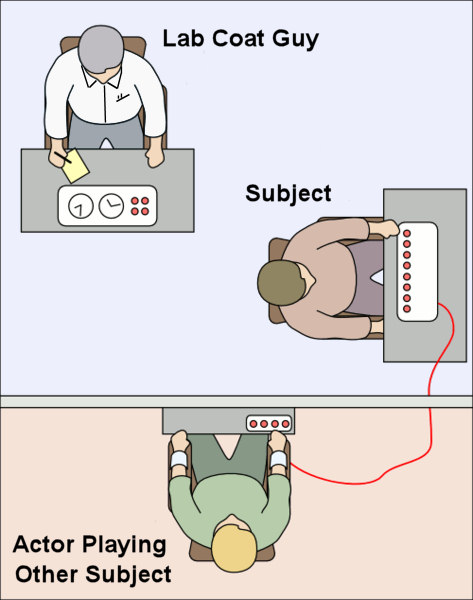
The subject was told that the shocks started at 45 volts and would increase with every wrong answer. Each time they pushed the button, the actor on the other end would scream and beg for the subject to stop.
So, can you guess how this went?
The Result:
Many subjects began to feel uncomfortable after a certain point, and questioned continuing the experiment. However, each time the guy in the lab coat encouraged them to continue. Most of them did, upping the voltage, delivering shock after shock while the victim screamed. Many subjects would laugh nervously, because laughter is the best medicine when pumping electrical currents through another person's body.
Eventually the actor would start banging on the wall that separated him from the subject, pleading about his heart condition. After further shocks, all sounds from victim's room would cease, indicating he was dead or unconscious. If you had to guess, what percentage of the subjects kept delivering shocks after that point?
Five percent? Ten?
Between 61 and 66 percent of subjects would continue the experiment until it reached the maximum voltage of 450, continuing to deliver shocks after the victim had been zapped into unconsciousness or the afterlife. Repeated studies have shown the same result: Subjects will mindlessly deliver pain to an innocent stranger as long as a dude in a lab coat says it's OK.

Most subjects wouldn't begin to object until after 300-volt shocks. Zero of them asked to stop the experiment before that point (keep in mind 100 volts is enough to kill a man, in some cases).
What This Says About You:
You might like to think of yourself as a free-thinking marauder, but when it comes down to it, odds are you won't stick it to The Man because of the fear The Man will stick it right back up your ass. And this was just a guy in a lab coat--imagine if he'd had a uniform, or a badge.
Charles Sheridan and Richard King took this experiment one step further, but asked subjects to shock a puppy for every incorrect action it made. Unlike Milgram's experiment, this shock was real. Exactly 20 out of 26 subjects went to the highest voltage.

Almost 80 percent. Think about that when you're walking around the mall: Eight out of ten of those people you see would torture the shit out of a puppy if a dude in a lab coat asked them to.
For more, go buy You Might Be a Zombie anywhere books are sold online or in person.
If you enjoyed that, you might like our rundown of 5 Mental Disorders That Can Get You Laid. Or check out the T Shirt designs you'll be wearing tomorrow and submit your own in the Photoshop contest in the forum. If you're out of ideas, head over to eHow for Cracked.com Editor Jack O'Brien's handy guide on How to Design a Funny T-Shirt. And if you're tired of finding the best Cracked has to offer on your own sign up for the Cracked Newsletter and receive the choicest articles in your inbox every Thursday morning.
